
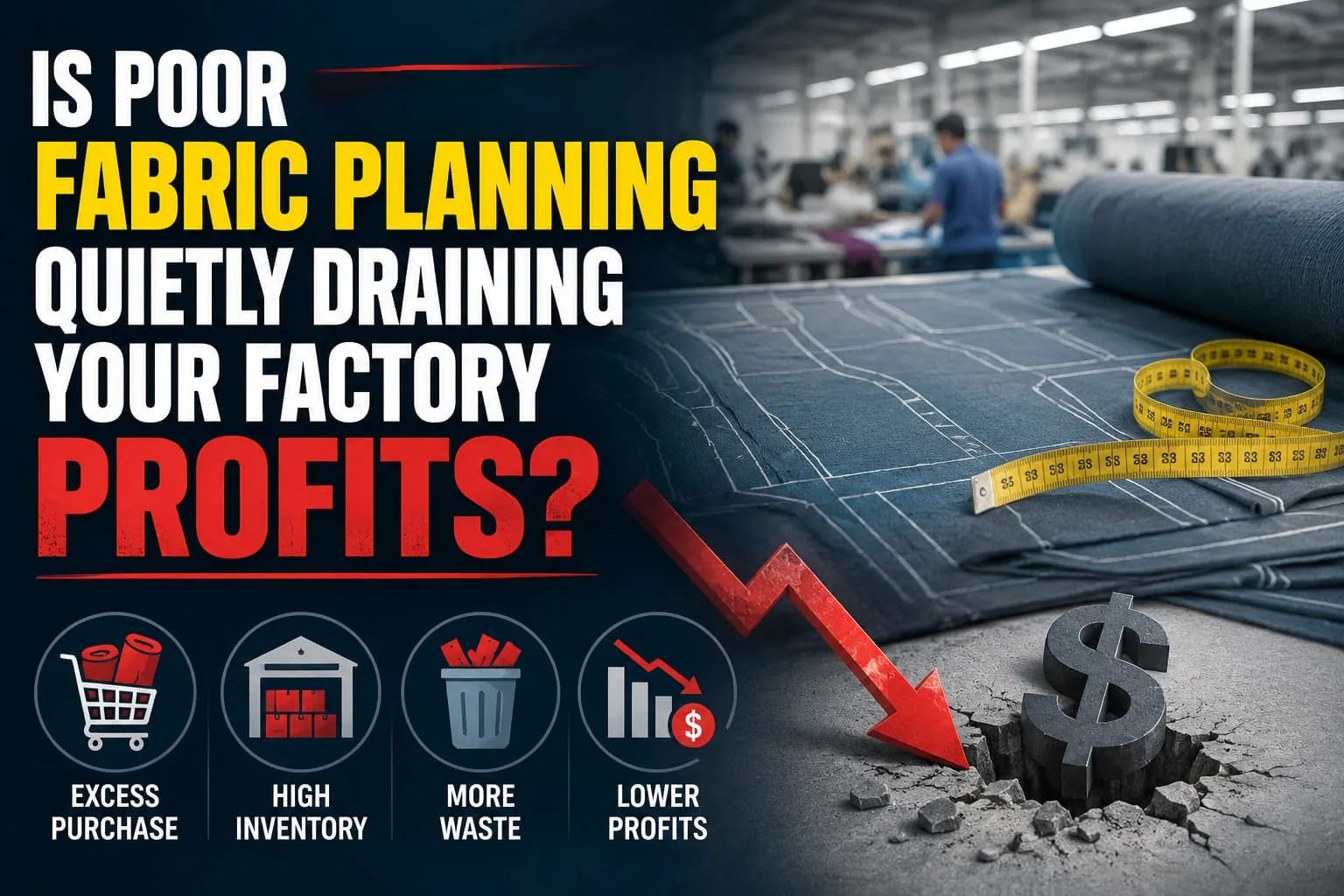
When people talk about profitability in apparel manufacturing, Fabric Cut Plan Software is rarely part of the conversation. Most discussions focus on production efficiency, labor costs, or output levels because these metrics are visible, easy to measure, and frequently reviewed.

However, one of the most significant factors affecting profit margins is far less visible: fabric planning.
Fabric alone accounts for 50–70% of the total garment cost, meaning even minor planning inefficiencies can create substantial financial losses. Despite this reality, many factories still treat fabric planning as a routine operational task rather than a strategic business function.
This is where the challenge begins.
Without the support of modern Cut Plan Software, fabric utilization often remains below its true potential. Poor fabric planning rarely causes a single major problem. Instead, it creates a chain of small, hidden inefficiencies—excess fabric consumption, avoidable waste, inaccurate marker planning, and higher production costs—that gradually reduce profitability over time.
Let’s explore where these hidden costs occur and how they impact garment manufacturers.

Excess Fabric Procurement: How Fabric Cutting Software Helps Reduce Overbuying
In many garment factories, planners intentionally overestimate fabric requirements to avoid production delays caused by fabric shortages. While this approach may seem like a safe strategy, it often leads to unnecessary costs and inventory buildup.
Without accurate planning tools such as Fabric Cutting Software, manufacturers frequently purchase more fabric than they actually need. Every extra meter of fabric that remains unused represents capital tied up in inventory rather than contributing to revenue generation. Over time, these excess purchases accumulate into significant volumes of dead stock, creating financial and operational challenges.
The consequences include:
- Reduced cash flow, as working capital remains locked in excess inventory
- Increased storage requirements, leading to warehouse congestion
- Higher risk of fabric obsolescence, where materials may never be used in future production
What appears to be a protective safety buffer can quickly become a hidden drain on profitability. By using advanced Fabric Cutting Software to improve fabric estimation and consumption planning, manufacturers can purchase more accurately, reduce waste, and maintain healthier cash flow.
Underestimation of Fabric:
The opposite problem is equally damaging. When fabric requirements are underestimated, factories are forced into reactive procurement, a mode of buying that is structurally expensive. With no lead time and no leverage, sourcing teams must accept whatever price the market offers at that moment. This leads to:
· Increased procurement costs
· Production delays
· Idle labor (people waiting for fabric)
· Pressure on delivery timelines
In short, instead of saving money, underplanning creates expensive firefighting situations.
Read More - The Blueprint for Starting a Garments Business: A Comprehensive Bangladesh Apparel Production Case Study

End bits and Unused Fabric:
Every cutting operation produces remnants, those short end-pieces left after the lay. In isolation, each end-bit appears insignificant. Aggregated across hundreds of orders and thousands of cuts, they represent a meaningful volume of fabric purchased, warehoused, and partially consumed without ever generating a finished garment.
The real issue is not just the leftovers, it’s the lack of visibility.
In many factories:
· End-bits are not tracked properly
· There’s no clarity on usable length, width, or type
· No system exists to reuse them effectively
So what happens?
Perfectly usable fabric sits in storage, unutilized, and eventually gets ignored or written off. This is pure value loss, fabric that was bought but never converted into revenue.

Recutting & Rejections
Fabric is not a perfectly consistent material. It varies.
You will always see differences in shrinkage, width, shade, etc., and it carries defects. A fabric plan that does not account for these realities will be wrong, and the cutting room will absorb the consequences. Recutting components due to deviations and defects is common across the industry, but it is not inevitable.
Each recut consumes additional fabric beyond what was costed. Buffer stock gets drawn down faster than anticipated. Replenishment orders are triggered. What begins as a small allowance calculation error cascades into a series of unplanned interventions, each one adding cost, time, and friction.
The Consumption Accuracy
Of all the fabric planning failures, this one is the most mathematically devastating. A 3% deviation in fabric consumption per garment sounds trivial. Applied across a production run of 50,000 pieces, it is anything but. 1,500 metres of fabric, either written off as waste or scrambled for as an emergency procurement. This can go two ways:
· Shortfall → urgent buying, delays, possible penalties
· Excess → wasted fabric, direct hit to margins
What makes this worse is that the error often starts at the costing stage. If actual consumption is higher than what was estimated, the factory absorbs the loss completely. There’s no recovery. Which is why accuracy at the planning stage is non-negotiable.

Also Read: How Fabric Waste Increases Apparel Production Cost ? and What Factories Can Do About It
From Reactive to Precise: What Good Fabric Planning Looks Like
The common thread across all these challenges is the lack of data-driven visibility and optimization in fabric planning. Factories that rely on spreadsheets, manual calculations, and institutional memory are essentially working with an incomplete picture. While their estimates may be broadly correct, small inaccuracies often lead to significant losses. In garment manufacturing, those details directly impact profitability.
Modern Fabric Cutting Software addresses these issues at their source by replacing reactive decision-making with proactive control. Instead of relying on assumptions, manufacturers gain access to accurate consumption planning, optimized marker utilization, and real-time visibility into fabric requirements across every production stage.
This is exactly the gap that optacut, Jaza Software's intelligent Fabric Cut Plan Software, is designed to fill. OptaCut brings precision and data-driven decision-making to the cutting  room—an area that has traditionally depended on experience, manual planning, and guesswork rather than measurable insights.
As an advanced Cut Plan Software, OptaCut helps manufacturers reduce excess fabric purchases, improve fabric utilization, minimize end-bits, and optimize cutting efficiency. The result is better control over material costs and stronger profit margins.
Factories using OptaCut have achieved up to 5% fabric savings—not by changing their fabric, workforce, or production speed, but simply by eliminating the hidden inefficiencies embedded in traditional fabric planning and consumption processes.
The shift OptaCut enables isn’t about doing more; it’s about eliminating losses that already exist. For most factories, the savings are already on the cutting floor. OptaCut brings them into view, makes them measurable, and helps recover value that would otherwise be lost.
Conclusion
Fabric planning is not just a cutting room activity—it directly impacts profitability. Small inaccuracies in fabric estimation, consumption, and utilization can result in significant hidden costs across procurement, inventory, and production. Factories that leverage data-driven fabric planning and Fabric Cutting Software gain better control over fabric usage, reduce waste, improve utilization, and protect margins.
In an industry where fabric accounts for the largest share of garment production costs, even small improvements can deliver substantial financial benefits. By adopting advanced Fabric Cut Plan Software and Cut Plan Software, manufacturers can transform fabric planning from a routine operational task into a strategic advantage, driving higher efficiency, lower costs, and stronger profitability across the entire production process.
accounts for the largest share of garment cost, planning it right is one of the fastest ways to improve profitability.
Want to identify hidden fabric losses and improve cutting room efficiency? Let's connect and analyze your cutting room data to uncover savings opportunities and improve fabric utilization across your factory.