What verification was meant to do
Start with the intent, because it matters. Google rolled out Google Ads Advertiser Verification to confirm that a real business or person funds each ad. You submit identity documents and business details, Google checks them, and your verified name then appears in the Ads Transparency Center where anyone can look you up. The goal is to keep fraudsters, impersonators, and fly-by-night operators off the platform, and to make repeat offenders easier to lock out.
By Google’s own numbers, it reaches almost everyone. Verification now spans more than 200 countries, and Google says over 90% of the ads people see come from verified advertisers. The company frames it as a win for honest businesses too, since a verified badge signals legitimacy to users and locks banned operators out of simply opening a fresh account. On paper, it is a trust tool, not a punishment.
Why it feels like a trigger
The problem is what sits on the other side of the check. Verification does not just grant a badge when you pass. It carries hard consequences when you stumble, and those consequences look a lot like the suspensions advertisers already fear.
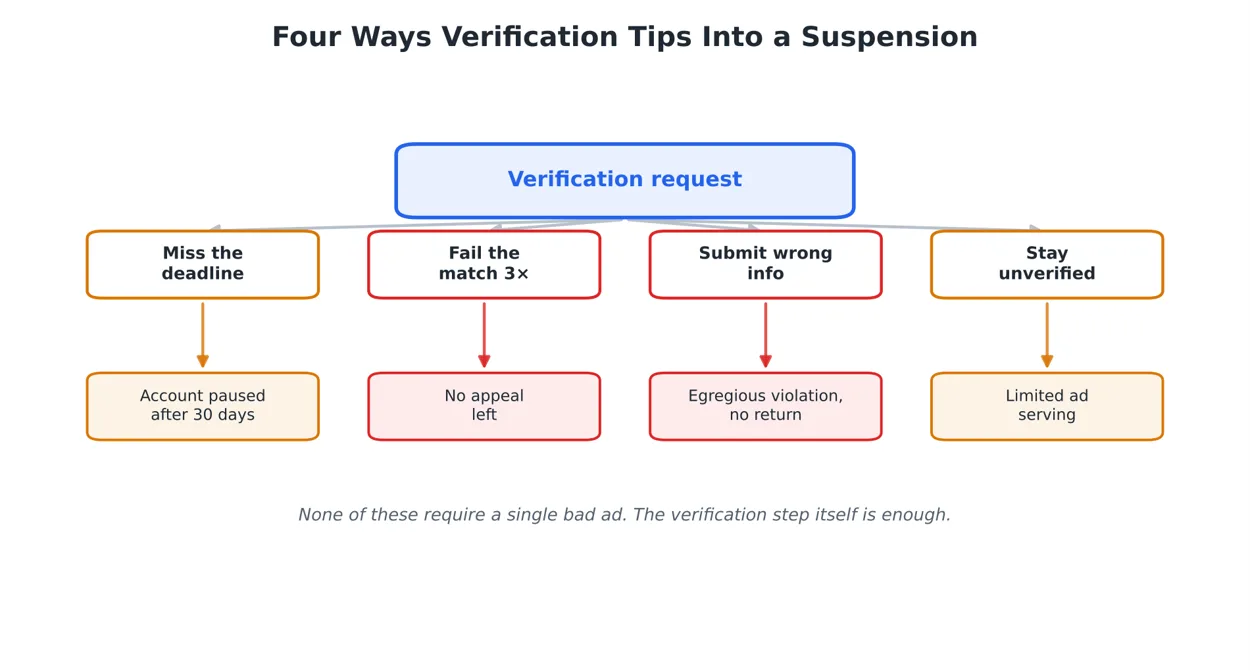
Miss the deadline and your account gets paused. Business operations verification gives you about 30 days, and reviews take up to seven business days. Blow past the window and your ads stop serving until you finish.
Fail the check too many times and you lose your appeal. Selected advertisers who fail identity checks three times cannot appeal the outcome. A few mismatched documents can end the conversation before a human ever weighs in.
Submit the wrong information and the penalty is severe. Since a November 2025 clarification, Google treats false verification information as an egregious violation. Those accounts face suspension without warning and cannot come back. An honest mistake that looks like a misstatement carries real danger.
Stay unverified and your reach shrinks anyway. Verification status feeds Google’s limited ad serving policy, so unverified advertisers can have their impressions capped without breaking any rule. From June 2026, Google applies this to Search.
Safeguard and trigger at the same time
Here is the honest answer: verification is both. It is a safeguard by design and a suspension trigger in practice. Those two things are not in conflict. A smoke alarm protects your house and still goes off when you burn toast. Verification protects the ad ecosystem, and it still pauses accounts over paperwork.
For legitimate advertisers, the trigger side bites hardest because the system checks for an exact match, not for honesty. Your name has to match your documents down to the suffix. Your country has to line up across your profile, your documents, and your payment method. A recent address change, a trading name, or a blurry photo of a real certificate can all fail the check. None of that is fraud, yet each one can start the slide toward a pause.
When one failed check spreads
A stalled verification rarely stays contained. Once Google cannot confirm who you are or what you do, the doubt can bleed into other policies.
If your business details do not add up, your ads can get read as deceptive, and you may need to Resolve Google Ads Misrepresentation Policy problems on top of the verification task. If you advertise a brand name and cannot prove you have the right to use it, the same scrutiny can push you into needing to Resolve Google Ads Trademark Policy claims. If your ads use images or video you cannot show you own, you may end up working to Resolve Google Ads Copyright Policy complaints as well. What began as one identity check can snowball into a Google Ads Account Suspended notice and a much longer fight to get back online.
How to keep it a checkbox, not a shutdown
You cannot opt out of verification, but you can stop it from becoming a suspension. The failures above are almost all preventable, and the fixes come straight from Google’s own guidance. Treat it as a precise task:

Five habits that keep verification a routine checkbox instead of a shutdown.
- Start before the deadline. Begin the moment the task appears, so a slow review or a rejected document still leaves you time to fix and resubmit.
- Match every field exactly. Make your name, address, and country identical across your payments profile, your documents, and your card before you upload.
- Send clean original documents. Use a sharp, well-lit photo of the real document, all pages, with no screenshots or photocopies.
- Fix the exact flag, then retry. Google tells you which field failed. Correct that one thing instead of guessing, because attempts are limited.
- Keep your details consistent over time. A later change to your billing or business info can trigger a fresh check, so keep everything aligned.
The bottom line
Advertiser verification is not a trap set to catch you, and calling it just another suspension trigger sells the intent short. It genuinely keeps bad actors out. But for everyday advertisers, the line between a safeguard and a shutdown is thin, and it runs through a strict, document-matching check with sharp penalties for getting it wrong. Respect that, prepare for it, and verification stays a formality. Ignore it, rush it, or fumble the details, and it becomes exactly the trigger people fear.