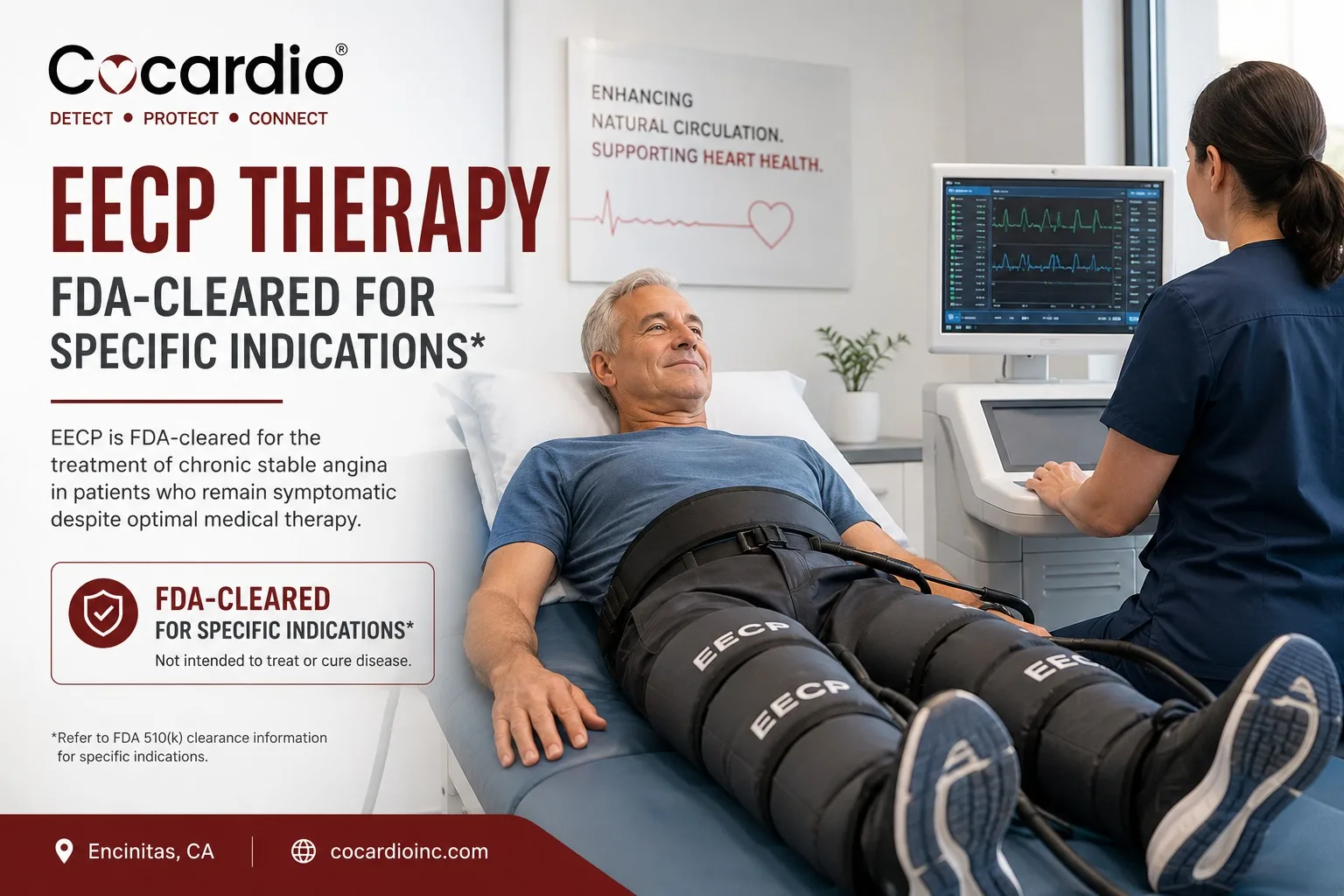
What FDA clearance means for EECP
FDA clearance means a specific EECP/ECP device has been reviewed under the applicable device pathway and cleared for its stated intended use. FDA records for external counterpulsation systems include chronic stable angina among the intended indications, particularly in patients whose symptoms remain difficult to manage and who may not have suitable revascularization options.
- “FDA-cleared” is the most technically accurate wording for these devices.
- Clearance applies to particular devices and intended uses, not to every marketing claim made about EECP.
- A clinician still has to decide whether a person is an appropriate candidate based on symptoms, diagnosis, medical history, and contraindications.
If you are comparing EECP therapy near me options, ask the center what device it uses, who oversees treatment, what diagnosis is being treated, and how your cardiologist will be kept involved.
Is EECP cleared for coronary artery disease prevention?
EECP should not be presented as an FDA-cleared “prevention cure” for coronary artery disease. Its established regulatory and clinical role is more specific, with chronic stable or refractory angina being the clearest recognized indication. CoCardio’s coronary artery disease page describes a prevention-first approach built around education, early detection, circulation-focused care, and coordination with existing cardiology care.
For that reason, the phrase eecp for coronary artery disease prevention is best understood as part of a broader prevention strategy, not as a claim that EECP removes plaque or guarantees that coronary disease will be reversed. Prevention still depends on identifying risk, addressing modifiable factors, and following an individualized medical plan.
How EECP treatment works for chronic stable angina
During eecp treatment, inflatable cuffs are placed around the lower body and timed with the heartbeat. The cuffs inflate and deflate in a synchronized sequence intended to augment circulation without surgery. Because treatment is external, there is no catheter or incision involved.
For people Living With Angina or Chest Pain?, the practical goal is symptom management and improved function when EECP is medically appropriate. The FDA-cleared indication should not be confused with emergency chest-pain care. New, severe, prolonged, or worsening chest discomfort needs prompt medical evaluation.
What to ask an EECP center before starting
A high-quality consultation should clarify why EECP is being considered, what outcome is realistic, and how progress will be monitored. People comparing eecp therapy centers can use a simple screening checklist.
- What diagnosis is EECP being recommended for?
- Is my angina stable, and have urgent causes of chest pain been ruled out?
- Are there any reasons EECP may not be suitable for me?
- How will treatment be coordinated with my cardiologist or prescribing clinician?
- What is included in the quoted EECP therapy cost, and what insurance or Medicare requirements may apply?
Can EECP reverse heart disease naturally?
Claims about “reversing” heart disease need careful wording. EECP may be used to improve symptoms and circulation in selected patients, but it should not be described as a proven way to erase coronary plaque or replace evidence-based risk reduction. A search for Reverse heart disease naturally should lead to a broader conversation about measurable risk factors, lifestyle, medical therapy, and appropriate non-invasive options rather than a promise of reversal.
An illustrative example is a person with chronic stable angina who still has activity-limiting chest pressure despite ongoing cardiology care. If that person is an appropriate EECP candidate, the therapy may be added to the existing plan. The decision should be based on a clinical assessment, not on the word “FDA” alone.
Common mistakes to avoid
- Treating “FDA-cleared” as proof that EECP is right for every person with coronary artery disease.
- Assuming EECP is an emergency treatment for acute chest pain.
- Stopping prescribed heart medication because a non-invasive option is available.
- Choosing a center based only on price without asking about clinical oversight, diagnosis, device use, and coordination of care.
Key takeaways
- EECP/ECP devices are FDA-cleared for specific indications that include chronic stable angina.
- FDA clearance does not equal a blanket approval for coronary artery disease prevention or plaque reversal.
- EECP is non-invasive and should be considered within an individualized cardiovascular care plan.
- People in Encinitas and the greater San Diego area can discuss candidacy and next steps with CoCardio®.
FAQ
Is EECP FDA approved?
EECP is more precisely described as FDA-cleared. FDA 510(k) records show external counterpulsation devices cleared for intended uses that include chronic stable angina.
Is EECP approved to prevent coronary artery disease?
FDA clearance for EECP is tied to specific device indications, especially chronic stable angina. It should not be presented as a stand-alone FDA-cleared method that prevents all coronary artery disease.
Is EECP invasive?
No. EECP uses external cuffs around the lower body that inflate and deflate in coordination with the heartbeat; it does not require an incision or catheter.
How do I know whether EECP is appropriate for me?
A licensed healthcare professional should review your diagnosis, symptoms, cardiovascular history, current treatment, and possible contraindications before recommending EECP.
A practical next step in Encinitas
EECP has a legitimate FDA-cleared role, but the indication and the patient matter. If you are exploring non-invasive support for chronic stable angina or coronary artery disease symptoms, review CoCardio’s eecp for coronary artery disease prevention information and use the EECP therapy near me contact page to discuss whether an evaluation is appropriate for you.
Medical disclaimer:
This article is for general educational purposes only and is not a substitute for diagnosis, treatment, or personalized medical advice. New, severe, or worsening chest pain can be an emergency. Seek urgent medical care when appropriate and discuss EECP/ECP with a licensed healthcare professional who knows your medical history.
Yes, EECP systems have received FDA clearance for specific medical uses, including treatment of chronic stable angina. The more precise regulatory term is “FDA-cleared,” because these external counterpulsation devices are generally marketed through the FDA’s 510(k) pathway. That clearance does not mean EECP is FDA-cleared as a stand-alone method to prevent every case of coronary artery disease, so people searching for eecp for coronary artery disease prevention should separate the recognized angina indication from broader prevention goals.
That distinction matters because coronary artery disease can involve plaque buildup, reduced blood flow, angina, and different levels of cardiovascular risk. At CoCardio® in Encinitas, non-invasive circulation-focused care is positioned to work alongside existing cardiology care rather than replace medical evaluation, prescribed medication, or procedures when those are indicated.