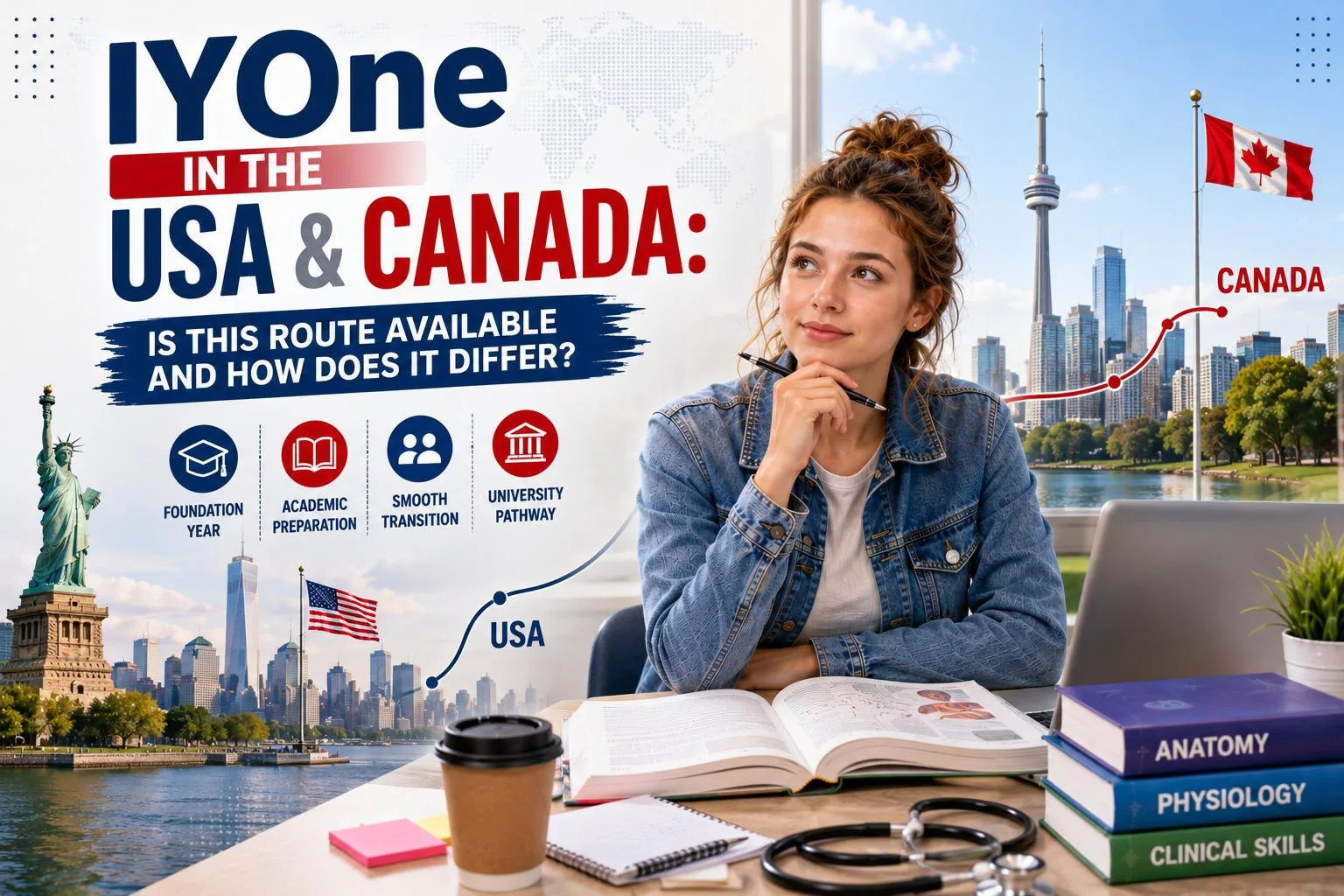
International Year One is available in both the USA and Canada, but the route does not look the same at every university. In the USA, some universities and pathway partners use the name International Year One for a supported first year that carries degree credit. In Canada, the same idea may appear as International Year One, UTP Stage II, or a university transfer pathway. Students should compare the credits, progression rules, degree options, and visa setup rather than rely on the program name alone.
For many international students, International Year One sits between direct entry and a foundation program. It gives students first-year university study with added academic and English support. In a well-matched program, the student can move into the next stage of the degree after meeting the stated conditions. The exact rules depend on the university, major, pathway provider, and country.
What Is an International Year One?
International Year One is a first-year undergraduate pathway for international students who need more support than direct-entry students. The course often combines degree-level subjects with academic English, writing, study skills, advising, and transition support. Students may also receive more guided teaching than they would in a standard first-year course. The aim is to help them complete first-year work and continue in the main degree.
The key difference from a foundation year is timing. A foundation year usually comes before Year One of a bachelor's degree, so it may add another stage before the degree starts. International Year One normally covers first-year degree content itself. That is why a student may be able to continue into the next degree stage without adding a full extra year.
Is International Year One Available in the USA?
Yes. International Year One is available in the USA, but it is not offered by every university and the name is not used in one fixed way. Oregon State University currently offers an International Year One undergraduate pathway for students who need more academic or English support than its direct-entry route. The program combines academic skill development with courses that count toward the chosen degree.
San Francisco State University and Mercy University are other current examples where International Year One routes are promoted for international students. At Mercy, the pathway is designed to replace the freshman year rather than sit before it. That detail matters because it shows why students must read the academic structure before assuming a pathway adds time. A good U.S. IYOne should make the credit value and next academic step clear.
How the U.S. Model Works
The U.S. university system is built around credits, so progress may depend on the number and type of credits completed. An International Year One student may take general education classes, major-related courses, English support, and academic skill modules in the same period. The mix changes by university and subject. A student should ask which courses count toward graduation and which are support courses only.
At Oregon State, students who complete the International Year One requirements can move into degree-seeking status. That wording matters because American universities do not always describe progress as a simple Year One to Year Two move. Students should check the degree plan, credit total, and major requirements together. This gives a better picture of how much of the bachelor's degree has actually been completed.
Is International Year One Available in Canada?
Yes. International Year One is also available in Canada, but students may need to search under more than one name. Canadian pathway colleges often use the term International Year One together with "UTP Stage II." In that model, the pathway is designed as the first-year equivalent of a partner university degree. Students who complete the required courses and reach the required GPA can transfer into the next stage of the partner university program.
Fraser International College uses International Year One, also called UTP Stage II, for routes linked to Simon Fraser University. Toronto Metropolitan University International College uses the same naming style for pathways linked to Toronto Metropolitan University. This means a student who searches only for "International Year One Canada" may miss valid options listed under university transfer or UTP terms. Searching by the final university and degree can give better results.
International Year One in the USA vs Canada
Both countries offer first-year pathways, but the structure often differs. Canada commonly uses a partner-college transfer model, where a pathway college delivers the first-year-equivalent program before the student moves to the partner university. In the USA, the pathway may be framed more as a supported freshman year linked to the university. Neither model is automatically better.
AreaUSACanadaCommon namesInternational Year One, undergraduate pathwayInternational Year One, UTP Stage II, university transfer programMain purposeSupported first-year study with degree creditFirst-year-equivalent study linked to partner transferProgressionContinue in the degree or move to degree-seeking statusTransfer into the next stage of the partner degreeCredit modelUniversity-specific credit planCredits mapped to partner-university transferEntry rulesGPA, English, and subject requirementsAcademic average, English, and subject requirementsMajor choiceDepends on pathway optionsOften linked to a defined faculty or degree routeThe table shows the broad pattern, not a rule for every institution. A U.S. program can look much like a Canadian transfer program, and a Canadian pathway can be closely connected to one university. Students should read each offer as its own academic plan. The key questions are what you study, what credit you earn, and what happens after you pass.
The Credit Question Matters Most
The most useful question to ask before accepting International Year One is simple: "Exactly how many credits will count toward my bachelor's degree?" A pathway can sound attractive because it promises progression, but its real value depends on what happens to those credits after completion. Students should also ask who issues the transcript and which courses count toward the final degree. Written answers are safer than general promises.
This becomes even more important for students who may change majors. A business pathway may fit well into a business degree, but some of those credits may not meet the needs of engineering or science. The same risk appears when a student wants to move to another university. University credit does not always mean that every institution will accept it in the same way.
How Progression Works in the USA
Progression in the USA can depend on course completion, GPA, English results, and major rules. Some pathways state that successful students move into standard degree status. Others may require set grades in key subjects before the student can continue in the planned major. Competitive majors can have higher standards than general university admission.
Students should read the word "successful" carefully. It may mean passing every required class, meeting a minimum GPA, completing an English level, or earning a set grade in math or science. A pathway may also have different rules for different majors. "Progression available" should never be read as "progression without conditions."
How Progression Works in Canada
Canadian International Year One programs often state the number of courses and GPA needed for transfer to the partner university. Fraser International College, for example, uses program-specific transfer standards for Simon Fraser University. The required GPA can differ by degree route, which means the rule for arts may not match the rule for computing or another subject. Toronto Metropolitan University International College also links successful UTP Stage II study to the next stage of the related TMU degree.
This model can be easy to follow when the partner agreement is clear. The student starts in the pathway college, completes the required academic program, and transfers after meeting the stated rules. The main mistake is assuming that the same pathway gives automatic transfer to any Canadian university. Partner progression and outside transfer are not the same thing.
Entry Requirements for International Year One
Entry requirements change by university, home-country qualification, and subject. Most programs check high school completion, school grades, English ability, and subject prerequisites. Engineering, computing, and science routes often ask for stronger math or science preparation. Business, arts, and social science routes may use a different academic profile.
English requirements can also change by pathway length. A student with stronger English may enter a shorter route, while someone who needs more language support may need extra terms or an integrated English course. Students should check accepted tests, overall scores, section scores, and any later English rule for progression. They should never assume one English score works for every stage.
What Subjects Can Students Study?
International Year One can cover many common undergraduate fields. Current pathways include business, computing, engineering, science, arts, social sciences, communication, and other subject areas. The exact list depends on the university and the first-year courses built into the pathway. Some schools offer many routes, while others offer only a small set.
The safest approach is to start with the final degree. A student who wants computer science should check the computer science progression route first. A student who wants engineering should check math, physics, chemistry, and GPA rules before paying a deposit. Choosing the easiest pathway first can create credit or subject problems later.
International Year One vs Foundation Year
International Year One and a foundation year solve different problems. A foundation year is normally for students who need more preparation before first-year degree study because of academic, subject, or English gaps. International Year One is meant for students who can begin first-year university work but still need added support. The student studies degree-level content from the start.
This difference can affect total study time. A student who completes a first-year-equivalent IYOne and moves into the next degree stage may stay close to the standard graduation timeline. A foundation student normally enters Year One after finishing the foundation stage. Students should still check the written course map because the title alone does not prove how long the full degree will take.
International Year One vs Direct Entry
Direct entry is usually simpler for a student who already meets the university's academic and English requirements and feels ready for standard first-year study. International Year One adds support, but that support can come with a separate fee structure, set progression rules, or fewer subject choices. A student should not pick IYOne only because it sounds easier. The better route depends on grades, language level, study needs, and the target degree.
IYOne can make sense when the student is close to direct-entry standards but needs more help with academic English, writing, study methods, or adjustment to a new education system. It can also help when a school qualification does not match normal direct-entry rules. The value comes from two things: useful degree credit and meaningful support. Both should be clear before the student accepts the offer.
IYOne vs Community College in the USA
Community college is another route worth comparing in the USA. Students can study at a two-year college and later transfer credits into a university degree. This can give more transfer choices and may lower first-stage tuition in some cases, but every course must be planned around the target university. It is not the same model as an International Year One tied to a specific institution.
A university-linked IYOne may give a clearer route for students who already know where they want to graduate. Community college may suit students who want more transfer freedom or a different cost structure. Neither option should be chosen only on the first-year price. Students need to compare credit transfer, major access, total time, and the full degree cost.
IYOne and University Transfer Programs in Canada
In Canada, a university transfer program is not always a separate option from International Year One. Some pathway colleges use both terms for the same first-year-equivalent route, with UTP Stage II being a common example. This can confuse students who learned about IYOne through UK-based study information. Looking at the academic level gives a clearer answer than looking at the title.
Students should check whether the program is stated to be equivalent to first-year university study. They should then check the university that receives the student after completion. The course total, GPA rule, and linked faculty should also be clear. These points tell a student far more than the words used in the program name.
Does International Year One Add an Extra Year?
Not always. A true International Year One can take the place of the first year when its credits are built into the bachelor's degree. Mercy University, for example, describes its IYOne route as replacing the freshman year. Canadian UTP Stage II programs can also act as first-year equivalents before transfer into the next degree stage.
Extra time can still appear after failed courses, repeated modules, major changes, or moves to universities that do not accept all pathway credits. Students should calculate the full route from the first IYOne term to graduation. The best question is not only how long IYOne takes. Students should ask how many terms they will need from the day they start until they finish the degree.
Can You Change Your Major or University After IYOne?
A major change may be possible, but it can affect credit use and graduation time. First-year business courses may not meet the first-year needs of engineering, science, or another tightly planned degree. Even a change within the same faculty can require extra prerequisites. Students who are unsure about their major should ask about change rules before they begin.
Moving to another university can be even less certain. Progression to the named partner university is usually the clearest route because the courses were built for that purpose. A different university may review credits one by one and accept all, some, or none toward the new degree. Students who want transfer freedom should ask for course codes, credit values, transcript details, and written transfer guidance.
Cost of IYOne in the USA and Canada
There is no single useful price for International Year One in either country. Tuition changes by university, pathway length, city, major, housing, insurance, and student fees. A program that looks cheaper at first can cost more when it needs extra terms or when some credits do not fit the final degree. Students should compare the full cost to graduation rather than only the first invoice.
A practical budget should include tuition, mandatory fees, housing, food, health coverage, books, local travel, visa costs, and possible repeat-course costs. Students should compare IYOne with direct entry, foundation study, community college, or another transfer route when those options are available. The cheapest first year is not always the cheapest bachelor's degree. Lost credits can change the total cost quickly.
Visa and Post-Study Work Checks
International Year One students in the USA must follow the rules tied to their student status and school. F-1 students must maintain a full course of study, and work or practical training depends on federal rules and authorization. Students should confirm who issues the Form I-20 and how the pathway appears in their academic record. The university's international student office should confirm the current setup.
Canada also needs careful checking. Admission to a school does not by itself mean every student or program will qualify for a post-graduation work permit later. PGWP eligibility depends on current federal rules, the school, program, and the student's study history. Students should check the latest official requirements before paying a deposit and again before making post-study work plans.
Questions to Ask Before Accepting an IYOne Offer
A strong International Year One offer should answer the main academic questions in writing. Marketing phrases such as "direct progression" or "pathway to Year Two" are not enough on their own. Students need to know the exact academic conditions and what happens after completion. These checks can prevent expensive surprises:
- How many credits count toward the final degree? Ask for the exact number, course list, and where each course fits in the bachelor's plan.
- What GPA and grades are needed for progression? Check both the overall GPA and any subject-specific grade rules.
- Is progression tied to one university or major? A clear route to one partner degree may not give the same result elsewhere.
- What happens after a failed course? Ask whether it can be repeated, what it costs, and whether it delays progression.
- Can the credits move to another university? Ask about outside transfer, not only transfer to the named partner.
- Will changing major add time? Check which credits remain useful when the student changes subject.
A Better Way to Choose an International Year One
Start with the final bachelor's degree, not the pathway. Pick the subject and target university first, then check whether direct entry is possible. When direct entry is not available or does not fit the student's needs, compare the official International Year One or transfer routes linked to that degree. This keeps the final goal at the center of the decision.
Then map the credits and progression rules. Check the courses, GPA, English conditions, transfer point, visa setup, total study time, and full cost to graduation. Compare those points with foundation study, direct entry, and other transfer routes. The best International Year One is not the one with the easiest admission; it is the one with the clearest route to the degree the student actually wants.
Red Flags to Watch For
Students should be careful when a pathway does not clearly name the partner university, degree, credit value, or progression standard. They should also question phrases such as "guaranteed transfer" when no GPA or course conditions are shown. Another warning sign is a claim that all credits will work at any university. The receiving institution normally decides how outside credits are used.
Outdated visa or post-study work advice is another warning. Rules can change, and an old article may no longer match current policy. Students should use current university documents for academic facts and current government information for immigration rules. Any promise that affects a major financial decision should be confirmed in writing.
Is International Year One Better in the USA or Canada?
Neither country is automatically better for every student. The USA may suit someone whose chosen university offers a supported first-year pathway with strong degree credit and a clear move into standard university study. Canada may suit a student who prefers a mapped International Year One or UTP Stage II route into a named partner university. The better choice depends on the exact degree, cost, progression terms, visa plan, and study needs.
Students should compare programs at the university level rather than only at the country level. A clear Canadian pathway can be better than a weak U.S. option, and the reverse can also be true. The strongest route is the one that gets the student from high school to the target bachelor's degree with low credit risk and a clear academic plan. That is the test that matters.
Final Verdict
International Year One is a real study route in both the USA and Canada. In the USA, it often appears as a supported first-year or undergraduate pathway with degree credit. In Canada, it may appear as International Year One, UTP Stage II, or a university transfer pathway that leads into the partner university. Students should focus on credit value, progression rules, major fit, total cost, and visa conditions before choosing.
The name alone does not tell you whether a program is a good choice. Read the degree map, check the progression conditions, and ask what happens to every credit you earn. Compare the route with direct entry, foundation study, community college, or another transfer option when relevant. A well-chosen International Year One can keep a student on track for the intended degree without wasting time or credit.
Frequently Asked Questions
Is International Year One available in the USA?
Yes. Some U.S. universities and pathway partners offer International Year One or similar undergraduate pathways for international students. These programs can combine first-year degree courses with English and academic support. Availability depends on the university and major.
Is International Year One available in Canada?
Yes. Canada has International Year One programs, though many are also called UTP Stage II or university transfer pathways. These programs can be equivalent to first-year study at a partner university. Students usually transfer after meeting the required course and GPA conditions.
Is UTP Stage II the same as International Year One?
In several Canadian pathway colleges, yes. UTP Stage II is used as the name for a first-year-equivalent university transfer program. The student should still check the exact degree link, credits, and transfer requirements for the chosen institution.
Does International Year One lead to Year Two?
It can. Many IYOne programs are built so successful students move into the next stage of the related bachelor's degree. The move is normally subject to course, GPA, English, and major requirements. Students should check the written progression rules before enrolling.
Is International Year One better than a foundation year?
It depends on the student's academic level. International Year One is usually better suited to students who are ready for first-year degree content but need added support. A foundation year is usually a better fit for students who need more preparation before first-year university study.
Can International Year One save time?
It can save time compared with a route that adds a separate pre-degree year. That benefit only applies when the IYOne credits count toward the final bachelor's degree and the student progresses on schedule. Failed courses, major changes, or outside transfers can add extra terms.