For years, international students choosing a US university could focus mainly on the usual questions: Which program fits? How much will it cost? Where is the best research opportunity?
Now there is another question on the application checklist: Can I finish my degree within the new immigration timeline?
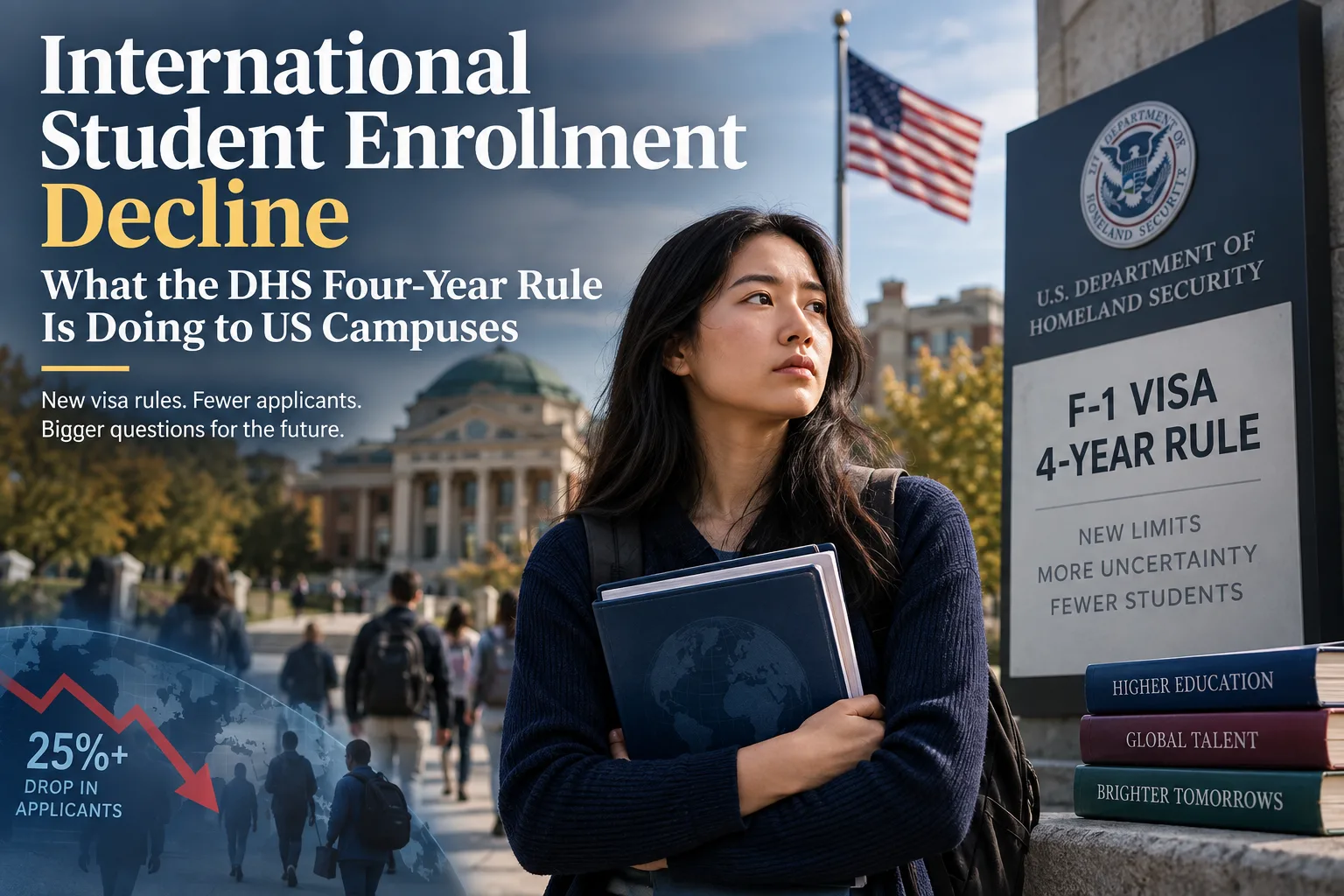
That concern is becoming more than a hypothetical problem. Research into recent court filings shows that international applicants to the University of Illinois's flagship campus fell by more than 25 percent, while the University of Maryland, Baltimore saw several dozen students withdraw just weeks before the semester began.
The common thread is a new Department of Homeland Security framework that replaces the traditional "duration of status" approach with a four-year admission period for F-1 students. Students who need longer may have to seek an extension, adding a new layer of uncertainty to academic planning.
Why Degree Length Now Matters More
The biggest change is not simply that students face another immigration requirement. It is that the length of an academic program now carries greater significance.
Under the earlier duration-of-status system described in the research, students could generally remain in the US while completing their approved program and maintaining status. The new framework introduces a four-year limit, creating particular concerns for students whose programs naturally extend beyond that period.
PhD candidates are an obvious example. Research rarely follows a perfect timetable. A project can take longer than expected, funding can change, or a student may need an additional semester to complete a dissertation.
The same issue can affect five-year professional programs such as architecture and engineering. Even a student enrolled in a shorter course may face complications if illness, research delays, funding problems or other circumstances push completion beyond the expected schedule.
That changes how students compare countries. A doctoral applicant considering universities in the US, Canada, the UK and Australia may now look at visa predictability alongside academic reputation.
The degree itself has not changed. The calculation around it has.
Universities Are Feeling the Impact Before Students Arrive
The enrollment effects described in the research are significant because they occur before students even reach campus.
A university may spend months recruiting international applicants, reviewing applications and issuing admission offers. Once students accept, the institution begins planning around those numbers. Housing, course sections, orientation programs, teaching assignments and research teams all depend on reasonably reliable enrollment forecasts.
Withdrawals close to the start of a semester disrupt that planning.
The University of Maryland, Baltimore example illustrates the timing problem. Several dozen students reportedly withdrew only weeks before the semester began, when many of the university's operational decisions had already been made.
Illinois presents a different but equally important warning. A decline of more than 25 percent in international applicants is large enough to affect university departments, particularly those that depend on international graduate students for tuition revenue, teaching support and research activity.
The consequences can move beyond the admissions office. Graduate students often work in laboratories and teaching sections, so a smaller incoming class can affect research schedules and staffing plans.
There is also a local economic effect. International students spend money on housing, food, transportation, retail and other services. A sustained reduction can therefore reach beyond university finances.
Students Need a Different Application Strategy
The new environment makes early academic and visa planning more valuable.
Prospective students should examine the typical completion time for their chosen program rather than relying only on the official program length. A course advertised as four years may have a very different risk profile from a doctorate that commonly takes five or six years.
Students should also ask university international offices specific questions about extension procedures and how the institution is preparing students for the new framework. The research recommends treating programs that typically exceed four years with particular care.
This does not mean students should automatically rule out US universities. It means they should understand the additional planning involved before accepting an offer.
Academic workload is another part of that calculation. Students dealing with demanding coursework, research deadlines and immigration paperwork have less spare time when several responsibilities arrive together. For students who need additional help managing assignments and coursework, coursework writing assignments help can provide subject-specific academic support while they focus on their wider study and visa planning.
The point is not to outsource the degree. It is to manage the workload more efficiently when administrative demands compete for attention.
The Risk Is Highest for Longer Programs
Not every international student faces the same level of exposure.
A student enrolled in a short master's program may complete the degree well before reaching the four-year threshold. A doctoral student, dual-degree student or five-year professional-program student has much less room for unexpected delays.
That creates an unusual situation. Two students can arrive at the same university under the same F-1 framework but face very different levels of immigration uncertainty based largely on their academic timeline.
Families should therefore build contingency time into financial and academic planning. If a program normally takes several years, students need to understand what happens if the expected completion date moves.
This is particularly relevant for research-intensive degrees. A dissertation cannot always be treated like a fixed calendar appointment. Results may require another experiment, a supervisor may request additional work, or funding arrangements may change.
The new immigration framework makes those ordinary academic uncertainties more consequential.
The Competition for Global Students Is Changing
US universities are competing for international students against institutions in other countries. When students compare destinations, they consider tuition, rankings, research opportunities and employment prospects. Immigration predictability now enters that comparison more directly.
The research records a student withdrawal from the University of Wisconsin-Madison in which the newly published DHS rule was identified as a significant factor in the decision. It also notes that fourteen institutions and the University of California system submitted declarations describing the effects as serious and potentially irreparable.
For universities, the response cannot stop at waiting for the legal dispute to end.
Clear communication matters. International offices can help by explaining program timelines, extension procedures and contingency planning before students make enrollment decisions.
Students also need practical academic support when managing complex assignments alongside these responsibilities. For demanding research papers and term papers, term paper writing help can give students additional subject-focused assistance while they handle academic advising and immigration requirements.
The larger lesson is straightforward. International students are not choosing universities in an information vacuum. They are comparing the complete experience, from admission to graduation.
If the US wants to remain a leading destination for global students, academic excellence alone may not be enough. Students need confidence that the path from their first semester to their final degree will remain manageable.
The universities that provide that clarity early will have an advantage. In a global education market, uncertainty can influence a student's decision long before they ever set foot on campus.