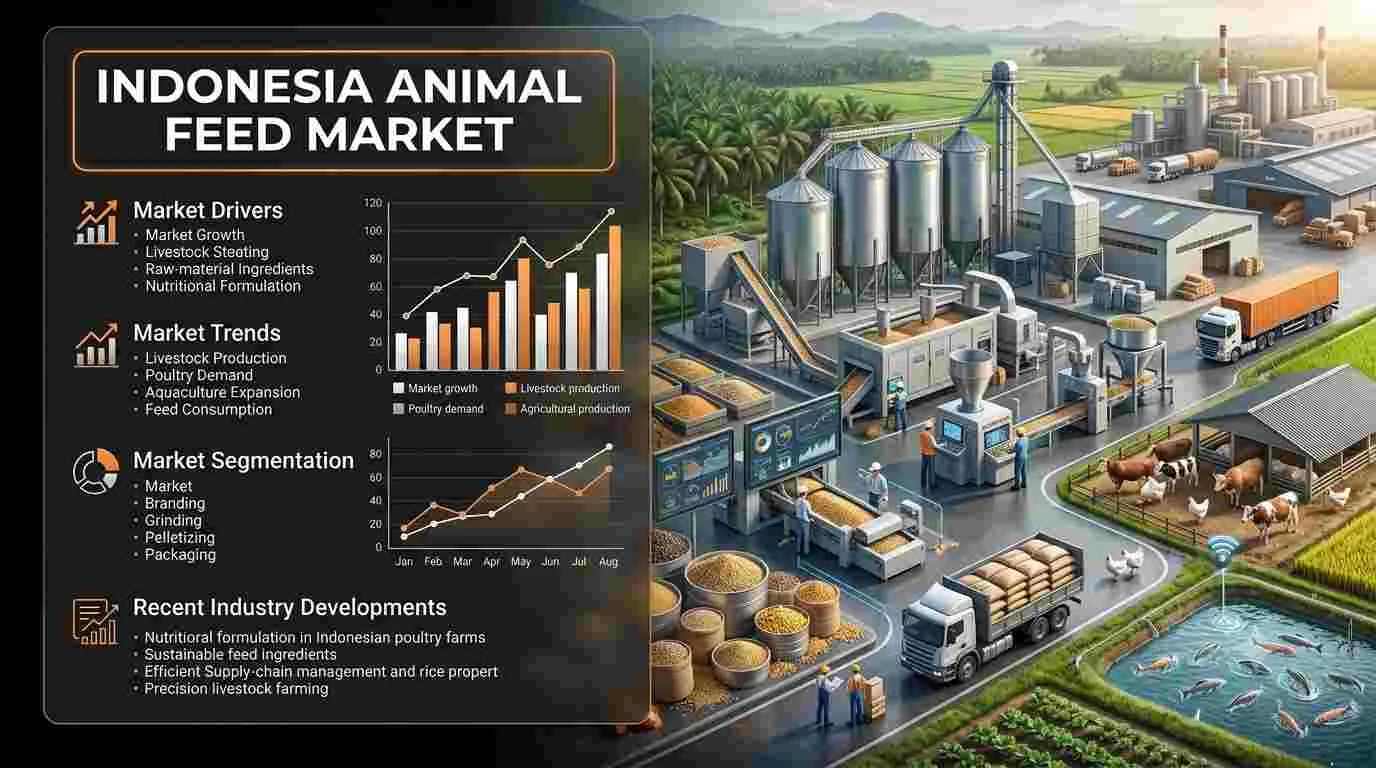
IMARC Group, a leading global market research and management consulting firm, has published its latest market intelligence report on the Indonesia Animal Feed Market. The Indonesia animal feed market size is from USD 9.0 Billion in 2025 to USD 9.6 Billion in 2026. Looking forward, the market is expected to reach USD 13.1 Billion by 2034, exhibiting a growth rate of CAGR of 4.02 percent during 2026-2034. The growth is primarily driven by rising demand for meat and dairy products, continual advancements in animal nutrition technologies, as well as initiatives promoting sustainable farming by the Indonesia government.
Indonesia's animal feed sector is being reshaped by a landmark government push toward national corn self-sufficiency, surging poultry feed demand, and growing adoption of alternative, sustainable feed ingredients. Poultry accounts for the majority of the animal type segment share in 2025, while pellets hold the largest share in the form segment and cereals represent the leading ingredient segment. Indonesia achieved corn self-sufficiency in 2025, carrying over 4.5 million tons of stock into 2026, and the government has committed to importing no corn for animal feed, seed production, or household consumption throughout the year, with national production targeted at 18 million tons. At the same time, researchers at Indonesia's National Research and Innovation Agency (BRIN) are advancing spirulina microalgae as a sustainable, omega-3-rich feed alternative, while the government has unveiled a USD 1.2 billion investment in new feed mills to meet a projected rise in national feed production from 26 to 28 million tonnes in 2024 to 35 to 40 million tonnes by 2026. Combined with continued foreign direct investment from global agribusiness majors, these forces are reshaping the competitive landscape and setting the stage for durable, long term growth across Java, Sumatra, Kalimantan, Sulawesi, and other regions.
Indonesia Animal Feed Market at a Glance
- Market Size (2025): USD 9.0 Billion
- Market Size (2026): USD 9.6 Billion
- Market Forecast (2034): USD 13.1 Billion
- Growth Rate (2026-2034): CAGR of 4.02 percent
- Base Year: 2025, Historical Period: 2020-2025, Forecast Period: 2026-2034
- Leading Animal Type: Poultry, accounting for the majority of market share, led by broilers, layers, and turkeys
- Leading Form: Pellets, favored for digestibility, reduced waste, and operational efficiency
- Leading Ingredient: Cereals, led by corn as the primary energy source in feed formulations
How Sustainable Innovation is Reshaping the Future of the Indonesia Animal Feed Market
- Spirulina Microalgae as a Sustainable Feed Alternative: Indonesia's National Research and Innovation Agency (BRIN) reported in July 2025 that it is using spirulina, a type of microalgae high in omega-3, to enhance livestock productivity, offering an inexpensive and environmentally sustainable feed alternative that improves meat, egg, and milk quality while curbing reliance on costly traditional feed.
- USD 1.2 Billion Feed Mill Investment Program: Indonesia's Ministry of Agriculture announced a USD 1.2 billion investment in a network of new feed mills across several regions, with construction of the first facilities scheduled to begin in 2026 to meet surging poultry feed demand as the national chicken population, including broilers and layers, is projected to reach 4.8 to 5 billion head by 2026.
- Precision Feed Pricing and Supply Management Systems: In parallel with its feed mill investment, Indonesia's Agricultural Ministry announced plans to introduce a fixed government purchase price for corn from farmers and a maximum retail price for livestock producers, reflecting a more data-driven, centrally coordinated approach to stabilizing the national feed supply chain.
Grab a sample PDF of this report: https://www.imarcgroup.com/indonesia-animal-feed-market/requestsample
Indonesia Animal Feed Market Trends and Drivers
Demand across the Indonesia animal feed market is being underpinned by increasing consumption of animal-based products. As the nation's population experiences rising affluence and urbanization, there is a corresponding surge in demand for meat, eggs, and dairy products, placing significant pressure on the livestock industry and necessitating a proportional increase in high-quality animal feed production.
The market's structural differentiator is the shifting consumer preference toward organic and sustainably produced animal products. Increasing awareness of health and environmental sustainability is prompting consumers to opt for organic and naturally produced meat and eggs, requiring specialized animal feed that adheres to stringent organic standards and is free from synthetic pesticides and genetically modified organisms.
A third driver is growing emphasis on sustainable and eco-friendly feed practices. Farmers and producers are gravitating toward alternative protein sources including insects, algae, and plant material, alongside the use of organic waste materials such as food waste and agricultural by-products in feed formulation, reflecting both consumer pressure and government policies encouraging more environmentally friendly approaches.
Government Schemes and Regulatory Initiatives Driving Demand
- National Corn Self-Sufficiency Program: Indonesia's Directorate General of Food Crops under the Ministry of Agriculture (Kementan) confirmed the country achieved feed corn self-sufficiency in 2025, with the government committing not to import corn for animal feed, seed production, or household consumption throughout 2026, supported by a national target of 18 million tons of production.
- National Food Agency Government Purchase Price Decree: Indonesia's National Food Agency set the government purchase price for corn under Head of National Food Agency Decree No. 216 of 2025, supporting farmer income stability and market predictability as the country transitions away from feed corn imports.
- One Million Hectare Corn Cultivation Collaboration: The Indonesian government's corn self-sufficiency drive is reinforced by joint cultivation efforts between the Ministry of Agriculture, the National Police, and local governments, aimed at planting corn across one million hectares nationwide, with President Prabowo Subianto personally operating a corn combine harvester at a June 2025 harvest event in West Kalimantan.
- USD 1.2 Billion Feed Mill Investment Initiative: The Ministry of Agriculture's Directorate General of Livestock Production and Animal Health announced a USD 1.2 billion investment in new feed mills, with national feed production targeted to rise to 35 to 40 million tonnes in 2026 from 26 to 28 million tonnes in 2024.
- BRIN-Backed Sustainable Feed Research: Indonesia's National Research and Innovation Agency continues to back research into alternative feed ingredients such as spirulina microalgae, aligning with the government's broader push toward sustainable, environmentally friendly livestock farming practices and reduced import dependency.
Indonesia Animal Feed Market Industry Segmentation
The report has segmented the market into the following categories:
Breakup By Animal Type:
- Swine (Starter, Finisher, Grower)
- Ruminants (Calves, Dairy Cattle, Beef Cattle, Others)
- Poultry (Broilers, Layers, Turkeys, Others)
- Aquaculture (Carps, Crustaceans, Mackeral, Milkfish, Mollusks, Salmon, Others)
- Others
Poultry represents the largest segment, driven by Indonesia's rapidly expanding broiler, layer, and turkey farming sectors, with feed manufacturers developing formulations that enhance growth rates, reproductive efficiency, and overall poultry health to meet rising national demand.
Breakup By Form:
- Pellets
- Crumbles
- Mash
- Others
Pellets account for the largest market share, offering improved digestibility, reduced waste, and enhanced nutrient absorption through a compressed, uniform particle format that facilitates easier storage, transportation, and precision feeding practices.
Breakup By Ingredient:
- Cereals
- Oilseed Meal
- Molasses
- Fish Oil and Fish Meal
- Additives (Antibiotics, Vitamins, Antioxidants, Amino Acids, Feed Enzymes, Feed Acidifiers, Others)
- Others
Cereals represent the leading ingredient segment, with corn serving as the primary energy source for livestock, directly benefiting from Indonesia's national corn self-sufficiency program and rising domestic production targets.
Competitive Landscape
The Indonesia animal feed market features a mix of global agribusiness majors and established domestic feed producers. Key players include:
- ADM
- BASF SE
- PT Cargill Indonesia
- IT CJ INDONESIA
- Louis Dreyfus Company
- PT Central Proteina Prima Tbk (CP Prima)
- PT Charoen Pokphand Indonesia Tbk
- PT Japfa Comfeed Indonesia Tbk
- PT Malindo Feedmill Tbk
- PT Sreeya Sewu Indonesia Tbk
Leading companies invest significantly in research and development, innovating feed formulations to optimize nutritional content and feed efficiency, while incorporating advanced technologies that contribute to livestock health and productivity. Global player ADM strengthened its Indonesian footprint through the acquisition of PT Trouw Nutrition Indonesia, while De Heus Animal Nutrition expanded its domestic manufacturing base with a new production facility in Central Java, reflecting sustained international investment in the country's feed supply chain.
What Does The Full Report Cover?
- Historical, current, and forecast market size for the Indonesia animal feed market from 2020 to 2034
- Market breakup by animal type, form, and ingredient
- Key growth drivers, restraints, and opportunities shaping the market
- Porter's Five Forces analysis and value chain assessment
- Competitive landscape, market structure, and player positioning
- Detailed profiles of major animal feed companies operating in Indonesia
Recent News and Developments in the Indonesia Animal Feed Market
- January 2024: Archer Daniels Midland (ADM) announced its acquisition of PT Trouw Nutrition Indonesia, a top animal nutrition solutions provider, including strategic premix manufacturing facilities in Pasuruan and Cibitung, aimed at addressing rising demand for protein across the country.
- October 2024: De Heus Animal Nutrition inaugurated its fifth production facility in Purwodadi, Central Java, with a monthly production capacity of 15,000 tons, reinforcing its leadership position in the Indonesian animal feed market.
- June 2025: Indonesia's Directorate General of Food Crops confirmed the country was on track to halt corn imports for animal feed by 2025, supported by a collaborative one million hectare corn cultivation program involving the Ministry of Agriculture, the National Police, and local governments.
- July 2025: Indonesia's National Research and Innovation Agency (BRIN) reported progress using spirulina microalgae to enhance livestock productivity, offering a sustainable, omega-3-rich feed alternative that reduces reliance on costly traditional feed ingredients.
- February 2026: Indonesia's Ministry of Agriculture confirmed plans to boost dry corn cob production to 18 million tons for 2026, supporting the country's continued corn self-sufficiency and reinforcing the feed industry's domestic raw material base.
Note: If you require specific details, data, or insights that are not currently included in the scope of this report, we are happy to accommodate your request. As part of our customization service, we will gather and provide the additional information you need, tailored to your specific requirements. Please let us know your exact needs, and we will ensure the report is updated accordingly to meet your expectations.
Key Questions This Report Answers
- How big is the Indonesia animal feed market and what is its growth outlook through 2034?
- What are the key growth drivers, restraints, and opportunities in the Indonesia animal feed market?
- Which animal type, form, and ingredient segments hold the largest share of the market?
- How are government schemes such as the corn self-sufficiency program shaping market demand?
- Who are the key players in the Indonesia animal feed market, and how is the competitive landscape evolving?
- What role is sustainable feed innovation playing in the future of Indonesia's animal feed industry?
About Us
IMARC Group is a global management consulting firm that helps the world's most ambitious changemakers to create a lasting impact. The company provides a comprehensive suite of market entry and expansion services. IMARC offerings include thorough market assessment, feasibility studies, company incorporation assistance, factory setup support, regulatory approvals and licensing navigation, branding, marketing and sales strategies, competitive landscape and benchmarking analyses, pricing and cost research, and procurement research.
Media and Sales Contact
IMARC Group
Email: [email protected]
United States: +1-201-971-6302
India: +91-120-433-0800
United Kingdom: +44-753-714-6104