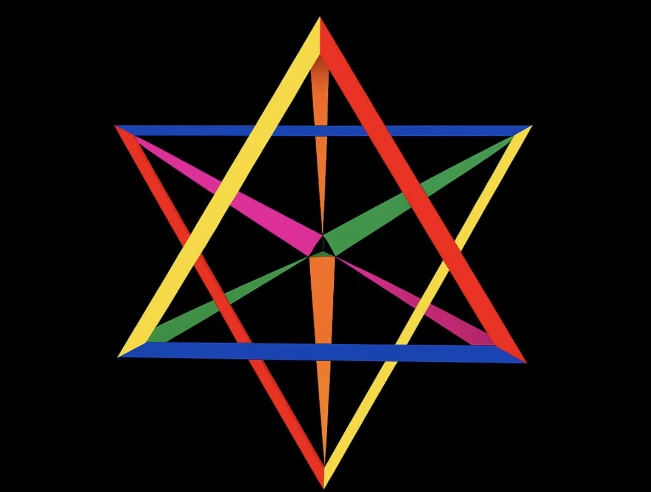
Oregon City, Oregon — I Ching, Multiple Dimensions, and Hyper-Spherical Geometry is extending an open invitation to mathematicians, scientists, educators, and independent researchers worldwide to engage with a bold new geometric framework that challenges traditional models of space, dimension, and symmetry.
Built on decades of independent research, the Geometric Unity framework proposes a unified mathematical system based on hyper-spherical geometry, Platonic solids, and dual tetrahedral structures. By addressing long-standing issues such as handedness, observer orientation, and dimensional symmetry, the model offers fertile ground for academic exploration and critical discussion.
Unlike many theoretical constructs that remain confined to abstraction, the Geometric Unity approach emphasizes structural clarity and geometric visualization. Its integration of group theory, matrix duality, and observer-based orientation presents opportunities for meaningful inquiry across multiple disciplines, including mathematics, physics, philosophy, and systems theory.
The manuscript featured on the I Ching, Multiple Dimensions, and Hyper-Spherical Geometry platform serves as both a conceptual foundation and an academic provocation. It revisits unresolved mathematical questions, explores alternative geometric interpretations, and proposes novel ways of understanding multidimensional space. While the framework challenges conventional assumptions, it does so with intellectual transparency, inviting critique, refinement, and further development.
I Ching, Multiple Dimensions, and Hyper-Spherical Geometry does not position itself as a closed system, but as an evolving body of work. Scholars and researchers are encouraged to study the material, test its assumptions, and participate in constructive dialogue that advances collective understanding.
At a time when interdisciplinary collaboration is essential to scientific progress, I Ching, Multiple Dimensions, and Hyper-Spherical Geometry offers a rare opportunity to reexamine foundational principles through a fresh geometric lens, one that seeks unity rather than fragmentation.
Researchers and academics can explore the work at: https://geometricunity.solutions/