
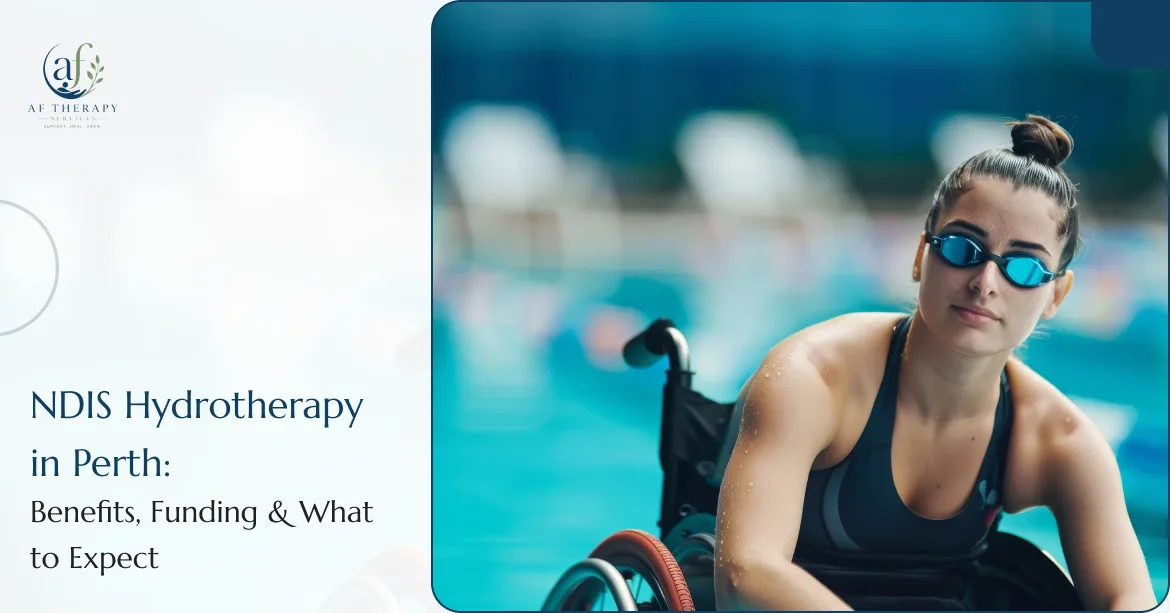
Choose hydrotherapy if pain, joint damage, or fall risk is capping how much land-based exercise you can tolerate, or if you're managing a progressive condition like MS or Parkinson's where buoyancy-supported movement extends what's physically possible. Choose land-based physio if you're building functional strength for real-world tasks — walking on uneven ground, climbing stairs, transferring in and out of a car — since gravity-loaded practice transfers more directly to daily life.
Most participants don't actually need to choose. But if your plan review is forcing a decision about where funding goes, or you're trying to work out which one to prioritize first, here's the honest comparison.
The Core Difference, Stripped of Marketing Language
Land-based physio trains your body against real-world gravity, on real-world surfaces, with real-world friction. That's its whole value proposition — it prepares you for the actual conditions you'll face outside the clinic.
Hydrotherapy removes about 90% of your body weight-bearing load at chest depth. That's not a gentler version of the same thing. It's a different physics environment that lets you do movement your body literally cannot manage on land yet.
Neither is "better" in the abstract. They solve different problems.
Where Land-Based Physio Wins
Functional carryover. If your goal is climbing your own front steps or getting off a low couch without help, practicing that movement on land beats practicing it in water. Water doesn't teach your nervous system how to manage gravity — it teaches it to move without gravity, which is a different skill.
Balance and proprioception under real conditions. Standing on one leg in a pool is not the same challenge as standing on one leg on your kitchen floor. If falls prevention is the priority, land-based work eventually has to happen.
Access and cost. Not every provider has a heated, accessible pool. Land-based physio is available almost everywhere, funded the same way, and doesn't require travel to a specific facility.
Where Hydrotherapy Wins
Pain-limited participants who've plateaued on land. This is the group we see most often at our Balcatta clinic. Someone's been doing land-based physio for months, progress has stalled because pain caps how much work they can tolerate per session, and hydrotherapy reopens the door. We had a participant managing multiple sclerosis who'd all but stopped attending physio — ten minutes of standing exercise and the pain took over. Three hydrotherapy sessions in, she was doing thirty minutes of active resistance work. Nothing about the MS changed. The environment did.
High fall-risk participants building confidence. Water is a low-consequence environment to fail in. If you stumble in a pool, you don't hit the ground. That matters enormously for older participants or anyone managing balance conditions who've developed real fear around movement after a fall.
Post-surgical joint recovery, early stage. Right after joint surgery, land-based load can be counterproductive. Hydrotherapy lets rehabilitation start earlier than land-based work would allow, which often shortens the overall recovery timeline.
The Comparison Nobody States Plainly Enough
FactorHydrotherapyLand-Based PhysioJoint loadMinimal (buoyancy-supported)Full weight-bearingBest forPain-limited, high fall-risk, early post-surgicalFunctional/real-world strengthSession tolerance for pain conditionsOften higherOften lowerReal-world carryoverIndirectDirectFacility requirementHeated, accessible poolStandard clinic spaceTypical NDIS funding categoryImproved Daily Living / Capacity Building — Health & WellbeingSame categories, more universally availableWhat Actually Happens for Most Participants: Both, Sequenced
Here's what I'd push back on if a participant told me they were choosing one exclusively: for a lot of conditions, the smartest plan uses hydrotherapy to unlock capacity, then land-based physio to convert that capacity into functional, real-world strength.
A participant recovering from hip surgery might spend the first three weeks almost entirely in the pool, building range of motion and light strength without loading the joint before it's ready. Then land-based sessions take over as the joint tolerates more, focusing on the actual movements — stairs, uneven ground, getting up from a chair — that hydrotherapy alone won't fully train.
This is exactly why NDIS hydrotherapy in Perth increasingly shows up on plans alongside physiotherapy, not instead of it. Support coordinators who understand this sequencing tend to write both into a plan from the start rather than treating it as an either/or funding decision.
What Determines Your Actual Answer
Your condition type. Progressive neurological conditions (MS, Parkinson's, motor neurone disease) tend to benefit from ongoing hydrotherapy long-term, not just as a bridge. Acute injuries tend to use hydrotherapy short-term before transitioning fully to land-based work.
Your pain tolerance right now. If pain is the binding constraint on your progress, hydrotherapy addresses that constraint directly. If pain isn't the issue and you're simply building strength, land-based physio is usually the more efficient use of session time.
Your funding structure. Some participants have separate line items for both; others need to prioritize one within a tighter allied health budget. This is worth raising with your support coordinator before your next plan review, not after you've already committed funding elsewhere.
Facility access. If the nearest heated, wheelchair-accessible pool is a long drive away, that travel burden is a real factor, not a minor inconvenience — particularly for participants who tire easily.
What We'd Actually Recommend
If you're asking us directly: don't treat this as permanent either/or. Start with whichever addresses your current limiting factor — pain and fall risk point toward hydrotherapy first, functional goals point toward land-based physio first — then reassess every few months as capacity changes.
At AF Therapy Services, we run both under one roof in Balcatta, alongside Occupational Therapy, Speech Therapy, Dietetics, Exercise Physiology, Allied Health Assistant support, and Group Therapy. That matters practically: when a physio and hydrotherapy therapist share clinical notes on the same participant, the sequencing decision gets made collaboratively instead of you having to coordinate two providers who've never spoken.
Bottom Line
Neither hydrotherapy nor land-based physio is the universally right answer — the right answer depends on what's actually limiting your progress right now. If you're unsure which fits your NDIS goals, that's a conversation worth having before you lock in a plan, not after.
Call AF Therapy Services in Balcatta on (08) 6184 6736 to talk through your specific goals and funding, and we'll help you work out the right starting point — and whether you need one service or both.