In the world of advanced manufacturing, Metal Injection Molding (MIM) stands out as a revolutionary process that combines the versatility of plastic injection molding with the strength and durability of metals. If you're browsing categories like MIM parts on Mike's Shopping Room, you're tapping into a treasure trove of high-precision components designed for demanding applications. delves deep into MIM parts—what they are, how they're made, their advantages, key applications, and why they're a game-changer for industries from automotive to medical devices. Whether you're an engineer sourcing parts or a hobbyist exploring custom solutions, understanding MIM can elevate your projects.
What Are MIM Parts?
MIM, or Metal Injection Molding, is a net-shape manufacturing technology that produces complex, high-volume metal components with intricate geometries. Unlike traditional machining or casting, MIM starts with fine metal powders (typically 1-20 microns in size) mixed with a binder to form a feedstock. This mixture is injected into a mold under high pressure, mimicking plastic injection molding.
Once molded, the "green" part undergoes debinding (removing the binder) and sintering (high-temperature fusing of metal particles). The result? Parts with densities up to 99% of wrought metal equivalents, tolerances as tight as ±0.3%, and surfaces smooth enough for minimal post-processing. Common materials include stainless steels (316L, 17-4PH), tool steels, superalloys like Inconel, and even ceramics or carbides.
Sites like Mike's Shopping Room showcase MIM parts ranging from tiny gears and hinges to robust structural components. These aren't off-the-shelf widgets; they're engineered for performance, often customized to client specs. For instance, a MIM part might feature internal threads, undercuts, China Metal Injection Molding Parts or thin walls (as slim as 0.5mm) that would be cost-prohibitive via CNC machining.
The MIM Process: Step-by-Step Breakdown
To appreciate MIM parts, let's walk through the production pipeline:
Feedstock Preparation: Metal powders are blended with polymers (wax, thermoplastic) and additives. The powder loading is critical—around 60-70% by volume—to ensure sinterability.
Injection Molding: Heated feedstock (180-200°C) is injected into precision molds at 100-150 MPa. Cycle times mirror plastics: 10-60 seconds per part, enabling millions of units annually.
Debinding: Binders are extracted via solvent, thermal, or catalytic methods. This yields a fragile "brown" part.
Sintering: Parts are heated to 70-80% of the metal's melting point (e.g., 1350°C for stainless steel) in a controlled atmosphere. Shrinkage of 15-25% is predictable and accounted for in mold design.
Secondary Operations: Optional heat treatment, plating, or machining for ultra-precision.
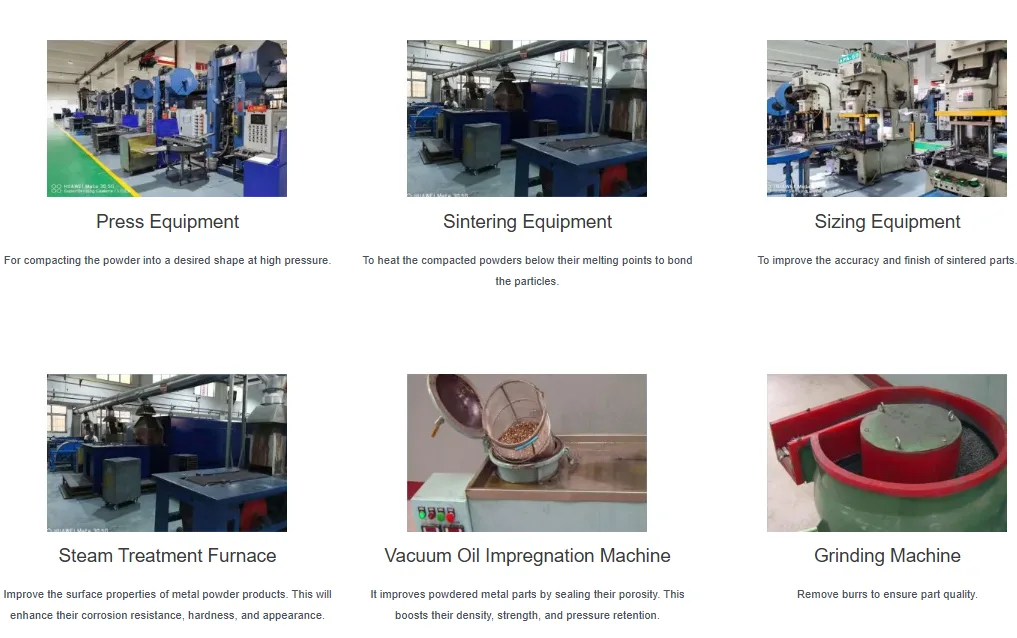
This process shines for high-volume runs (10,000+ parts), slashing costs by 30-50% compared to machining. powdered metal gears Quality control is rigorous—parts undergo dimensional inspection, metallurgical analysis, and non-destructive testing. ISO-certified MIM producers, like those supplying Mike's Shopping Room, ensure traceability and compliance with standards like ASTM F2791.
Advantages of MIM Parts Over Traditional Methods
Why choose MIM? Here's a data-driven comparison:
Design Freedom: Undercuts, splines, and micro-features without assembly.
Material Efficiency: Near-zero waste, eco-friendly.
Performance: Isotropic properties (uniform strength in all directions) rival forged parts.
Scalability: Ideal for consumer electronics (e.g., phone hinges) to aerospace brackets.
Drawbacks? Upfront tooling costs ($5,000-$50,000 per mold) suit medium-to-high volumes. Size limits (typically <250g, 100x100x50mm) mean it's not for massive components.
Key Applications of MIM Parts
MIM parts power innovation across sectors. Here's a spotlight:
Automotive and Aerospace
Precision gears, shifter mechanisms, and turbocharger impellers demand MIM's strength-to-weight ratio. In EVs, MIM connectors handle high currents without corrosion. Aerospace uses MIM for fuel nozzles and sensor housings, where titanium or superalloys withstand extremes.
Medical and Orthopedic
Biocompatible 316L MIM parts form surgical tools, implants, and dental prosthetics. Their porosity can be engineered for bone ingrowth. FDA-approved MIM reduces infections via smooth finishes (Ra <0.8μm).
Consumer Electronics and Firearms
Phone camera modules, laptop hinges, and firearm triggers (e.g., SIG Sauer's MIM safeties) leverage MIM for durability and miniaturization. A single smartphone might use 20+ MIM components.
Defense and Industrial
MIM armors penetrators, robotic grippers, and pump valves. Custom MIM parts from suppliers like Mike's Shopping Room cater to niche needs, such as wear-resistant bushings in heavy machinery.
Emerging trends? 5G antennas, wearables, and hypersonic vehicles push MIM into new alloys like MIM-17-4PH for 1,200 MPa tensile strength.
Material Spotlight: Top MIM Alloys
Stainless Steel 316L/17-4PH: Corrosion-resistant, magnetic/precipitation-hardenable.
Low-Alloy Steels (Fe-2Ni): Cost-effective for structural parts.
Tool Steels (M2, D2): Hardness up to HRC 60 for cutting tools.
Titanium (Ti-6Al-4V): Lightweight for implants/aerospace.
Properties post-sintering match wrought materials, verified by tensile tests (e.g., 316L: 500 MPa yield strength).
Sourcing MIM Parts: Tips from Mike's Shopping Room
Platforms like Mike's Shopping Room MIM category simplify procurement. Look for:
Customization: Upload CAD files for quotes.
Certifications: AS9100 for aerospace, ISO 13485 for medical.
Lead Times: 4-12 weeks for prototypes, 8-16 for production.
MOQs: Often 1,000+ for economics.
Pricing? A 5g stainless steel gear might cost $0.50 in volume. Bulk discounts and global shipping make it accessible.
Conclusion:
MIM parts represent the pinnacle of precision manufacturing—affordable, complex, and reliable. From the rugged MIM components in your next firearm to the life-saving implants in hospitals, this technology quietly powers progress. Dive into Mike's Shopping Room MIM parts to source yours, and elevate your designs. With MIM, complexity isn't a barrier; it's an opportunity.