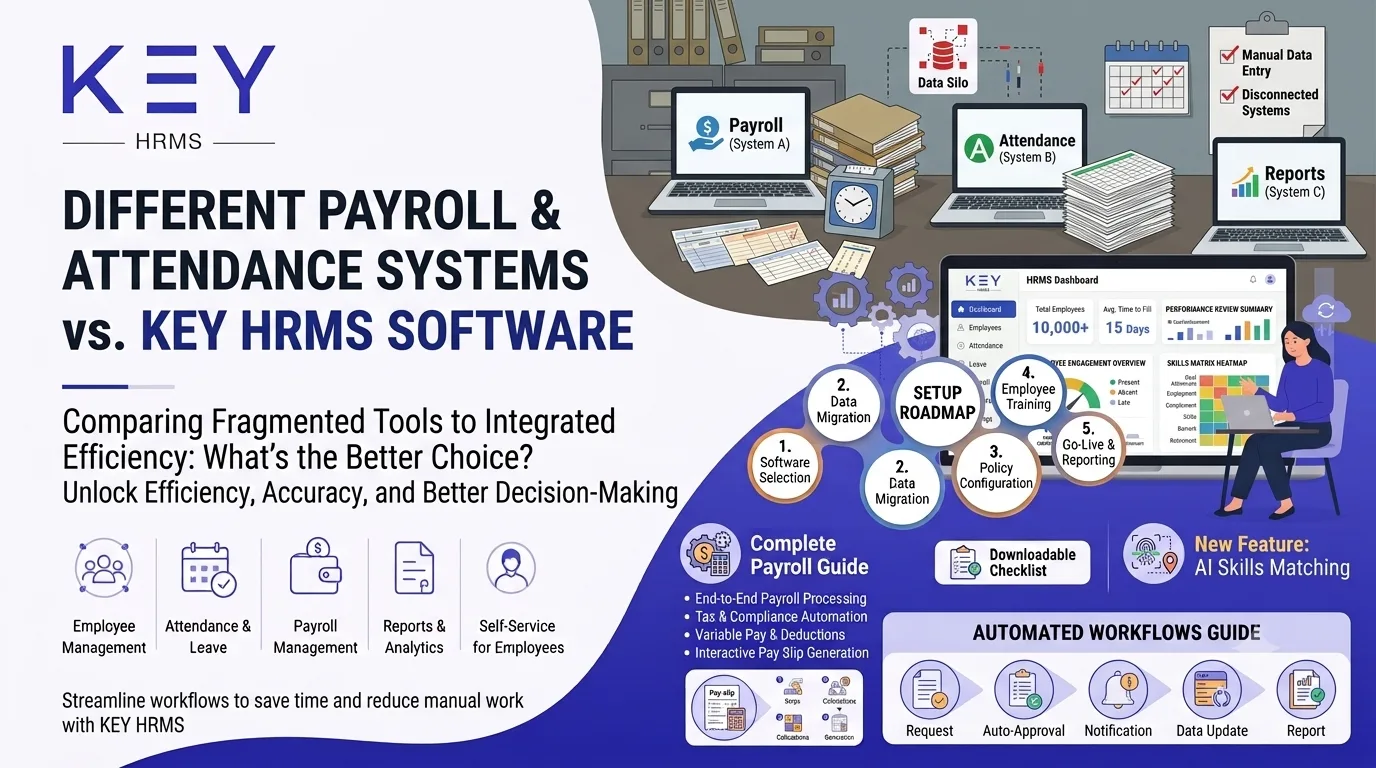
An essential component of operating a modern firm is effectively managing personnel information. HR departments frequently use various software programs for functions like payroll, attendance, leave, and personnel data as businesses expand. While utilizing distinct systems can address specific issues, it can also result in more labor when HR must transfer data across various platforms.
An integrated HRMS software solution might provide a more straightforward answer in this situation. Businesses can combine several HR procedures into a single, centralized platform rather than handling payroll and attendance through separate systems.
Different Payroll and Attendance Systems: What Are They?
Systems for separate payroll and attendance are solutions made to handle particular HR tasks on their own. While payroll software manages salary computations, payslips, deductions, and payroll reports, an attendance system might concentrate on employee check-ins, working hours, shifts, overtime, and attendance records.
How Different Systems Typically Operate
Before salaries are processed when separate systems are used, employee attendance data may need to be synchronized or shared with the payroll system.
An HR specialist might, for instance, examine attendance data in one program before using it in another payroll system. Spreadsheets, exports, imports, or human data entry may be used if the systems do not automatically communicate.
Even though each of these technologies can be helpful on its own, managing them all at once could become difficult as the company expands.
Difficulties in Using Different Payroll and Attendance Software
It's not always a terrible idea to use specialized systems. Businesses should, however, take into account the extra coordination needed when crucial employee data is dispersed across several platforms.
Duplicate Input of Data
HR departments may need to repeatedly enter or transfer the same personnel data while systems are disconnected. It costs time and raises the risk of data entry errors when these tasks are repeated.
Having Trouble Linking Payroll and Attendance
Payroll computations may be impacted by attendance data, especially when companies handle leave, overtime, working days, or attendance-based pay changes.
HR specialists may need to confirm and transmit data before finishing payroll processing if attendance and payroll are managed independently.
Several Systems to Oversee
HR teams must keep in mind various logins, procedures, dashboards, and reporting when using several systems. This may eventually complicate day-to-day HR management.
HRMS Software: What Is It?
The purpose of an HRMS (Human Resource Management System) is to integrate many HR tasks onto a single, consolidated platform. Organizations can handle employee-related tasks using a networked system rather than utilizing distinct technologies for each task.
A single, centralized database for employees
Employee data can be kept in one location using an HRMS. Without continuously switching between different programs, HR staff may manage employee records and use pertinent information across various HR procedures.
Interconnected HR Procedures
Employee management, attendance, leave, payroll, onboarding, and employee self-service are all connected by an integrated HRMS.
Because data used in one HR function can support another, this results in a better ordered workflow.
Payroll and Attendance: Independent vs. Combined
The degree of integration is the primary distinction between HRMS software and independent systems.
Using Different Systems
HR might have to:
Monitor attendance using a single app.
Examine the leaf details independently.
Provide pertinent information to payroll.
Check employee information.
Pay employees using a different system.
Keep track of reports on several platforms.
This strategy might be effective, but it might need more cooperation.
Using an Integrated HRMS
These tasks are brought closer together by an HRMS. Payroll processing can be aided by attendance and leave data, and employee records are still accessible on the same platform.
HR personnel may find it easier to keep consistent employee information as a result of less repeated work.
Principal Advantages of HRMS Use
HR Teams Save Time
HR specialists might spend less time moving data between systems when standard procedures are linked. As a result, they have more time to concentrate on strategic duties and staff assistance.
Enhances the Consistency of Data
Inconsistencies between various records can be minimized by keeping employee data in a single system. For routine employee management, HR departments share a common source of information.
Makes Employee Self-Service Easier
Additionally, self-service functions can be made available to employees through an integrated HRMS. Without depending on HR for every routine request, employees might be able to view pertinent data, submit leave requests, verify attendance, or access paystubs.
How an Integrated Approach Is Provided by KEY HRMS
Through a consolidated platform, KEY HRMS unifies crucial HR procedures. In a single, integrated platform, businesses can handle employee data, attendance, leave, payroll, onboarding, performance, and employee self-service.
An Integrated HR Process
An integrated HRMS enables companies to handle payroll and attendance as related components of the employee lifecycle rather than as entirely distinct tasks.
This can facilitate the management of routine HR administration, especially for expanding companies that require a scalable approach to handle growing personnel data and procedures.
Which Strategy Is Best for Your Company?
The organization's size, needs, current systems, and budget all influence the best decision. Businesses with straightforward needs or well-established systems that already connect well may find success with separate payroll and attendance solutions.
However, an integrated HRMS might be advantageous for companies trying to streamline HR activities. Multiple HR features on a single platform can simplify the system and offer a more uniform approach to personnel management.
In conclusion
Individual HR duties can be efficiently handled by separate payroll and attendance systems, but coordinating data across several platforms may result in extra administrative effort. By combining personnel management, attendance, leave, payroll, and other HR operations, HRMS software provides a more integrated approach.
An integrated platform like KEY HRMS can offer a useful approach to handle daily personnel operations from one location for companies trying to cut down on manual processes and establish a more structured HR environment.