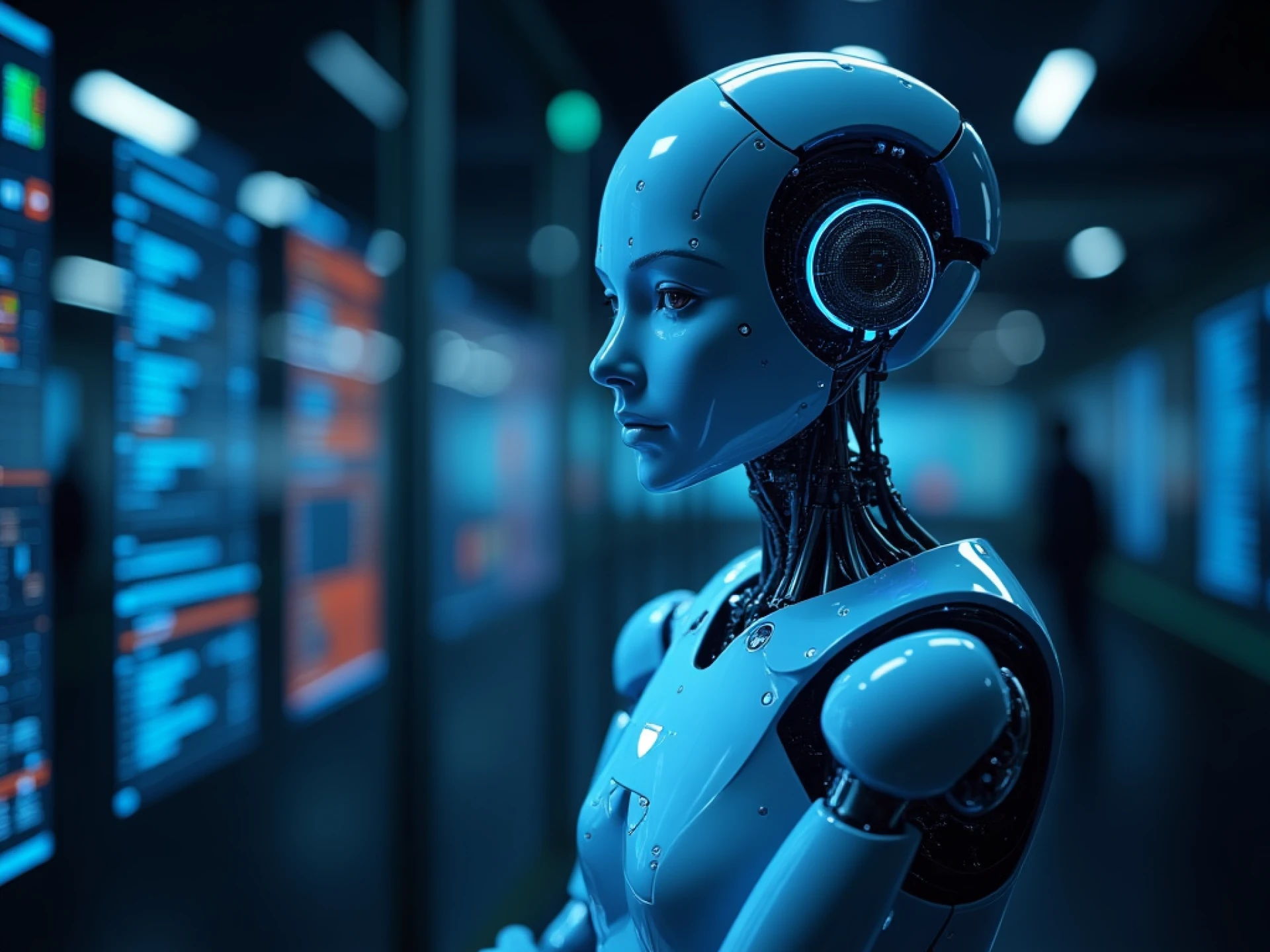
Rapidly changing the talent management of businesses, in the pass of time till about 2025, Human Resource Management System (HRMS) is expected to shift from being payroll and employee record keeping tools to much more. This has included the inclusion of Artificial Intelligence in transforming how organizations actually recruit, manage, or develop their human resource pool. This synergy between HRMS and AI is not just upgrading technology, as it was previously but complete overhaul in how businesses approach talent management.
In this blog, read about how talent management is being redefined from recruitment through employee development to retention through HRMS systems by AI.
How is AI Transforming Recruitment and Talent Acquisition?
Out of all the aspects undertaken in talent management, recruitment is arguably the most important, for AI comes as a major booster. Traditional recruitment processes are often long and sometimes viewed subjectively, resulting in lost opportunities or biased hiring decisions. Through AI-based HRMS, one major advantage that organizations would gain is the possibility of automating recruitment processes by means of screening candidates, resume parsing, and predictive hiring.
AI algorithms are capable of processing thousands of resumes in minutes to find the best candidates using specific criteria based on preset experience and skills. Thus, humans may be less biased, while selections made are more objective. Furthermore, AI tools can analyze extensive data in order to predict those candidates most likely to achieve success in a given role, thus producing insights beyond those garnered from the traditional interview.
By 2025, AI-driven HRMS will assist not only in resume screen-out but also in candidate matching, cultural fit analysis, and external recommendations for promotion for internal movement based on skills and career trajectory. This not only saves time but also guarantees a better hiring decision.
Can AI in HRMS Improve Employee Onboarding?
Onboarding is a phase in the career of an employee during which the employee needs training most on the job. Onboarding can really help in improving engagement within a company, increase productivity, and better retention. AI can take away the hassle of a few important onboarding jobs through integration of AI technology in HR and ensure that new hires will create harmony with the company.
HRMS AI can also create personalized onboarding experiences by assessing an individual new employee's skills, prior experiences, and career prospects. For example, AI can recommend training modules or match new hires with mentors according to their specific roles and learning styles. AI chatbots can, in addition, answer questions in real-time, thus providing instant support and resources for much better experiences of the new hire.
With AI, organizations can ensure that every employee, regardless of city, will have a uniform experience while being onboarded. By the year 2025, the use of AI for onboarding will be all over talent management, where it will take the time required for producing an optimum candidate performance for any new employee.
How is AI Enhancing Employee Development and Training?
Employee development and a culture of continuous learning are really essential when striving to stay ahead of competitors. The application of AI-powered HRMS will greatly improve the L&D environment by creating personalized learning journeys for the employees.
Through AI pathways, the HRMS is capable of assessing employee skills and recommending courses, certifications, or training relevant to their career interests and previous learning experiences. Such personalized learning helps employees work and develop concurrently with their own growth and the strategic goals of the organization. The training path also dynamically adjusts for employee needs and organizational needs, leveraging AI to support inputs from performance reviews, employee feedback, and skill assessments.
AI applications are also able to forecast potential skills gap among organizations and help organizations prepare for upskilling opportunities. For example, if AI finds any skill becoming very crucial for business success, then the HRMS can recommend developing training programs to prepare the employees for future challenges.
From 2025, AI applications will have established the basics for the personalization of learning experiences that retain and engage employees while fast-tracking their careers and thus helping businesses evolve with changes in the industrial sector.
Can AI in HRMS Improve Employee Engagement and Retention?
HR teams are primarily concerned with employee engagement and retention, and how AI intervenes in realizing those goals is revolutionary. Traditional employee engagement surveys, to say the least, have been valuable yet are often few and far between when organizations require real-time insights to stay ahead.
Through sentiment analysis, an AI-driven HRMS is continuously assessing employee satisfaction by gauging employee feedback, social media interactions, and communication patterns. The AI would detect early signs of disengagement via communication suddenly dropping or performance declining, and HR teams can take preventative measures before losing a valued employee.
On a different level, AI can offer managers insights into the wants and career aspirations of individual employees so as to tailor engagement strategies. For instance, AI could suggest different reward or recognition types a given employee would find most meaningful to ensure they feel treasured and appreciated.
Retention strategies can become proactive and data-driven because of its AI analysis of patterns and trends to foretell which employees may be leaving, with relevant customized interventions suggested like career development opportunities or internal mobility options.
How Will AI and HRMS Impact Workforce Planning?
Workforce planning is an integral part of talent management. It is the new territory that artificial intelligence will be entering in terms of data processing. AI-embedded HRMS will predict needs for talent in future years owing to intervals of trending, booming businesses, and skills shortages.
Organizations may project future staffing requirements more accurately through the use of historical data. If an organization plans to go into another market or introduce a new line of business, AI can help identify the necessary new skills associated with talent and support HR efforts in future hiring planning. AI also has the ability to detect possible shortfalls in the current workforce, meaning businesses are almost ready for changes in demand.
From an organization that had revolutionized workforce planning in 2025, it would have shifted to strategic talent management through an AI-powered human resource management system in cloud computing, as companies will be agile and more responsive to shifts in the marketplace.
How Will AI in HRMS Enhance Diversity and Inclusion?
One of the key areas is how artificial intelligence transforms diversity and inclusion policies and practices as culture within organizations. It is well-known that the traditional forms of hiring are not free of bias, which ranged from gender bias, ethnic bias, or to educational bias. For instance, the combination of AI with HRMS enables the organization to eliminate bias in hiring and decisions of talent management with the help of data-driven ways.
The importance of gender neutrality in job descriptions, state-of-the-art analysis in resume reviews, and equal consideration for candidates from different backgrounds ensured by an AI algorithm can help government agencies eliminate any subjective decision-making process. So, diversity and inclusive workforce-building activities allow the organization to formulate an environment known for innovation and productivity.
Also, AI could operate within HRMS and govern and report lots of D&I metrics as insight into HR teams for better-targeted initiatives.
Conclusion: What’s Next for HRMS and AI in Talent Management?
Talent management will, by the year 2025, be undergoing a structural change brought about by the interrelationship between AI and an HRMS. AI is transforming the recruitment space while bringing enhanced employee development, engagement, and retention, thus allowing HR teams to take a more strategic, data-driven view on talent management.
As AI technology further evolves, expect to see more advanced features in HRMS, such as real-time sentiment analysis, predictive workforce planning, or automated career pathing. Organizations embracing such innovations will gain an upper hand in attracting, developing, and retaining top talents in an ever-competitive market.
The AI-driven HRMS holds the future of talent management, and organizations using these tools will not only improve on their HR governance but will also turn towards an engaged, skilled, and diverse workforce. The incorporation of AI will empower HR teams to take data-driven decisions, improve employee satisfaction, and, thus, contribute directly to the success of the enterprise.