Enhancing AI Search with Vector Databases
AI technology has advanced quite a bit in recent years. We now have
- Chatbots that can provide answers to our queries
- Recommendation systems that can learn our preferences
- Search engine algorithms that can find exactly what we need.
Despite all these AI capabilities, developers still face certain challenges while using it. Traditional databases can handle big data, but they can not understand the user's query.
The vector database for AI apps can help AI software perform searches by accurately understanding the user’s intent.
Overview of Vector Database
The idea behind a vector database is quite simple. Think about how we search online.
A person might look for: “best places to visit in summer.”
Another one might search “Top vacation destinations for warm weather.”
Their search prompts are different, but both are looking for the same information. A traditional database considers them different because the words do not match.
A vector database can look beyond the words. It focuses on the meaning behind the queries.
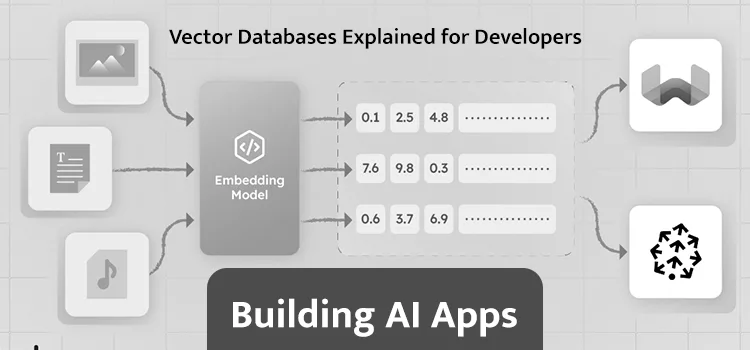
It has become possible with AI models that represent information in numerical representation. This representation is called a vector. These vectors allow the system to understand how this information relates to each other.
Vector databases store them and help AI-based applications find relevant information as per the search request. Simply, it allows AI systems to answer the question, “Which information is closest to the query?”
This ability has made vector databases important in modern AI development.
Now, let’s see why traditional databases often struggle with AI workloads.
Why Traditional Databases Are Not Enough For AI Applications
Traditional databases are excellent for structured data. They work well when the user is searching for customer IDs, product codes, order numbers, transaction records, and more.
For example, if you are searching for customer number 1026, a traditional database can find it instantly. But AI applications usually need different outputs. They are required to understand the user’s intent.
If a user asks, “How can I save money on electricity bills?”
The same question another user asks, but with different wordings, “ways to reduce power costs at home.”
A traditional database can perceive this prompt as different because of the different words. The vector databases are created as a solution. Instead of prioritizing the keywords, it focuses on the context.
That is why many businesses working with an AI software development company are using vector databases as part of their AI infrastructure.
This feature is becoming more valuable with the growing advanced AI technologies.
How Vector Databases Work
The process is easier to understand when broken into simple steps.
Step 1: Data Conversion
As a first step, information is transformed into vectors. It includes
- Documents
- Product Descriptions
- Images
- Customer support articles
- Audio files
An AI model analyzes the data and converts it into numerical values that represent its meaning. These numerical values are called embeddings.
Step 2: Vector Storage
Once the embeddings are created, they get stored inside the vector database. The databases store useful information, such as:
- Document names
- Categories
- Product IDs
- Source information
It helps organize the data.
Step 3: Query Processing
When a user asks a question, the AI model converts the query into a vector.
Step 4: Similarity Search
Then, the vector database compares the user’s vector with the stored vectors. It searched for the information that is closest to the meaning.
Step 5: Result Delivery
The vector database sends the most relevant results back to the application. It helps users receive the answers that match the intent rather than just exact keywords. The entire process happens in a very short time.
This is what makes modern AI applications more advanced and responsive.
Popular Use Cases for Vector Databases
Vector databases are used in many applications that people interact with in their daily lives.
AI Chatbots
Modern chatbots need access to a large amount of information. A vector database helps these chatbots find the most relevant information while generating a response.
It helps AI chatbots generate the most answers.
Recommendation Engines
Think about how an OTT platform recommends movies or an online store suggests relevant products. The vector database identifies products that match the user’s interests.
These curated results provide a user with a more personalized experience.
Semantic Search
Users do not always write exact keywords for the search. They simply write naturally. Vector databases help applications understand those questions and send relevant results.
Retrieval-Augmented Generation (RAG)
RAG systems combine large language models with external knowledge sources. A vector database for AI apps is often the foundation of RAG architecture because it enables rapid information retrieval before generating responses.
Image and Media Search
With modern apps, users can search using images rather than text. Vector databases enable similarity-based image retrieval.
These use cases represent the growing importance of vector databases in AI development.
Let’s discuss the major benefits a vector database delivers to the developers.
Benefits of Using Vector Databases
Developers choose vector databases for AI apps for several reasons.
Faster Similarity Search
Manually searching through millions of vectors is extremely time-consuming. Vector databases use optimized indexing techniques for rapid searches.
Better Context Understanding
The database focuses on the core meaning rather than exact words.
It improved search accuracy.
Scalability
AI applications often process large amounts of data. Vector databases are designed to handle massive datasets efficiently.
Improved User Experience
It helps the users receive more relevant results. It leads to better engagement and satisfaction.
AI System Compatibility
Most vector databases are compatible with mainstream AI platforms and machine learning processes.
In many cases, companies collaborate with an AI development company when deploying vector databases effectively.
From the developer’s perspective, it implies developing smarter applications.
Choosing the Right Vector Database
All vector databases are different. Developers should evaluate the following factors before making a decision.
Performance
Search speed is critical for user-facing applications.
Scalability
Growth must not affect the database performance.
Integration Methods
It is the ability to integrate with various cloud computing services and AI technologies.
Security
Security measures are essential for enterprise-level applications.
Cost
Present-day needs as well as scaling costs must be considered.
To implement such an application professionally, organizations usually prefer specialized AI development services.
Such a choice can have great consequences for application performance.
The Future of Vector Databases
AI applications are becoming smarter every year. Users now expect the system to understand natural language and provide accurate answers. Also, they expect systems to deliver personalized experiences.
Traditional databases are not capable of delivering these results at speed. Vector databases are helping bridge the gap between raw data and smart AI experiences.
As generative AI, semantic search, and recommendation systems continue to evolve, vector databases are becoming a standard part of AI development.
Conclusion
An AI application requires more than just data storage. They need a way to understand meaning, context, and the correlation between different types of information. This is exactly what a vector database for AI apps is offering.
In AI platform development, the use of the vector database can help your application provide fast and relevant results. Through vector databases, the AI system can determine what users intend to communicate without being limited by keywords.
With the increase in the advancement of AI technology, it has become essential for any developer to understand vector databases. Investing in vector database technology can help an AI software development company create smarter, better, and more user-friendly AI applications.