Large Language Models (LLMs) can understand requests, generate content, and reason through complex problems. However, an LLM by itself cannot directly interact with most external systems.
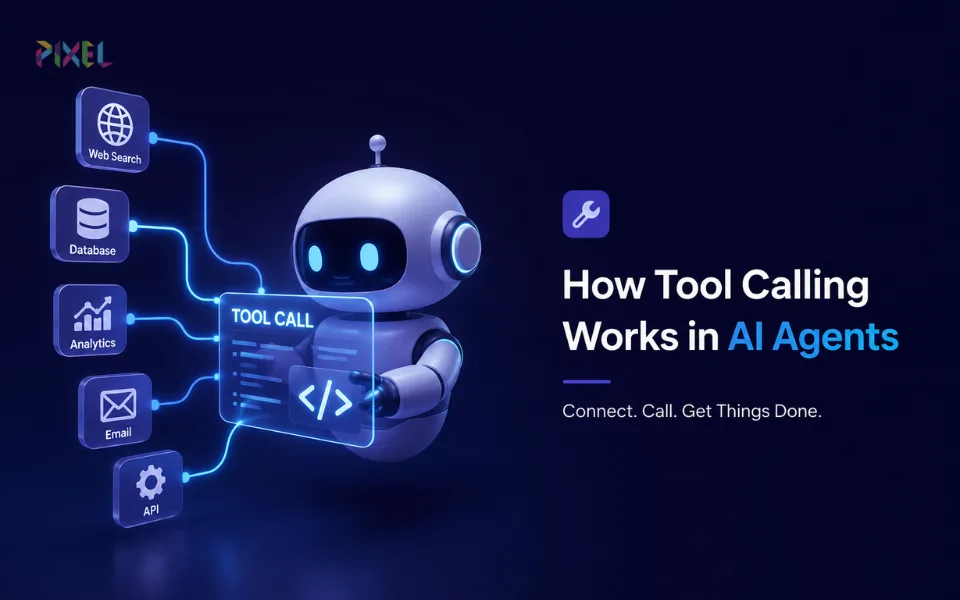
Tool calling provides the connection between an LLM and external capabilities such as APIs, databases, search systems, payment services, calendars, and internal business functions.
How Does Tool Calling Work?
The basic tool-calling process follows a structured workflow:
User Request → LLM → Tool Selection → Structured Tool Call → Validation → Tool Execution → Tool Result → Final Response
When a user asks for something that requires external information, the LLM will figure out what capability is required and pick an appropriate tool. It then builds a structured request with the tool name and required parameters.
The application validates these parameters before executing the tool. Once the external service returns a result, the information is passed back to the LLM, which uses it to generate the final response.
Key Components
A typical tool-calling architecture consists of several components:
- LLM: Understands the request and determines which capability is needed.
- Tool Definition: Describes the tool, its purpose, inputs, and expected data types.
- Tool Executor: Handles the actual API call, database query, or business operation.
- Agent Loop: Connects the reasoning and execution stages, allowing an agent to perform multiple tool calls when required.
Tool definitions are particularly important because they act as a contract between the LLM and the application. Clear descriptions and well-defined parameters help the model understand when and how a capability should be used.
A Simple Example
Consider an AI agent that needs to answer a user's question about current weather.
The LLM cannot rely on its stored knowledge for continuously changing information. Instead, it can select a weather tool, provide the required location and unit parameters, and allow the application to retrieve the latest data.
The returned information is then provided to the LLM, which converts the structured result into a natural-language answer.
You can use the same format for database lookups, product searches, calendar operations, CRM systems, financial applications, and other business workflows.
Why Tool Calling Matters
Tool calling allows AI agents to move beyond simply generating information. With the right tools and permissions, an agent can:
- Access real-time information
- Interact with APIs and databases
- Retrieve application-specific data
- Perform business operations
- Combine multiple tools for complex workflows
For example, an agent could search for information → analyze the result → query a database → perform an action → generate a response.
The Bigger Picture
Tool calling is a fundamental mechanism behind practical AI agents. It connects the reasoning capabilities of an LLM with the external systems required to perform real-world tasks.
But how does the model actually select a tool? What does a tool definition look like? Where does schema validation happen, and how does the agent handle multiple tool calls?
Read the complete technical guide on the below link: