When Sara first started learning algebra, she had a simple rule.
“If I remember the formula, I can solve the question.”
Her teacher soon noticed a problem.
Sara could remember many formulas. She could repeat the steps from memory. She could even finish simple exercises quickly.
But when the numbers changed, she became stuck.
One afternoon, her teacher wrote a simple problem on the board.
A rectangle had a length of 8 cm and a width of 5 cm. What was its area?
Sara quickly answered.
“40 square centimetres.”
Then the teacher changed the question.
“A rectangle has an area of 40 square centimetres. Its length is 8 cm. What is its width?”
Sara stopped.
She knew the area formula. She had memorised it many times. Yet she was unsure what to do.
This is where good maths teaching makes a difference.
Help Students Understand the Reason
A formula is useful. But students also need to understand why it works.
Instead of asking Sara to memorise:
Area = length × width
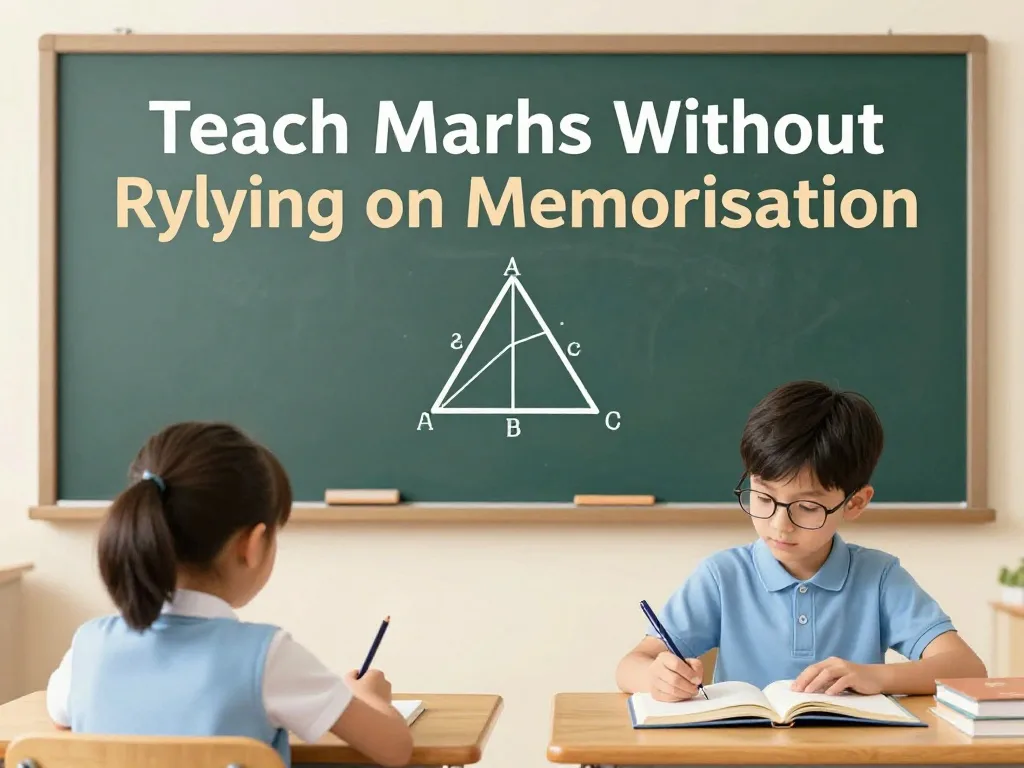
her teacher drew the rectangle on the board.
She divided it into small squares.
There were 8 rows and 5 columns.
Together, they counted the squares.
There were 40.
Sara could now see where the formula came from.
The formula was no longer just a line of symbols. It represented something she could understand.
Research on mathematics teaching supports this approach. Conceptual understanding helps students connect mathematical ideas and apply them in new situations.
Ask “Why?” More Often
A maths lesson can change when teachers ask better questions.
Instead of only asking:
“What is the answer?”
try asking:
“Why did you choose this method?”
“Could you solve it another way?”
“What would happen if we changed this number?”
“Can you explain your answer?”
These questions make students think about the process.
They also give teachers a chance to see where a student is struggling.
A student may get the correct answer for the wrong reason. Another student may make a small calculation error while showing excellent understanding.
Both situations need different support.
Use Real-Life Examples
Maths becomes easier to understand when students can see it outside the textbook.
Imagine teaching percentages.
A teacher could write several percentage questions on a worksheet.
Or they could give students a simple shopping problem.
A jacket costs AED 200. It has a 25% discount. How much will it cost?
Students can calculate the discount.
They can also discuss what 25% means.
Then the teacher can change the situation.
“What if the discount was 30%?”
“What if the original price was AED 350?”
This turns one calculation into a conversation about percentages.
Real-life examples also help students understand when a mathematical idea is useful.
Let Students Try Before Giving the Method
Sometimes teachers explain everything before students have a chance to think.
There is another option.
Give students a problem first.
Let them try.
They may make mistakes. That is fine.
The teacher can then discuss the different methods students used.
Research on problem-based learning has found that attempting problems before formal instruction can support deeper conceptual understanding and transfer to unfamiliar problems.
The aim is not to leave students confused.
The teacher still provides guidance.
The difference is that students have already started thinking about the problem.
They have something to connect the new method to.
Encourage More Than One Method
There is rarely only one useful way to think about a maths problem.
For example, a student may calculate 15 × 6 by using multiplication.
Another student may think:
10 × 6 = 60
5 × 6 = 30
60 + 30 = 90
Both methods reach the same answer.
Discussing both approaches helps students see the structure behind the numbers.
It also teaches them to choose methods instead of following steps automatically.
Use Diagrams and Visual Models
Some mathematical ideas are difficult to understand through words alone.
Diagrams can help.
Fractions can be shown with shaded shapes.
Algebra can be represented with boxes or number lines.
Geometry can be explored through drawings.
Graphs can turn a collection of numbers into something students can see.
Visual models are especially useful when introducing a new idea.
Once students understand the concept, symbols and formulas become easier to use.
Make Mistakes Part of the Lesson
Sara used to hide her mistakes.
She thought a wrong answer meant she was bad at maths.
Her teacher changed that attitude.
When Sara made an error, they looked at it together.
“Where did your thinking change direction?”
That question was very different from:
“You got this wrong.”
Over time, Sara became more willing to attempt difficult questions.
She started explaining her thinking.
She also started checking her answers.
This matters because problem solving requires students to reason, test ideas and sometimes change direction. Research on mathematics education places problem solving and reasoning at the centre of effective mathematical learning.
Practise Skills After Understanding
Avoiding memorisation does not mean avoiding practice.
Students still need fluency.
Basic number facts, formulas and procedures can become easier with regular practice. Recent research suggests that memorisation and thinking strategies should not always be treated as opposites. Both can have a place when used appropriately.
The key is timing.
First, help students understand the idea.
Then give them opportunities to use it.
With practice, the method becomes more familiar.
Students no longer need to think about every small step.
Give Students Time to Explain
One of the simplest teaching strategies is also one of the most useful.
Ask students to explain their answer.
They can speak.
They can write.
They can draw.
They can show their working.
When students explain an idea, they have to organise their thoughts.
Teachers also gain valuable information.
They can see whether a student understands the concept or has simply remembered a procedure.
For students who need additional support, personalised instruction can make this process easier. A maths tutor can slow down when a concept is difficult and move forward when the student is ready. Students looking for targeted support can explore online Maths Tutors in Dubai for personalised maths lessons.
From Remembering to Understanding
Sara eventually stopped asking, “Which formula do I need to remember?”
She began asking a different question.
“What is this problem really asking me to find?”
That small change made a big difference.
Good maths teaching is not about removing every formula or fact from the classroom.
It is about giving those facts meaning.
Students should know the rules.
But they should also understand when to use them, why they work and how they connect to other ideas.
When maths is taught through questions, examples, diagrams, discussion and problem solving, students can become more independent thinkers.
They are not simply remembering an answer.
They are learning how to find it.