Social Science can sometimes feel like a subject where students have to remember too many facts, terms, events, and explanations. But studying it effectively does not mean memorising every line of the textbook.
For Class 9 students, a better approach is to understand the topic first, connect it with examples, and then revise the important information. This becomes particularly useful with the new NCERT curriculum, which places emphasis on competencies, experiential learning, connections across subjects, and understanding rather than learning content in isolation.
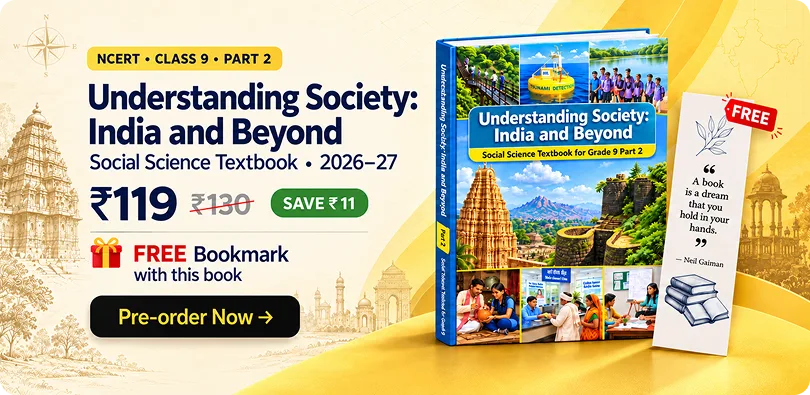
One of the books students can use as their core resource is Understanding Society: India and Beyond Part 2, the Social Science textbook for Grade 9.
Why Social Science Feels Difficult
The difficulty is often not the amount of content but the way students approach it.
A chapter may include historical developments, social institutions, geographical ideas, political concepts, or examples from everyday life. If everything is treated as a separate fact, revision becomes difficult.
Instead, try to understand the relationship between different ideas.
For example:
Concept → Explanation → Example → Impact
This simple pattern can make a long chapter much easier to remember.
Start With the Textbook, Not With Random Notes
When preparing from a Class 9 Social Science Textbook, students sometimes collect notes, videos, guides, and question banks before properly reading the main textbook.
That can create confusion.
Start with the textbook itself. Read the chapter once without worrying about memorising everything. Try to understand what the chapter is trying to explain.
After that, use additional resources only for topics that you find difficult.
The NCERT textbook portal provides access to textbook resources and chapter-wise material for different classes.
Read Social Science Like a Story
History and society-related topics become easier when you follow the sequence of events and ideas.
Instead of asking:
“What do I need to memorise from this page?”
ask:
“What is this section trying to explain?”
For example, if a topic discusses the development of an institution or society, think about:
- What existed before?
- What changed?
- Why did it change?
- Who was affected?
- What happened afterwards?
This turns a collection of facts into a logical sequence.
Make Geography More Visual
Geographical concepts are easier to remember when you visualise them.
Keep a map beside you while studying whenever the topic involves:
- places
- regions
- rivers
- mountains
- trade routes
- settlements
- environmental features
You can also create simple diagrams instead of writing lengthy notes.
A five-minute sketch may sometimes help you remember a concept better than a full page of written notes.
Understand Civics Through Everyday Examples
Political and civic concepts can initially appear abstract to Class 9 students.
One way to make them easier is to connect them with things you already understand.
When studying democracy, elections, institutions, or representation, think about questions such as:
- Who participates?
- How are representatives selected?
- Why are institutions necessary?
- What responsibilities do citizens have?
- How are decisions made?
The Grade 9 Part 2 syllabus includes areas related to democracy and elections, including electoral systems, constituencies, electoral rolls, and the Election Commission of India.
Understanding the purpose of these concepts is generally more useful than simply memorising their definitions.
How to Make Short Notes
Your notes do not need to reproduce the textbook.
For each chapter, try making a single-page revision sheet containing:
1. Main topic
Write the central idea of the chapter.
2. Important terms
List unfamiliar words with short meanings.
3. Key points
Write five to eight important ideas.
4. Examples
Add examples that help you understand the concept.
5. Questions
Write two or three questions that you should be able to answer after revision.
This makes your notes useful when examinations are approaching.
Use a Three-Round Revision Method
Instead of studying the same chapter repeatedly in exactly the same way, change your approach each time.
First Round: Understand
Read the chapter carefully and identify the main ideas.
Second Round: Recall
Close the book and explain the topic in your own words.
Third Round: Practise
Answer questions without looking at your notes.
If you cannot explain a particular concept during the second or third round, mark it for another quick review.
Don't Ignore the Questions You Get Wrong
Making mistakes is actually useful during revision.
Keep a small “things I need to revise” section in your notebook.
Whenever you:
- forget a definition,
- confuse two concepts,
- write an incomplete answer,
- misunderstand a timeline,
- make a map-related mistake,
write it down.
Before an examination, revise this list instead of rereading every chapter from the beginning.
Choosing the Right Class 9 Social Science Book
Students searching for a Class 9 Social Science Textbook part 2 should first make sure they are using the correct class, subject, part, publisher, and edition for their academic session.
The NCERT Class 9 Social Science textbook can serve as the main textbook around which students organise their reading and revision.
For students specifically searching online for an ncert Class 9 Social Science text book, checking the exact title and Part 2 designation before ordering is a simple step that can prevent confusion.
A Simple Weekly Study Routine
You do not need to spend several hours every day on Social Science.
A simple weekly routine could look like this:
Monday: Read a new section
Tuesday: Continue reading and mark important ideas
Wednesday: Make short notes
Thursday: Revise without looking at the book
Friday: Practise questions
Saturday: Review difficult concepts
Sunday: Quick revision of the week's topics
The exact schedule can be adjusted according to your school timetable.
Keep Your Study Material Simple
More books do not automatically mean better preparation.
For most school-level preparation, it is better to have:
- one main textbook,
- clear personal notes,
- regular question practice,
- a revision notebook,
- and selected additional resources when required.
Students can also explore other school and NCERT-related resources through the B3Books website.
Final Thoughts
The best way to approach Class 9 Social Science is to move away from the idea that every chapter has to be memorised word for word.
Read to understand.
Write to organise your thoughts.
Practise to test your understanding.
Revise to strengthen your memory.
Whether you are working through history, geography, society, democracy, or other Social Science concepts, the same basic strategy can help: understand the idea first, then remember the details.
That approach can make Social Science more manageable throughout the academic year—and much less stressful when examinations arrive.