
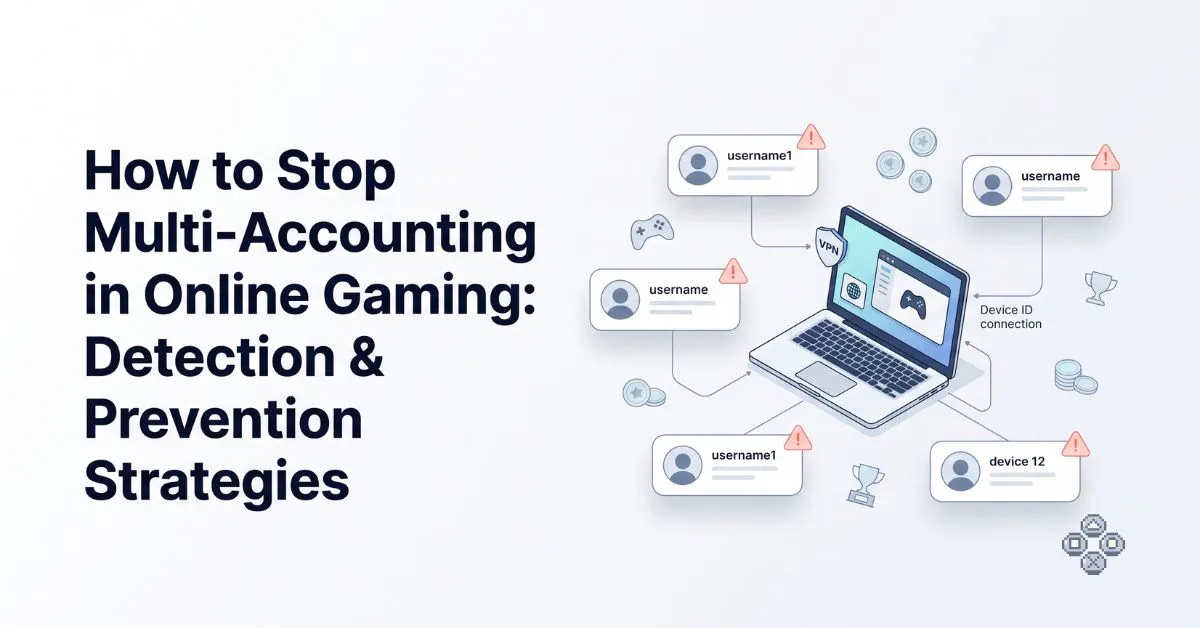
Picture this: You launch a generous welcome bonus to attract new players. Within hours, registrations start pouring in, player acquisition numbers look fantastic, and your campaign appears to be a success.
A few days later, your fraud team discovers that many of those "new players" aren't new at all. They're the same individual operating dozens of accounts, repeatedly claiming bonuses, manipulating matchmaking, or returning after previous bans.
This is multi-accounting in online gaming, and it's becoming one of the biggest challenges for gaming operators worldwide.
As fraudsters gain access to AI-powered tools, emulators, VPNs, and device spoofing techniques, traditional fraud detection methods are struggling to keep up. To stay ahead, gaming platforms need to look beyond account information and focus on what fraudsters find much harder to hide—the device behind every account.
In this guide, we'll explore how gaming platforms detect multi-accounting and the strategies that help prevent it without creating unnecessary friction for genuine players.
What Is Multi-Accounting in Online Gaming?
Multi-accounting is the practice of a single individual creating and operating multiple accounts on the same gaming platform to gain an unfair advantage.
While there are legitimate situations where users may own more than one account across different platforms or games, fraudulent multi-accounting is intentionally designed to exploit platform rules.
In online gaming, this often takes the form of:
- Claiming welcome bonuses multiple times.
- Rejoining a platform after being banned.
- Manipulating rankings or matchmaking.
- Colluding with other accounts in multiplayer games.
- Farming in-game rewards and promotional offers.
- Using alternate accounts to gain competitive advantages.
This practice is also commonly referred to as gnoming, particularly when fraudsters repeatedly create new accounts to abuse first-time player promotions.
Although each account appears to belong to a different player, they're often controlled by the same individual using tools designed to disguise their identity.
Why Multi-Accounting Is a Bigger Problem Than It Appears
At first glance, multi-accounting might seem like nothing more than bonus abuse. In reality, its impact reaches almost every aspect of an online gaming business.
Promotional budgets disappear faster
Welcome bonuses are designed to acquire genuine players. When one fraudster repeatedly claims those rewards through multiple accounts, marketing spend is wasted without generating long-term revenue.
Instead of acquiring ten real players, you may simply be rewarding one fraudster ten times.
Fair gameplay begins to suffer
Competitive games depend on trust.
Imagine a poker table where several accounts secretly belong to the same person, or teammates coordinating through alternate accounts to manipulate rankings. Honest players quickly notice when matches feel unfair—and many won't return.
Player data becomes unreliable
Gaming businesses rely heavily on player analytics to make decisions about marketing campaigns, engagement strategies, and product improvements.
Multi-accounting inflates registration numbers, distorts retention metrics, and creates the illusion of growth where none actually exists. Decisions based on inaccurate data often lead to inefficient marketing spend and poor product strategies.
Fraud evolves beyond promotions
Many fraudsters don't stop after claiming a welcome bonus.
Linked accounts can later be used for money laundering, payment fraud, collusion, account farming, or marketplace manipulation. What begins as seemingly harmless bonus abuse can quickly evolve into larger fraud operations.
Why Traditional Detection Methods Often Fail
Most gaming platforms still rely on account-level identifiers like email addresses, phone numbers, or IP addresses to identify suspicious users.
Unfortunately, these are also the easiest signals for fraudsters to manipulate.
Creating a new email address takes seconds.
Disposable phone numbers can be purchased in bulk.
VPNs and proxy networks allow users to constantly change their IP addresses.
Emulators and anti-detect browsers can make one device appear like many different devices.
From the platform's perspective, every new account looks legitimate.
This is exactly why fraudsters are able to scale multi-accounting so effectively. Instead of defeating sophisticated fraud detection systems, they're simply exploiting the weaknesses of outdated identifiers.
The challenge isn't identifying fake emails or suspicious IP addresses—it's identifying the individual operating behind them.
How Gaming Platforms Detect Multi-Accounting
Modern multi-accounting detection doesn't rely on a single signal. Instead, it combines multiple layers of intelligence to uncover hidden links between seemingly unrelated accounts.
1. Persistent Device Identification
Every fraudster needs a device.
While they can change usernames, passwords, emails, and even IP addresses, consistently appearing as an entirely new device is significantly more difficult.
Persistent device identification allows gaming platforms to recognize when multiple accounts originate from the same physical device—even after cookies are cleared, apps are reinstalled, or network settings change.
Instead of tracking accounts, platforms begin tracking the device behind them.
2. Detecting Fraud Tools
Professional fraudsters rarely rely on a standard browser or smartphone.
They frequently use tools such as:
- Emulators
- VPNs
- Proxies
- App cloners
- Device spoofers
- Anti-detect browsers
Detecting these tools provides valuable context during account registration and gameplay, helping operators identify high-risk users before fraud escalates.
3. Behavioral Intelligence
Even when account details differ, user behavior often remains surprisingly consistent.
Fraud teams monitor signals such as:
- Multiple accounts created within minutes.
- Similar gameplay patterns across different accounts.
- Accounts consistently joining the same matches.
- Identical betting or wagering behavior.
- Immediate bonus claims followed by rapid withdrawals.
Individually, these activities may appear harmless. Together, they reveal coordinated fraud.
4. Continuous Risk Monitoring
Fraud doesn't always begin at registration.
Many accounts appear completely legitimate during onboarding before becoming suspicious later in the player journey.
For example, a player may register normally, participate in a few games, activate multiple promotional offers, and suddenly attempt large withdrawals.
Continuous monitoring helps platforms identify when a seemingly genuine player begins exhibiting fraudulent behavior, allowing intervention before financial losses occur.
Best Practices to Prevent Multi-Accounting in Online Gaming
Detecting fraud is only half the battle. Preventing it requires multiple checkpoints across the player lifecycle.
Successful gaming platforms typically combine several strategies:
- Screen registrations using persistent device identification instead of relying solely on account details.
- Apply additional verification only to high-risk users rather than every player.
- Monitor device behavior throughout gameplay—not just during sign-up.
- Evaluate withdrawal requests using historical risk signals.
- Restrict promotions or tournament access for accounts linked to suspicious devices.
- Investigate clusters of related accounts instead of reviewing each account individually.
This layered approach reduces fraud while preserving a smooth experience for legitimate players, ensuring that security doesn't come at the cost of player satisfaction.
Building a Smarter Defense Against Multi-Accounting
Fraudsters will continue creating new email addresses, buying fresh phone numbers, rotating IP addresses, and adopting increasingly sophisticated evasion techniques.
What they can't easily replace is the device they use to access your platform.
That's why leading gaming operators are shifting from account-based detection to device intelligence for gaming. By combining persistent device identification with real-time fraud signals and continuous behavioral monitoring, platforms can identify linked accounts earlier, reduce bonus abuse, and stop coordinated fraud before it impacts player trust.
This device-first approach is exactly where solutions like SHIELD add value. Rather than relying on static identifiers alone, SHIELD Device Intelligence helps gaming platforms identify the root of fraud through persistent device identification and real-time fraud intelligence, making it easier to detect multi-accounting while keeping the experience seamless for genuine players.
Frequently Asked Questions
1. What is multi-accounting in online gaming?
Multi-accounting is when a single individual creates and manages multiple accounts on the same gaming platform to gain unfair advantages. This may include repeatedly claiming welcome bonuses, evading bans, manipulating rankings, colluding with other players, or farming in-game rewards.
2. Why is multi-accounting a problem for gaming platforms?
Multi-accounting leads to bonus abuse, unfair gameplay, inaccurate player analytics, higher fraud losses, and reduced player trust. It can also enable more serious fraud schemes, including payment fraud, collusion, and money laundering, making it a major concern for fraud and risk teams.
3. How can online gaming platforms detect multi-accounting?
Effective multi-accounting detection combines multiple signals, including persistent device identification, behavioral analytics, velocity monitoring, fraud tool detection (such as VPNs, emulators, and app cloners), and continuous session monitoring. Looking at these signals together helps identify linked accounts that traditional identifiers often miss.
4. How does device intelligence help prevent multi-accounting?
Device intelligence for gaming goes beyond basic account information by analyzing persistent device attributes alongside real-time fraud signals and behavioral patterns. It enables gaming platforms to recognize linked accounts, detect suspicious tools, and intervene before fraudsters can exploit bonuses or manipulate gameplay.
5. What is the difference between device fingerprinting and device intelligence?
Device fingerprinting primarily focuses on identifying a device using technical attributes such as browser configuration or operating system details. Device intelligence builds on this by combining persistent device identification with contextual fraud signals, behavioral insights, and real-time risk analysis, providing gaming platforms with a much more comprehensive view of fraudulent activity.