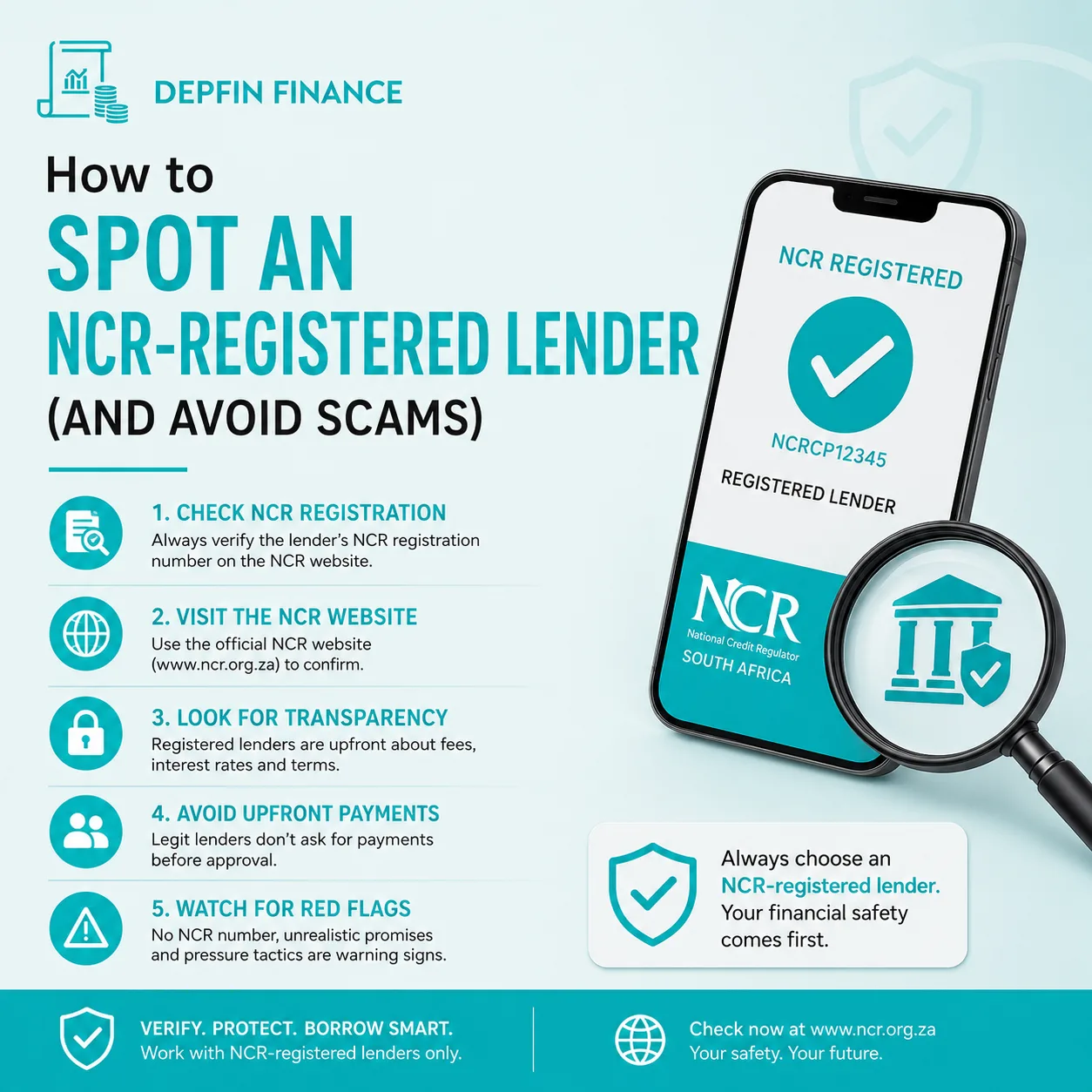
If you're trying to figure out whether a loan offer in South Africa is legitimate, the fastest and most reliable check is this: every registered credit provider has an NCR registration number, and you can verify that number for free on the National Credit Regulator's public register in under two minutes. If a lender can't or won't give you that number, or the number doesn't match their business name when you look it up, stop the application there. Everything else- interest rates, contact numbers, social media pages, and testimonials- is secondary to that one check.
This guide walks through exactly how that verification works, what the common warning signs of an unregistered or predatory lender look like, and what to do if you've already been targeted by one.
What Does It Mean for a Lender to Be "NCR-Registered"?
The National Credit Regulator (NCR) is the body established under South Africa's National Credit Act (NCA) to regulate the credit industry. Any business that extends credit to consumers, including short-term loans, personal loans, and business loans, is legally required to register with the NCR before offering credit.
Registration isn't a formality. It means the lender has agreed to follow rules around affordability assessments, interest rate caps, fee disclosure, and debt collection practices. It also means there's a regulator you can complain to if something goes wrong.
A lender operating without NCR registration is doing so illegally, full stop, regardless of how professional their website looks.
How Do I Check If a Lender Is Actually NCR-Registered?
This is the core skill this whole article is trying to teach, so it's worth doing slowly the first time you try it.
- Ask the lender directly for their NCR registration number. A legitimate provider will have this number printed on their website (usually in the footer or on an "About" page), in their loan agreement, and often in their email signature.
- Go to the NCR's public register. The NCR maintains a searchable database of registered credit providers on its official site, ncr.org.za.
- Search by business name or registration number. Enter the exact business name as it appears on their marketing, and cross-check the registration number they gave you against what comes up.
- Confirm the details match. The registered business name, and ideally the physical address, should line up with what the lender has told you. If the lender operates under a trading name that's different from the registered entity name, that's not automatically a scam, but it's worth asking why.
- Check the registration status, not just the existence of a listing. Registrations can be suspended or cancelled. A number that shows up but is flagged as inactive is a red flag on its own.
If you get to step 3 and nothing comes up, or the registration is for a different business entirely, you're not dealing with a registered lender.
A lender that cannot be found on the NCR's public register by name or registration number is not legally allowed to be lending you money.
What Are the Warning Signs of an Unregistered or Scam Lender?
Once you've learned to check the register, the next layer of protection is recognizing the patterns unregistered or predatory lenders tend to share. None of these on their own proves a scam, but seeing several together should make you cautious.
Warning signWhy it mattersAdvertises "no credit check"The NCA requires every registered credit provider to assess a borrower's affordability before granting credit. A lender skipping this step is either unregistered or breaking the law.Interest rate changes across different pages or adsRegistered lenders are required to disclose costs clearly and consistently. Different rates quoted for the same product usually mean the numbers haven't been checked or, worse, are deliberately vague.Contact numbers or addresses that don't match across platformsLegitimate businesses keep one set of verified contact details. Multiple mismatched phone numbers or addresses across a website, Facebook page, and Instagram account make it hard to know who you're actually dealing with and harder to hold anyone accountable later.Business social media run through a personal profileA registered financial services provider should have a verifiable business page, not a loan offer posted from what looks like a personal Facebook or Instagram account.Upfront fees before any money is paid outCharging an "insurance," "processing," or "release" fee before disbursing a loan is one of the most common advance-fee scam patterns in South Africa.Pressure to apply immediately, same-day approval on large sumsReal affordability assessments take some time. Instant approval on very large loan amounts, especially targeted at people who are blacklisted or under debt review, is designed to bypass the caution a borrower would normally apply.No NCR number, or a number that doesn't match on the registerThis is the one that settles the question. Everything else is a clue; this is the confirmation.If a lender is advertising "no credit check" loans, that phrase alone tells you they are either unregistered or not following the law that governs registered lenders.
Why Do Scam Lenders Specifically Target Blacklisted Borrowers?
People who've been blacklisted, or who are under debt review, are often the most financially stressed and the most motivated to say yes quickly. Scammers know this. Offers that promise loans "regardless of credit history" with no real affordability check aren't being generous; they're identifying the exact audience least likely to push back on unclear terms, upfront fees, or vague documentation.
This doesn't mean people with poor credit records can't get a legitimate loan. Registered lenders can and do lend to people with credit problems, but they're required to still run an affordability assessment first. The difference is: a real assessment takes your income, expenses, and existing debt into account before deciding, rather than promising approval before checking anything.
What Documents Should a Legitimate Lender Ask For?
This is a useful cross-check in itself. A registered lender conducting a real affordability assessment will typically request:
- A South African ID document
- Recent bank statements (commonly the last three months)
- Proof of residential address
- A recent payslip from your current employer
If a lender is willing to approve a large loan with little more than a name and a phone number, that's not a sign of efficiency; it's a sign they're not doing the assessment the law requires.
What Should I Do If I Suspect a Lender Isn't Registered?
- Don't pay any upfront fee, regardless of what it's called. Legitimate loan costs are deducted from the loan itself or repaid over the loan term, not paid in advance to "release" funds.
- Search the NCR register before signing anything, not after.
- Report it. The NCR accepts complaints about unregistered credit providers directly through its website.
- Check with the National Consumer Commission if the issue involves unfair contract terms rather than registration status specifically.
- Keep records of every communication, emails, WhatsApp messages, and screenshots of ads, in case you need to report the lender or dispute a transaction with your bank.
How Do Interest Rate Caps Work for Registered Lenders?
The NCA sets maximum interest rates and fees depending on the type of credit agreement, and these caps are reviewed periodically by the minister of trade, industry, and competition. Registered lenders must operate within these caps. If you're quoted a rate and want to sanity-check it, the NCR publishes the current maximum rates by credit agreement type, and you can compare a lender's offer against that publicly available ceiling.
This is also a practical reason consistency matters: a registered lender that's done its compliance work will quote you one clear rate for your specific product, not a range that shifts depending on which page of their site you're reading.
Key Takeaways
- The NCR public register is the single most reliable check. Search by business name and registration number before applying anywhere.
- "No credit check" is not a selling point. It's a sign the lender isn't doing what the law requires.
- Never pay an upfront fee to "release" a loan. This is one of the most common scam structures in South Africa.
- Consistency across contact details, rates, and social media matters. Mismatches aren't proof of a scam, but they're a reason to slow down and verify before signing anything.
- Legitimate lenders will still ask for real documents, ID, bank statements, proof of address, and a payslip because they're required to assess affordability, not just approve you.
Frequently Asked Questions
- Is it illegal to lend money in South Africa without NCR registration?
Yes. Any business extending credit to consumers is required under the National Credit Act to register with the NCR. Lending without registration is a criminal offense. - Can a registered lender still charge high interest?
Registered lenders must stay within the interest rate and fee caps set under the NCA for each type of credit agreement. Rates vary by loan type, but they can't exceed the published maximum. - What if the lender is registered but I still feel pressured or misled?
Registration doesn't excuse unfair treatment. You can lodge a complaint with the NCR or the National Consumer Commission, even against a registered provider if you believe your rights under the NCA were violated. - I already paid an upfront fee to a lender I now think is a scam. What do I do?
Contact your bank immediately to ask about reversing or disputing the payment, keep every piece of communication as evidence, and report the lender to the NCR. Acting quickly improves your chances of recovering funds. - Does a professional-looking website mean a lender is legitimate?
No. Website design has no bearing on registration status. The only reliable confirmation is checking the NCR's public register directly.
Connect with Depfin Finance
Depfin Finance
Contact
Email:
[email protected]
Telephone:
+27 60 460 1979
Head Office:
Office Ground Floor, The Glen Shopping Centre, C/O Orpen & Letaba Road, Eastcliff, Oakdene, Johannesburg, 2190
Branch Office:
208 De Waal Rd, Southfield, Cape Town, 7800 South Africa
Facebook
Instagram
Ready to Take the First Step?
Get a loan from R30,000 to R10 million in minutes at Depfin Finance.
Need more help? Our advisors are always ready to assist you.
📞 Call: +27 60 460 1979
💬 WhatsApp:
📧 Email: [email protected]