Planning a trip to the Thar Desert requires a thoughtful balance between historical exploration and desert immersion. Jaisalmer, fondly known as the Golden City, rises out of the dunes with yellow sandstone bastions, ancient merchant havelis, and expansive desert landscapes. Based on hands-on hospitality and guiding experience across western Rajasthan, here is a practical, step-by-step three-day itinerary designed to maximize your time, avoid tourist traps, and offer an authentic taste of Marwar culture.
Day 1: The Living Fort and Royal Havelis
Morning: Jaisalmer Fort (Sonar Qila)
Start your journey early inside Jaisalmer Fort before the midday sun peaks. Unlike most museum-style forts across India, Sonar Qila is a functioning living fort where roughly a quarter of the old city's population still resides. Constructed in 1156 AD by the Bhati Rajput ruler Rawal Jaisal, its 99 bastions turn deep amber as daylight shifts.
- Explore the narrow cobblestone alleys on foot to see local artisans carving sandstone and weaving textiles.
- Visit the intricately sculpted group of seven Jain Temples dating between the 12th and 16th centuries, renowned for their Dilwara-style marble and yellow stone reliefs.
- Walk up to Cannon Point for panoramic vistas across the golden rooftops and the horizon.
Afternoon: Merchant Architecture at Patwon Ki Haveli
Head down from the fort toward the cluster of grand residences built by wealthy Jain merchants during the Silk Road trading era.
- Patwon Ki Haveli: The largest and most ornate mansion complex in the city, comprising five distinct wings built between 1800 and 1860. Pay close attention to the delicate jali (latticed stone screens) that allow desert breezes to circulate while keeping the interior cool.
- Salim Singh Ki Haveli and Nathmal Ki Haveli: Notable for their arched balconies and carved elephant statues created by two brother stonemasons working independently on opposite sides of the facade.
Evening: Sunset at Gadisar Lake
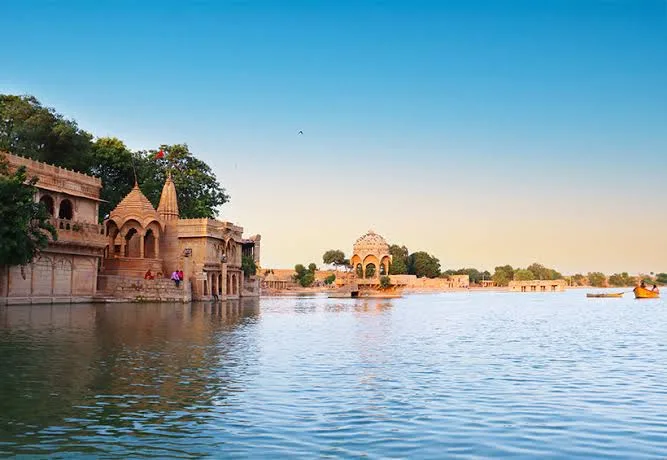
End your first day along the banks of Gadisar Lake, a historic rainwater reservoir built in the 14th century by Maharawal Gadsi Singh. Rent a rowboat or relax on the ghats as the sandstone chhatris (cenotaphs) glow under the evening sky.
Day 2: Desert Frontiers, Heritage Villages, and Sand Dunes
Morning: The Enigma of Kuldhara and Bada Bagh
After breakfast in town, begin driving westward toward the open desert.
- Bada Bagh: A peaceful complex of royal cenotaphs honoring the Maharawals of Jaisalmer, set against a backdrop of modern wind turbines. The early morning light offers clear angles for architecture photography without crowds.
- Kuldhara Heritage Village: Walk through the preserved ruins of an 84-village settlement abandoned overnight by Paliwal Brahmins in the early 19th century to escape an oppressive tax minister. The stone foundations provide an intimate look at medieval desert town planning.
Afternoon: Check-In at Sam Sand Dunes
Travel 40 kilometers west of the city to reach the deep Thar dunes. Staying directly on the perimeter of the sands allows you to bypass the long evening drive back to the city and experience true desert quiet. Selecting an authentic camp in sam sand dunes with Rajwada Desert Camp provides swiss tent accommodation, clean amenities, and direct access to traditional hospitality right at the edge of the ripples.
Evening: Dune Safari and Folk Music
As late afternoon sets in, head into the open dunes. For travelers looking to add thrill to their journey, participating in local Jaisalmer advanture activities like dune bashing in an open 4x4 vehicle, quad biking over sand crests, and camel treks offers an exhilarating perspective of the terrain. Wrap up the night back at camp around a traditional open-air bonfire, accompanied by live Manganiyar and Langa folk musicians performing authentic desert ballads under a canopy of stars.
Day 3: War Heritage, Border History, and Local Bazaars
Morning: Tanot Mata Temple and Longewala War Memorial
Dedicate your final morning to the border history of Rajasthan.
- Tanot Mata Temple: Located roughly 120 kilometers from the city near the Indo-Pak border, this sacred shrine is maintained by the Border Security Force (BSF) and is famous for surviving heavy shelling during the 1965 and 1971 conflicts.
- Longewala War Memorial: The historic battleground of the 1971 war, complete with preserved enemy tanks, combat vehicles, audio-visual history exhibits, and bunker displays managed by the Indian Army.
Afternoon: Return to Jaisalmer for Culinary and Bazaar Walks
Head back to the city center for a final culinary and shopping tour.
- Try an authentic Rajasthani thali featuring ker sangri (wild desert beans and berries), dal baati churma, and local gatte ki sabzi prepared with buttermilk.
- Pick up locally made souvenirs such as yellow sandstone coasters, camel leather goods, mirror-work textiles, and local spices at Sadar Bazaar and Manak Chowk.
Essential Travel Tips for Jaisalmer
- Best Time to Visit: Plan your trip between October and March when daytime temperatures hover comfortably around 22°C to 28°C.
- Clothing: Pack light cotton layers for daytime exploration and thermal jackets or windbreakers for chilly desert nights, as sands cool rapidly after dusk.
- Hydration: Desert air is dry even in winter; carry reusable water bottles and stay hydrated throughout outdoor excursions.
- Permits: If you plan to visit Tanot or the border outpost beyond, keep original government identity cards accessible for security checkpoints.