By Holistic Group | Lifestyle & Real Estate Insights | June 2026
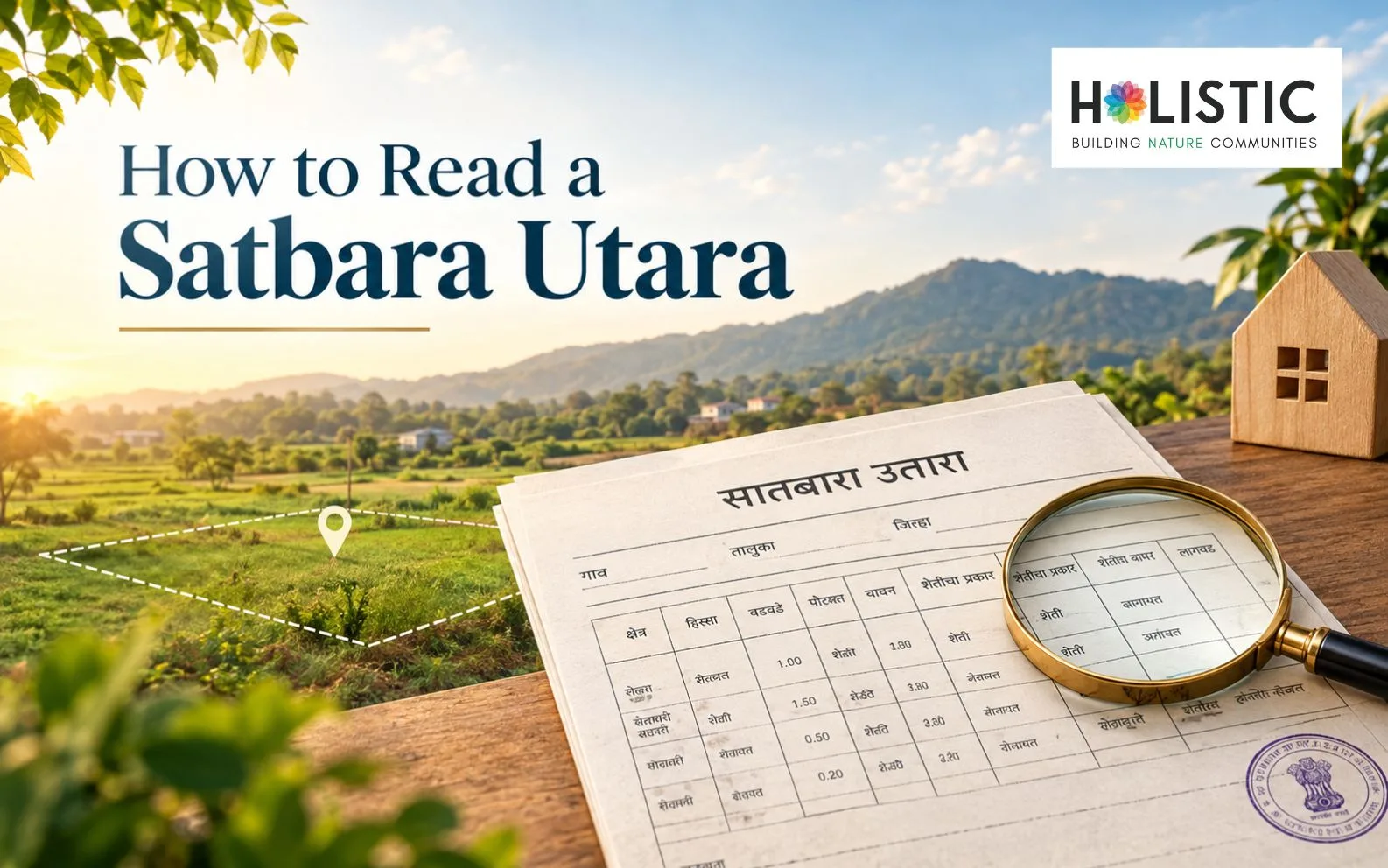
Buying land in Maharashtra requires careful verification of ownership, land area and official revenue records. One of the most important documents buyers come across is the Satbara Utara, also known as the 7/12 extract. It contains important information about a land parcel, including recorded occupant details, survey or group number, area, cultivation information and certain revenue entries.
For people considering agricultural land, farmhouse plots or land investments in areas such as Roha, Raigad and Karjat, understanding how to read a Satbara Utara can help them identify details that need further verification before proceeding with a purchase.
What Is a Satbara Utara?
A Satbara Utara is a land revenue record maintained by the Maharashtra government. Its name comes from two village record forms: Form 7 and Form 12.
Form 7 generally contains information about recorded holders or occupants, tenancy-related details where applicable, and other revenue record information. Form 12 primarily relates to agricultural and crop details.
Together, these records provide information about a particular land parcel. Buyers, landowners and other interested parties may use the document to review recorded land details and identify matters that require further investigation.
However, a 7/12 extract should not be treated as conclusive proof of legal ownership. A proper title search and verification of relevant legal documents are important before purchasing land.
1. Check the Owner’s Name and Recorded Occupant Details
One of the first things to check on a Satbara Utara is the name or names recorded against the land parcel.
Depending on the record, it may show details relating to recorded occupants, holders or other persons with recorded interests. If the land has multiple recorded holders, their names may also appear.
When reviewing these details, buyers should:
- Compare the recorded names with the seller’s identity documents.
- Check whether the seller is legally entitled to transfer the property.
- Verify the relevant inheritance, partition or mutation records if the land has changed hands.
- Confirm that all required co-owners or other interested parties are properly accounted for in the transaction.
A name appearing on the 7/12 extract does not automatically establish that the person has an undisputed and transferable title. The underlying title documents and applicable legal requirements must also be checked.
2. Understand the Survey Number or Gat Number
A survey number or Gat number helps identify a specific parcel of land within a village’s land records. The terminology used can vary according to the area’s land-record system.
This number is particularly important when comparing a Satbara Utara with a sale deed, property map or other land-related documents.
Before purchasing land, verify that:
- The survey or Gat number matches the number mentioned in the seller’s documents.
- The village and relevant land-record details correspond to the actual property.
- The land parcel shown in the official map matches the property being offered for sale.
- Any subdivisions, hissa numbers or changes in parcel boundaries are properly documented.
For example, if a seller offers an agricultural plot in Roha, Raigad, the survey or Gat number should be checked against the applicable official records and the land’s physical boundaries. A location description alone is not sufficient to establish that the correct parcel is being sold.
3. Check the Total Land Area
The land area recorded in the Satbara Utara is another important detail. It may be expressed in units such as hectares, ares or square metres, depending on the record.
Buyers should compare the recorded area with the area stated in the sale agreement, title documents, approved layout, if applicable, and other relevant records.
Pay attention to the following:
- Total recorded area of the land parcel.
- Any separately recorded subdivisions or portions.
- Differences between the recorded area and the area advertised by the seller.
- Whether the boundaries and measurements have been verified through appropriate land measurement procedures.
A difference between the area shown in the revenue record and the area stated by the seller should be clarified before the transaction proceeds.
The area of a larger survey parcel may also differ from the area of an individual plot carved out of it. Buyers should verify that the specific plot being purchased is legally identifiable and appropriately documented.
4. Understand Land Classification and Agricultural Details
A Satbara Utara may contain information about the nature of the land, its recorded use and agricultural activities. The exact fields available depend on the record and the land parcel.
These details can help buyers understand the property’s recorded agricultural context. However, agricultural land, non-agricultural land and land approved for a particular development are not interchangeable categories.
If you are considering land for a farmhouse, residential construction or another purpose, verify the applicable land-use permissions, zoning restrictions and conversion requirements with the relevant authorities.
Do not assume that buying a plot automatically gives you permission to construct a house, develop a resort or use the land for commercial purposes.
5. Review Crop Details in Form 12
The Form 12 portion of the record generally contains agricultural information, including crop-related details where recorded.
This information may help establish the agricultural context of a parcel and can be relevant when assessing land being used for cultivation.
When reviewing crop details, consider:
- The crop information recorded for the relevant period.
- Whether the land appears to be used for agricultural purposes.
- Whether the recorded details need clarification from the local revenue office.
- Whether the proposed use of the land is consistent with applicable permissions and restrictions.
Crop entries are not a substitute for a legal title search or a verification of development rights.
read our full blog: https://holisticgroup.in/how-to-read-a-satbara-utara/