The demand for high-quality cattle feed continues to grow as dairy and beef farming becomes more professional and commercially managed. Modern livestock farms need feed that can provide consistent nutrition while remaining convenient to transport, store, and distribute. For feed manufacturers, the challenge is to produce this feed efficiently while controlling raw material, labor, energy, and maintenance costs.
Cattle feed pellets provide a practical solution for many farming operations. By combining grains, protein meals, bran, forage materials, minerals, vitamins, and other ingredients into a balanced formula, manufacturers can process the mixture into compact pellets. The finished product is easier to handle than many loose feed materials and can be produced in standardized sizes.
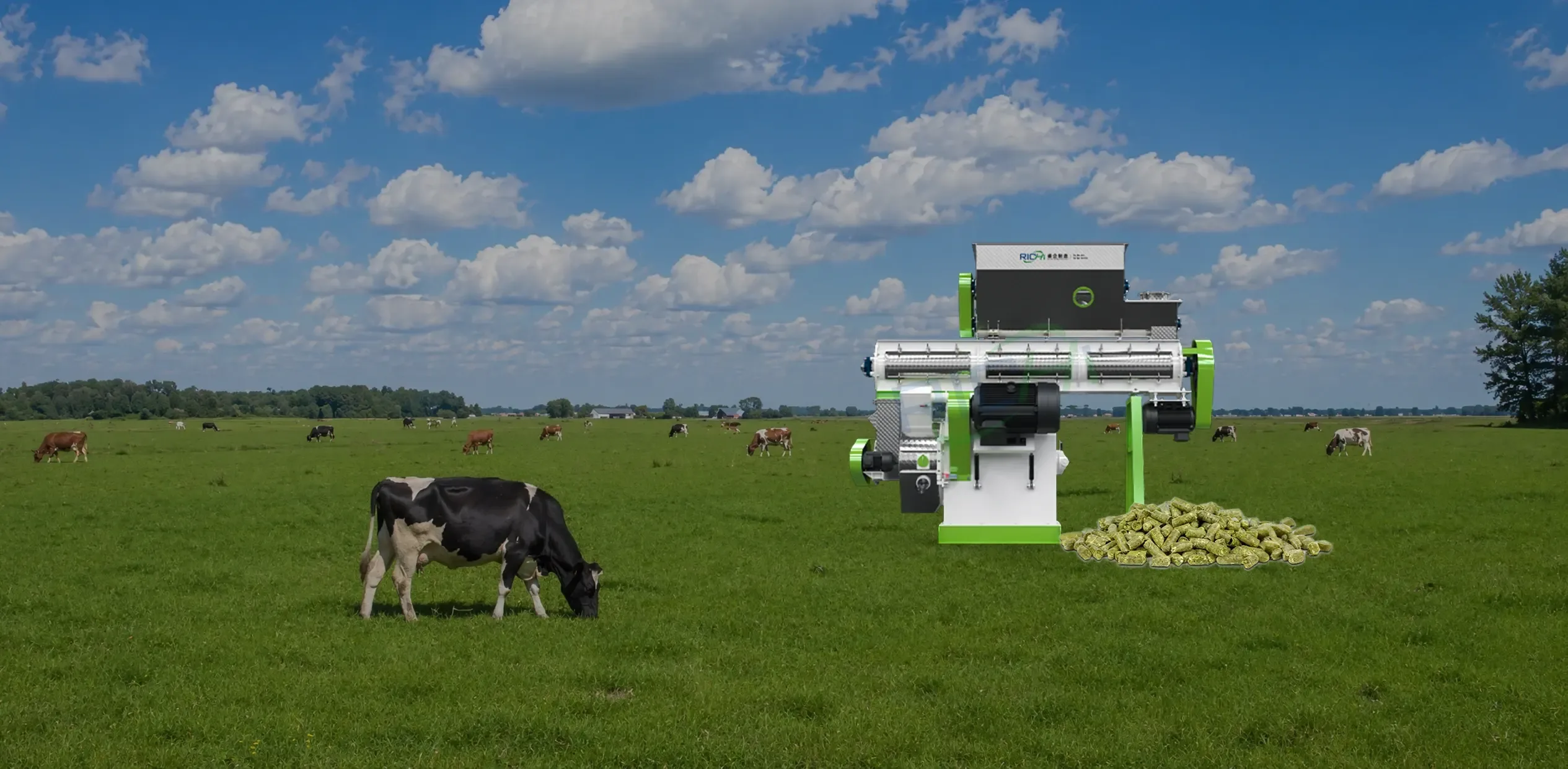
The pelletizing stage is central to this process. A properly selected cow feed pellet mill can compress prepared feed mixtures into uniform pellets with stable production performance. However, the pellet mill is only one component of a complete cattle feed manufacturing system. Grinding, batching, mixing, conditioning, cooling, screening, and packaging must also be properly coordinated.
For farmers and investors planning a cattle feed production project, understanding how each stage works can help them choose appropriate machinery and avoid unnecessary investment. RICHI Manufacture provides feed machinery and engineering solutions for customers who need individual machines or complete cattle feed production plants.
This article explains the complete process of producing cattle feed pellets, the role of pelletizing equipment, major factors affecting pellet quality, and practical ways to improve production efficiency.
Why Cattle Feed Pellets Are Used
Cattle feed can be supplied in several physical forms.
These include:
- Loose feed
- Mash feed
- Mixed feed
- Silage-based rations
- Pellets
Pellets are especially attractive for commercial feed manufacturers because they are compact and convenient.
They can be:
- Transported efficiently
- Stored conveniently
- Packaged easily
- Conveyed mechanically
- Produced in standardized sizes
Pelletizing can also help integrate multiple feed ingredients into one physical product.
Understanding the Cattle Feed Production Process
A typical cattle feed pellet production process includes:
Raw Material Receiving → Cleaning → Grinding → Batching → Mixing → Conditioning → Pelletizing → Cooling → Screening → Packaging
Depending on the formula and raw materials, additional processes may be required.
For example, high-moisture materials may require drying, while certain formulas may need liquid addition or coating after pelletizing.
The final process should always be designed around the actual raw materials and product specifications.
Raw Materials Used for Cattle Feed
A cattle feed factory may use a combination of energy, protein, fiber, mineral, and vitamin sources.
Common ingredients include:
- Corn
- Wheat
- Barley
- Sorghum
- Soybean meal
- Rapeseed meal
- Wheat bran
- Rice bran
- Alfalfa
- Grass
- Hay
- Molasses
- Mineral premixes
- Vitamin premixes
The formula depends on the target animal and nutritional requirements.
For example, dairy cow feed may be formulated differently from beef cattle feed.
Dairy Cow Feed
Dairy cows require feed that supports milk production, body condition, reproduction, and overall health.
The formula may include appropriate levels of:
- Energy
- Protein
- Fiber
- Minerals
- Vitamins
Feed manufacturers may produce different formulas for different stages of lactation.
This requires a flexible batching and mixing system.
Beef Cattle Feed
Beef cattle feeding programs are generally designed around growth and finishing performance.
The formula may change according to:
- Animal age
- Growth stage
- Target weight
- Feeding strategy
- Local ingredient availability
A pellet production system should therefore be capable of handling the formulas required by the target market.
Calf Feed
Young calves have different nutritional requirements from mature cattle.
Their feed may require finer particle size and different nutritional composition.
If a factory produces calf feed as well as adult cattle feed, the equipment should be selected with sufficient flexibility.
Raw Material Cleaning
Raw material cleaning is the first mechanical processing stage.
It removes unwanted materials such as:
- Stones
- Metal
- Dirt
- Foreign particles
Common cleaning equipment includes:
- Vibrating screens
- Rotary screens
- Magnetic separators
- Destoners
Cleaning helps protect downstream machinery and improve feed quality.
Grinding
Grinding reduces the particle size of raw materials.
Hammer mills are commonly used for grinding grain materials.
The grinding process influences:
- Particle size
- Mixing efficiency
- Pellet formation
- Pellet durability
- Energy consumption
The objective is not necessarily to grind everything as finely as possible.
Instead, the particle size should be optimized for the feed formula and pellet specifications.
Batching
After grinding, ingredients are weighed according to the feed formula.
Accurate batching is important because different ingredients contribute different nutritional values.
Automatic batching systems can improve:
- Dosing accuracy
- Recipe management
- Production consistency
- Labor efficiency
For large feed factories, computerized batching can allow operators to manage multiple formulas.
Mixing
The batched ingredients are transferred into a mixer.
The objective is to create a uniform mixture.
A well-designed mixer should distribute ingredients consistently throughout the batch.
Mixing time and mixer capacity should be matched to the overall production capacity.
Conditioning
Before pelletizing, the feed mixture may pass through a conditioner.
Steam is commonly introduced.
Conditioning can increase the temperature and moisture of the material and improve its physical properties.
It can contribute to:
- Better pellet formation
- Improved pellet durability
- More stable production
- Reduced fines
Conditioning parameters should be adjusted according to the formula and equipment.
The Role of a Cow Feed Pellet Mill
The cow feed pellet mill performs the core compression process.
The prepared feed mixture enters the pelletizing chamber.
Rotating rollers press the material against a die.
The pressure forces the material through die holes.
The extruded material is then cut into pellets.
The basic process is:
Feeding → Compression → Extrusion → Cutting
The final pellet quality depends on both the machine and the condition of the feed entering it.
Factors Affecting Pellet Mill Output
The output of a pellet mill is influenced by:
- Raw material
- Feed formula
- Moisture
- Particle size
- Conditioning
- Die specification
- Roller condition
- Feeding rate
- Operating parameters
Therefore, the advertised capacity of a machine should be considered as a reference rather than an absolute production guarantee for every formula.
(Learn about industrial cattle feed pellet machine price )
Choosing the Correct Pellet Mill Capacity
Capacity should be based on actual production requirements.
A farm producing feed for its own cattle may require a compact machine.
A local feed manufacturer may need a medium-capacity production line.
A commercial feed factory supplying multiple regions may require several high-capacity pellet machines.
Capacity should also be matched with:
- Grinder capacity
- Mixer capacity
- Conditioner capacity
- Cooler capacity
- Screening capacity
- Packaging capacity
This prevents production bottlenecks.
Die Selection
The die is an essential component of pelletizing equipment.
Its holes determine the approximate diameter of the finished pellets.
Die selection should consider:
- Pellet diameter
- Feed formula
- Raw material
- Compression requirements
- Target capacity
Factories producing multiple pellet sizes may require multiple dies.
Pellet Size
The appropriate pellet size depends on the product.
Factors include:
- Animal age
- Feed formula
- Feeding method
- Customer preference
- Market requirements
A flexible pelletizing system can make it easier to manufacture different product specifications.
Roller Maintenance
The rollers continuously operate against the die.
They are therefore subject to wear.
Operators should regularly check:
- Roller surface
- Roller bearings
- Lubrication
- Clearance
- General condition
Proper maintenance can help maintain stable output and pellet quality.
Cooling
Fresh pellets are hot after leaving the pellet mill.
They also contain moisture.
A cooling system reduces temperature and moisture before storage.
Commercial feed factories commonly use counterflow coolers.
Proper cooling helps reduce the risk of:
- Condensation
- Mold
- Storage deterioration
- Pellet breakage
Screening
After cooling, pellets are screened.
The screening system separates qualified pellets from fines.
The fines can often be recycled into the production process.
Effective screening improves finished product consistency and reduces waste.
Packaging
Finished cattle feed pellets can be packaged according to market requirements.
Common packaging options include:
- Small bags
- Medium bags
- Large bags
- Bulk loading
Automatic packaging equipment can perform weighing, filling, and sealing.
Commercial factories may integrate packaging with conveyors and palletizing equipment.
How to Improve Pellet Quality
Several factors should be controlled.
Raw Material Quality
Poor raw materials can affect pellet stability and finished feed quality.
Particle Size
Consistent grinding improves mixing and pellet formation.
Moisture
Moisture should be maintained within an appropriate range.
Conditioning
Steam conditioning should be stable and properly controlled.
Die Selection
The die should match the formula and desired pellet diameter.
Roller Adjustment
Correct roller clearance supports stable compression.
Cooling
Pellets should be adequately cooled before storage.
Handling
Excessive mechanical handling can increase breakage and fines.
Common Pellet Production Problems
Pellets Break Easily
Possible causes include:
- Insufficient compression
- Poor conditioning
- Incorrect moisture
- Unsuitable die
- Inadequate cooling
Too Many Fines
Possible causes include:
- Weak pellet formation
- Poor cooling
- Excessive handling
- Incorrect die selection
Low Production Capacity
Possible causes include:
- Insufficient material preparation
- Poor conditioning
- Unstable feeding
- Worn rollers
- Unsuitable die
High Energy Consumption
Possible causes include:
- Excessive grinding
- Overloaded equipment
- Poor maintenance
- Incorrect equipment sizing
Balancing the Production Line
A feed factory should be designed as an integrated system.
For example:
If the grinder is too small, the pellet mill may not receive enough material.
If the mixer is too slow, the pellet mill may have to wait for each batch.
If the cooler is too small, pellets may accumulate after the pellet mill.
If the packaging system is too slow, finished pellets can become a bottleneck.
Therefore, equipment capacity should be balanced.
Factory Layout
Factory layout affects both production efficiency and maintenance.
A typical layout is:
Raw Material Storage
↓
Cleaning
↓
Grinding
↓
Batching
↓
Mixing
↓
Conditioning
↓
Pelletizing
↓
Cooling
↓
Screening
↓
Packaging
↓
Finished Product Storage
The layout should provide logical material flow and sufficient access for maintenance.
Vertical Feed Plant Layout
A vertical layout uses different building levels.
Materials can move downward through the production system using gravity in some sections.
Potential benefits include:
- Reduced land requirements
- Shorter conveying distances
- Efficient use of building height
However, construction costs and maintenance access should also be considered.
Horizontal Feed Plant Layout
A horizontal layout places equipment mainly on the same floor.
Potential benefits include:
- Easier maintenance
- Easier equipment access
- Simpler expansion in some facilities
The appropriate layout depends on the available site and project budget.
Automation Levels
Different factories require different levels of automation.
Manual Production
Suitable for very small-scale production.
Semi-Automatic Production
Some processes are automated while operators control others.
Fully Automatic Production
A centralized control system coordinates major production stages.
Automation can improve:
- Production consistency
- Batching accuracy
- Labor efficiency
- Production monitoring
Dust Collection
Feed processing can generate dust, particularly during grinding.
Dust collection equipment can include:
- Bag filters
- Fans
- Ducting
- Cyclones
A properly designed dust collection system can help maintain a cleaner working environment.
Energy Efficiency
Energy is one of the major operating costs of a feed factory.
Energy-efficient operation can be supported by:
- Proper equipment sizing
- Efficient motors
- Optimized grinding
- Stable pelletizing
- Regular maintenance
- Reduced idle operation
Energy consumption should be evaluated together with equipment output.
Maintenance
Regular maintenance is necessary for reliable operation.
Key components to inspect include:
- Dies
- Rollers
- Bearings
- Motors
- Hammers
- Screens
- Conveyors
- Lubrication systems
Preventive maintenance can reduce unexpected downtime.
Choosing a Supplier
When selecting a supplier, buyers should evaluate more than the equipment quotation.
Important criteria include:
Manufacturing Experience
A supplier with strong manufacturing experience can provide more reliable equipment solutions.
Engineering Capability
A complete feed factory requires process and layout design.
Customization
Equipment should be adaptable to local raw materials and production requirements.
Installation
Professional installation and commissioning can reduce startup problems.
Training
Operators should understand correct operation and maintenance.
Spare Parts
Availability of wear parts is important for long-term production.
Technical Support
Responsive technical support can help solve operational problems.
RICHI Manufacture provides feed machinery and engineering services for customers developing cattle feed production projects. Its solutions can be customized according to capacity, raw materials, feed formulas, pellet diameter, automation requirements, and factory conditions.
Turnkey Cattle Feed Production
A turnkey project integrates multiple aspects of factory development.
The process may include:
Consultation → Process Design → Equipment Selection → Layout Design → Manufacturing → Transportation → Installation → Commissioning → Training
This approach can simplify coordination between different production stages.
A turnkey supplier can also help ensure that grinding, batching, mixing, pelletizing, cooling, screening, and packaging systems work together.
Investment Planning
The initial investment depends on the project scale.
Important cost categories include:
- Processing equipment
- Pelletizing equipment
- Storage
- Conveying
- Dust collection
- Electrical systems
- Packaging
- Factory construction
- Transportation
- Installation
- Commissioning
A pellet mill should therefore not be treated as the entire investment.
Small Farm Projects
A small cattle farm may only need a compact system.
A typical configuration can include:
- Feed grinder
- Mixer
- Pellet mill
- Cooler
- Screener
Packaging can be manual.
This approach reduces initial investment and keeps the system relatively simple.
Commercial Feed Factories
Commercial manufacturers may require more sophisticated systems.
These can include:
- Automatic raw material receiving
- Storage silos
- Automatic batching
- Large mixers
- Multiple pellet machines
- Automatic cooling
- Screening
- Packaging
- Dust collection
- Centralized control
The system should be designed according to expected market demand.
Future Expansion
A feed factory should consider future growth during the initial design.
Potential expansion may include:
- Additional storage
- Larger grinding capacity
- Additional pellet machines
- Larger cooling systems
- More packaging lines
Leaving sufficient space during the initial construction can make future expansion easier.
How to Prepare Before Buying Equipment
Before contacting a supplier, prepare the following information:
- Target production capacity
- Main raw materials
- Feed formulas
- Desired pellet diameter
- Daily working hours
- Automation level
- Factory dimensions
- Storage requirements
- Packaging method
- Future expansion plans
The more accurate the information, the more suitable the equipment recommendation can be.
Questions to Ask About a Pellet Mill
Potential buyers should ask:
- What is the expected capacity?
- What raw materials can it process?
- What pellet diameters can it produce?
- What motor power is required?
- What die specifications are available?
- What are the main wear parts?
- How frequently should maintenance be performed?
- What supporting equipment is required?
- Is installation available?
- Is operator training provided?
- Are spare parts available?
- Can the machine be integrated into a complete production line?
FAQ About Cow Feed Pellet Mills
What is a cow feed pellet mill?
A cow feed pellet mill is a machine that compresses prepared feed materials into compact pellets through a die. It is normally integrated into a larger cattle feed production system.
What materials can be used?
Common materials include corn, wheat, barley, sorghum, soybean meal, bran, alfalfa, grass, hay, minerals, vitamins, and other suitable feed ingredients.
Can a pellet mill process alfalfa?
Yes. Alfalfa can be incorporated into cattle feed pellets when particle size, moisture, and formulation are appropriate.
What determines pellet size?
The die hole diameter primarily determines pellet diameter.
What affects pellet quality?
Important factors include raw material quality, particle size, moisture, formula, mixing, conditioning, die selection, roller condition, cooling, and handling.
Is steam conditioning necessary?
Commercial pellet production often uses steam conditioning, although the exact process depends on the formula and machine configuration.
Why do pellets contain too much powder?
Possible reasons include poor conditioning, unsuitable moisture, insufficient compression, inappropriate die selection, inadequate cooling, or excessive handling.
How can pellet durability be improved?
Control particle size and moisture, optimize conditioning, select a suitable die, maintain proper roller adjustment, and cool the pellets correctly.
Can different cattle feed formulas be produced?
Yes. A properly designed production system can manufacture different formulas using recipe management and appropriate process adjustments.
Can different pellet diameters be produced?
Yes. Different dies can generally be used to produce different pellet diameters when supported by the pellet mill design.
Is a small pellet mill suitable for a farm?
A compact pellet mill can be suitable when the capacity matches the farm's feed requirements.
What equipment is needed besides the pellet mill?
A complete system may require grinding, batching, mixing, conditioning, cooling, screening, conveying, packaging, and dust collection equipment.
How can production efficiency be improved?
Production efficiency can be improved by balancing equipment capacity, controlling moisture and particle size, optimizing conditioning, maintaining the pellet mill, and reducing unnecessary material handling.
How important is factory layout?
Factory layout is important because it influences material flow, conveying distance, labor requirements, maintenance access, and future expansion.
Can RICHI Manufacture provide a complete cattle feed production solution?
Yes. RICHI Manufacture provides customized feed machinery and engineering solutions covering equipment configuration, process planning, layout design, manufacturing, installation, commissioning, and technical support according to project requirements.
Conclusion
Producing high-quality cattle feed pellets requires a coordinated production system rather than a single machine.
The process starts with suitable raw materials and an appropriate feed formula. Materials are cleaned, ground, accurately batched, and mixed before conditioning and pelletizing.
The cow feed pellet mill is responsible for compressing the prepared feed mixture into compact pellets. Its performance depends on the feed formula, particle size, moisture, conditioning, die specification, roller condition, and feeding stability.
After pelletizing, the finished pellets should be properly cooled and screened before packaging and storage. The capacities of all these machines should be balanced to prevent production bottlenecks.
For small farms, a compact production system may be sufficient. Medium and large commercial factories can benefit from automatic batching, centralized control, efficient material handling, multiple pelletizing machines, and automated packaging.
Investors should also consider factory layout, dust collection, energy efficiency, maintenance, spare parts, installation, and future expansion when planning a new facility.
Choosing the right supplier is equally important. A supplier with manufacturing and engineering capabilities can help integrate individual machines into a complete production system.
RICHI Manufacture provides customized feed machinery and turnkey engineering solutions for cattle feed production projects. Its services can cover process design, equipment selection, layout planning, equipment manufacturing, installation, commissioning, and technical support.
With appropriate planning, properly matched equipment, and effective production management, cattle feed pellet production can provide a reliable and scalable solution for dairy farms, beef farms, local feed businesses, and commercial feed manufacturers.