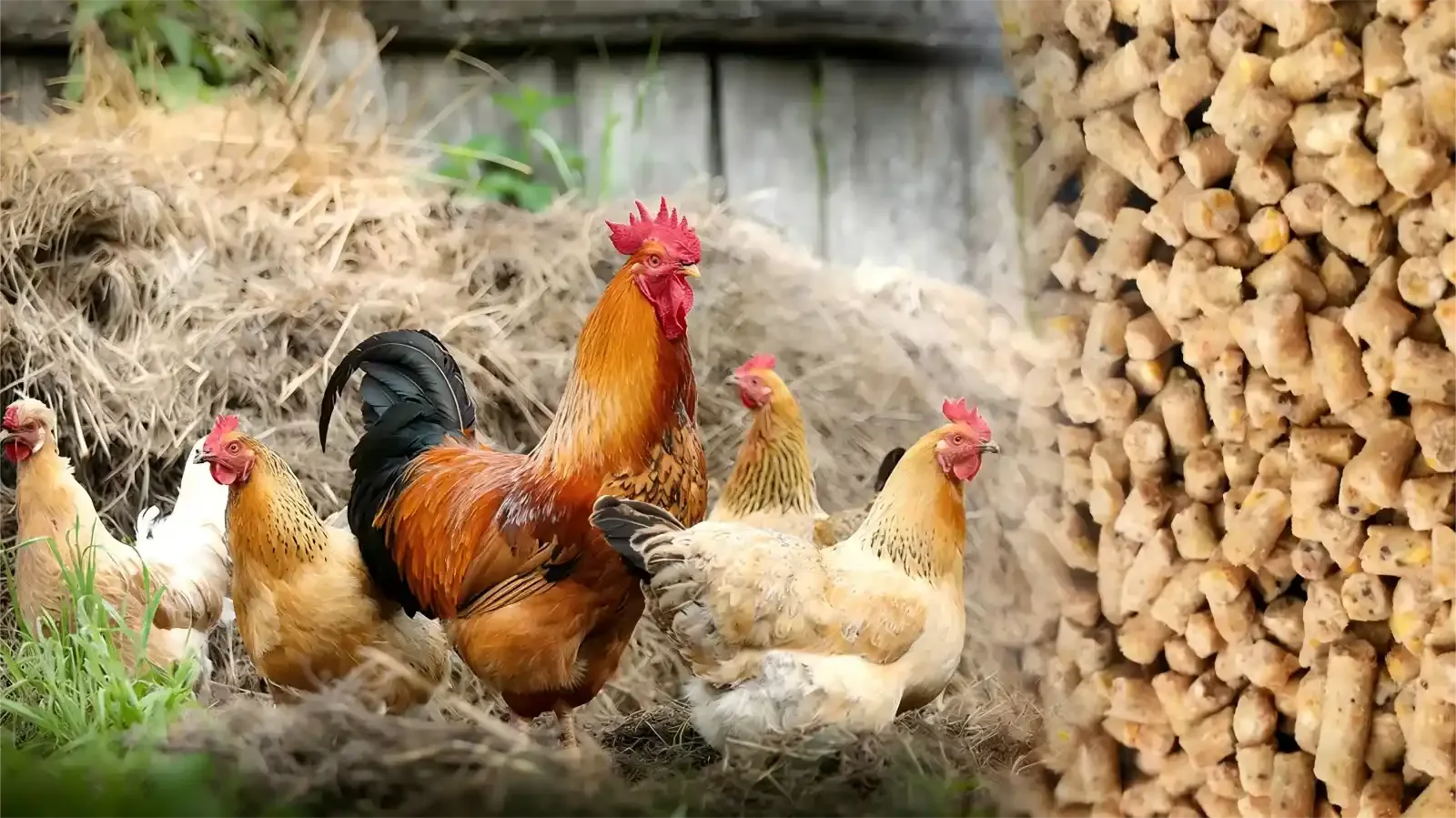
Chicken feed pellet production has become an important part of modern poultry farming and commercial feed manufacturing. Compared with loose mash feed, well-produced pellets are easier to transport, store, handle, and distribute. They can also help reduce feed separation and make it easier to provide a consistent nutrient mixture to chickens.
However, producing chicken feed pellets efficiently requires more than simply operating a pellet mill. Production efficiency depends on the entire processing system, including raw material preparation, grinding, batching, mixing, conditioning, pelleting, cooling, screening, and packaging.
A properly selected chicken feed pellets machine can play an important role in this process. It converts the prepared feed mixture into compact pellets, but its actual performance is influenced by the feed formula, raw material characteristics, particle size, moisture, conditioning, die specification, feeding rate, and operating conditions.
For poultry farms and feed manufacturers planning to increase production, understanding these factors can help improve pellet quality while controlling production costs.
Why Efficient Chicken Feed Pellet Production Matters
Feed is one of the largest operating costs in commercial poultry production. For feed manufacturers, production efficiency also directly affects manufacturing costs and delivery capacity.
An efficient production system can provide several benefits.
Lower Production Costs
Efficient equipment can reduce unnecessary energy consumption and minimize material losses.
Higher Production Capacity
A well-designed process allows the pellet machine to operate closer to its intended capacity without frequent interruptions.
More Consistent Pellets
Stable grinding, mixing, conditioning, and pelleting can improve pellet uniformity.
Less Feed Waste
Better pellet quality and effective screening can reduce excessive fines and broken pellets.
Easier Production Management
Automated batching, conveying, pelleting, cooling, and packing systems can reduce manual work and improve production consistency.
For a commercial feed factory, these improvements can have a significant effect over the long term.
What Makes Good Chicken Feed Pellets
Before discussing production efficiency, it is important to understand what the final product should look like.
High-quality chicken feed pellets normally need to have:
- Uniform diameter
- Appropriate length
- Good hardness
- Adequate durability
- Low fines content
- Stable moisture
- Smooth surface
- Consistent nutrient distribution
The exact requirements depend on the chicken type and growth stage.
Chickens at different ages may require different particle sizes. Broilers, layers, pullets, and breeders can also have different feed requirements.
Therefore, a feed factory should design its production process around the target products rather than using one fixed setting for every formula.
Choosing the Right Raw Materials
The first step toward efficient production is controlling the raw materials.
Common ingredients for chicken feed include:
- Corn
- Wheat
- Sorghum
- Soybean meal
- Wheat bran
- Rice bran
- Rapeseed meal
- Cottonseed meal
- Fish meal
- Vegetable oil
- Limestone
- Phosphate
- Salt
- Vitamin premixes
- Mineral premixes
- Amino acids
- Other additives
Each ingredient has different physical characteristics.
Corn contains significant starch and generally has good pelletizing properties. Soybean meal contributes protein. Bran can affect fiber content and pellet structure. Oil can influence lubrication and pellet formation.
Therefore, the formulation itself can affect how easily the feed can be pelleted.
Grinding Has a Major Influence on Pellet Quality
Grinding is often underestimated when designing a feed plant.
Large particles can make it more difficult to produce dense, uniform pellets.
A hammer mill is commonly used to reduce the particle size of corn and other grains before mixing.
A suitable grinding system should provide:
- Consistent particle size
- Stable throughput
- Reasonable energy consumption
- Easy screen replacement
- Reliable continuous operation
Grinding too coarsely can negatively affect pellet quality.
Grinding excessively fine can increase power consumption and dust generation.
The ideal particle size should therefore be selected according to the feed formula and final pellet specifications.
For many poultry feed applications, controlling the ground material to a suitable fine size is an important part of achieving stable pellet formation.
Accurate Batching Improves Production Consistency
After grinding, the ingredients need to be accurately weighed.
A commercial chicken feed plant may use dozens of ingredients.
Major ingredients such as corn and soybean meal can be handled through large weighing bins, while smaller additives may require a micro-dosing system.
Accurate batching helps ensure that each batch follows the intended formula.
Poor batching accuracy can cause two problems.
First, the nutritional value of the feed may not match the formulation.
Second, changes in the physical composition of the feed can affect pelletizing performance.
Therefore, batching accuracy is important for both feed quality and equipment stability.
Mixing Before Pelletizing
The ingredients must be mixed thoroughly before entering the pelletizing process.
A good mixer should distribute major and minor ingredients evenly.
This is particularly important when the formula contains small quantities of vitamins, minerals, enzymes, or other additives.
If the mixture is not uniform, the nutritional composition of different portions of the finished feed may vary.
For commercial feed production, the mixer should therefore be selected according to batch size, formula characteristics, mixing time, and required uniformity.
Why Conditioning Is Important
Conditioning is one of the most important steps before pelleting.
During conditioning, steam is introduced into the feed mixture.
The heat and moisture can soften the material and improve its physical properties before compression.
For grain-based poultry feed, conditioning can help support starch gelatinization and improve pellet binding.
Proper conditioning can result in:
- Better pellet durability
- Fewer fines
- Smoother pellets
- More stable production
- Improved pellet mill performance
However, conditioning needs to be controlled carefully.
Too little steam may result in insufficient conditioning.
Too much moisture can make the material difficult to pelletize and can increase the load on downstream cooling equipment.
Therefore, steam pressure, moisture, temperature, retention time, and feed rate should be considered together.
The Role of the Chicken Feed Pellets Machine
The pellet machine is the central equipment in the pelleting stage.
After conditioning, the feed enters the pelletizing chamber.
In a typical ring die system, pressure rollers compress the material against the inner surface of a rotating ring die. The material is forced through the die holes and emerges as compact feed pellets.
A cutter then determines the approximate pellet length.
The diameter of the finished pellets is mainly determined by the die hole diameter.
A modern chicken feed pellets machine should provide stable feeding, reliable compression, efficient transmission, and convenient adjustment.
For commercial poultry feed production, the machine also needs to withstand continuous operation and changing production conditions.
(Learn more: https://richipelletizer.com/chicken-feed-pellet-machine-for-sale/)
Selecting the Correct Ring Die
The ring die is one of the most important components of a pellet machine.
Its hole diameter determines the basic pellet diameter.
The compression ratio of the die also affects the pressure required during pelleting.
Different feed formulas may require different die configurations.
For example, a formula with high starch content may pellet differently from one containing higher levels of fiber or oil.
When a feed factory produces multiple products, it may need several ring dies.
This allows the same pellet machine to produce different pellet sizes for different poultry growth stages.
Pressure Roller Condition
The pressure rollers work together with the ring die to compress the feed.
If the rollers become excessively worn, the contact between the rollers and die may become less effective.
Possible consequences include:
- Reduced production
- Increased fines
- Uneven pellets
- Higher energy consumption
- Unstable operation
Operators should therefore inspect the rollers regularly.
The working gap between the rollers and ring die should also be adjusted according to the manufacturer's requirements.
Correct roller adjustment can help improve pellet formation and reduce unnecessary wear.
Feeding Rate Must Be Stable
The feeding system also affects production efficiency.
If the material enters the pellet machine too quickly, the machine may become overloaded.
If the feeding rate is too low, the machine may not reach its intended output.
A variable-frequency feeder can help operators adjust the material flow according to machine load and production requirements.
Stable feeding allows the pellet machine to operate more consistently.
For large commercial plants, automatic feeding control can be integrated into the central control system.
How Moisture Affects Pellet Production
Moisture is another important factor.
If the feed is too dry, it may be difficult to form strong pellets.
If it contains excessive moisture, the pellets may be soft after pelleting and require additional cooling and drying.
Moisture can come from:
- Raw materials
- Added liquids
- Steam conditioning
- Oil or molasses systems
Therefore, the complete moisture balance should be considered.
Operators should not simply increase steam addition when pellet quality decreases. They should first identify whether the problem is actually related to moisture, particle size, formula, die compression, or another operating condition.
Cooling the Finished Pellets
Fresh pellets leave the pellet machine at elevated temperature.
They also contain moisture introduced during conditioning.
A counter-flow pellet cooler is commonly used to reduce temperature and moisture before screening and packaging.
Effective cooling is important for storage stability.
If hot pellets are packed immediately, condensation may occur inside the packaging.
This can create conditions that negatively affect feed quality during storage.
Therefore, the cooling system should be matched to the pellet machine capacity.
An undersized cooler can become a bottleneck even when the pellet machine itself has sufficient capacity.
Screening Helps Improve Final Product Quality
After cooling, pellets should be screened.
A vibrating screen can separate:
- Good pellets
- Fine powder
- Broken pellets
- Oversized particles
The finished pellets can be sent to packaging, while recoverable fines can be returned to the production process.
Effective screening helps improve the appearance and consistency of the final feed.
It also prevents excessive powder from entering the finished product.
Crumbling for Young Chickens
Young chickens may require smaller particles than mature poultry.
A poultry feed crumble machine can be installed after the pellet machine and cooler.
The crumbler breaks larger pellets into smaller particles.
This allows a commercial feed plant to produce different types of chicken feed using a flexible production system.
For example, a factory may manufacture:
- Chick starter feed
- Broiler starter feed
- Grower feed
- Finisher feed
- Layer feed
- Breeder feed
The final particle size can be adjusted according to the target product.
Common Reasons for Excessive Pellet Fines
High levels of fines are a common concern in chicken feed production.
Several factors can contribute to the problem.
Insufficient Conditioning
If the feed is not properly conditioned, binding may be inadequate.
Incorrect Die Selection
An unsuitable compression ratio can affect pellet formation.
Excessive Roller Wear
Worn rollers may reduce compression efficiency.
Incorrect Moisture
The feed may be too dry or too wet.
Poor Grinding
Large or uneven particles can negatively affect pellet quality.
Improper Formula
High oil, fiber, or mineral levels can change pelletizing characteristics.
Inadequate Cooling
Poor cooling can affect pellet stability after production.
Therefore, operators should identify the actual cause instead of simply increasing pellet machine pressure.
Improving Energy Efficiency
Energy is an important production cost in a commercial feed factory.
The major energy-consuming processes may include:
- Grinding
- Mixing
- Steam generation
- Pelleting
- Cooling
- Conveying
- Packing
The pellet machine itself is a major energy consumer.
Several approaches can help improve overall efficiency.
Use Appropriate Raw Material Particle Size
Efficient grinding can reduce unnecessary load on the pellet mill.
Optimize Conditioning
Proper conditioning can reduce unnecessary resistance during pelleting.
Maintain the Die and Rollers
Worn components can reduce mechanical efficiency.
Avoid Overloading
Stable feeding helps keep the pellet machine operating within an appropriate load range.
Use Efficient Transmission
Modern heavy-duty gear transmission systems can provide efficient power transfer and are widely used in industrial ring die pellet machines.
The exact energy consumption of a production line depends on many variables, so it should be evaluated based on the complete process rather than motor power alone.
Production Capacity and Equipment Matching
A common mistake when planning a feed factory is selecting the pellet machine first and then trying to fit the rest of the equipment around it.
A better approach is to calculate the required production capacity for the complete line.
For example, if a factory needs to produce 100 tons per day and operates 20 hours per day, the average production requirement is:
100 ÷ 20 = 5 t/h
The production line should then be designed around this requirement.
However, the nominal capacity of each machine should not necessarily be exactly 5 t/h.
The grinding, mixing, conditioning, cooling, screening, and packing systems should have compatible capacities.
If one piece of equipment is significantly smaller than the pellet machine, it can become a production bottleneck.
Choosing Equipment for Different Production Scales
Different customers require different equipment configurations.
Small Poultry Feed Production
A small farm producing its own feed may use a relatively simple system.
The equipment may include:
- Feed grinder
- Mixer
- Small pellet machine
- Cooler
- Screen
- Packing equipment
The emphasis is usually on simple operation and reasonable investment.
Medium Feed Production
A medium-sized plant may require:
- Raw material cleaning
- Hammer mill
- Automatic batching
- Mixer
- Conditioner
- Ring die pellet machine
- Cooler
- Screen
- Packing machine
- Control system
This configuration provides greater production stability and automation.
Large Commercial Feed Factory
A large feed factory may include:
- Raw material receiving system
- Storage silos
- Cleaning system
- Multiple grinding lines
- Automatic batching
- Micro-dosing
- High-capacity mixer
- Steam conditioning
- Multiple pellet machines
- Cooling system
- Screening
- Crumbling
- Finished product storage
- Automatic packing
- Palletizing
- Dust collection
- Centralized control
The larger the project, the more important process coordination becomes.
Maintenance for Stable Operation
Regular maintenance can significantly improve equipment reliability.
Operators should inspect the following components regularly:
- Ring die
- Pressure rollers
- Bearings
- Gearbox
- Feeder
- Conditioner
- Lubrication system
- Motors
- Electrical components
- Safety devices
The die and rollers should be inspected for wear.
Lubrication should be performed according to the equipment manufacturer's maintenance schedule.
Unusual vibration, abnormal noise, increased temperature, or changes in electrical current should be investigated promptly.
Preventive maintenance is generally more economical than waiting for major equipment failure.
How to Reduce Production Downtime
Downtime can reduce the actual capacity of a feed factory even when the machines have sufficient nominal output.
Several measures can help reduce interruptions.
Keep Spare Wear Parts
Important spare parts should be available before they are needed.
Schedule Preventive Maintenance
Maintenance should be planned during periods of low production demand.
Train Operators
Operators should understand machine settings, safety procedures, lubrication, and basic troubleshooting.
Monitor Production Data
Changes in output, energy consumption, vibration, and pellet quality can indicate developing problems.
Maintain Stable Raw Material Supply
A pellet machine cannot operate continuously if the grinding or batching system frequently runs out of material.
Automation in Chicken Feed Production
Automation can improve production management, especially in medium and large feed factories.
A centralized control system can monitor:
- Raw material levels
- Batching accuracy
- Mixer operation
- Steam conditioning
- Pellet machine load
- Cooler temperature
- Screening
- Packing
- Equipment alarms
Automated systems can also reduce manual intervention.
For large factories operating multiple shifts, automation can help maintain consistent operating conditions.
Building a Complete Chicken Feed Pellet Plant
A commercial chicken feed pellet plant should be considered as a complete system rather than a collection of individual machines.
A typical process may include:
Raw Material Receiving
↓
Cleaning
↓
Grinding
↓
Batching
↓
Mixing
↓
Conditioning
↓
Pelletizing
↓
Cooling
↓
Screening
↓
Crumbling if Required
↓
Packing
↓
Finished Feed Storage
Each stage affects the next.
For example, poor grinding can affect mixing and pelleting. Poor conditioning can affect pellet durability. Insufficient cooling can affect storage. Poor screening can affect finished product quality.
This is why professional process design is important for commercial projects.
Factors Affecting Chicken Feed Plant Investment
The cost of a complete chicken feed plant depends on much more than the price of the pellet machine.
Important factors include:
- Production capacity
- Number of feed formulas
- Raw material types
- Storage requirements
- Grinding capacity
- Batching system
- Mixer capacity
- Pellet machine configuration
- Cooling capacity
- Screening requirements
- Packing method
- Automation level
- Factory layout
- Electrical system
- Dust collection
- Installation
- Commissioning
A small 1–2 t/h farm feed system can have a very different investment requirement from a 30–40 t/h commercial production line.
Therefore, a supplier should normally provide a customized quotation based on the actual project requirements.
Why Choose a Complete Engineering Solution
For a small farm, purchasing individual machines may be practical.
For a commercial factory, however, a complete engineering solution can simplify the project.
A professional supplier can help coordinate:
- Process design
- Equipment selection
- Capacity matching
- Factory layout
- Equipment manufacturing
- Transportation
- Installation
- Commissioning
- Operator training
- After-sales service
RICHI Pelletizer positions its feed equipment business around both individual pellet machines and complete turnkey production lines, with chicken feed pellet equipment listed in a capacity range of approximately 1–40 t/h and pellet sizes of 2–12 mm.
This type of complete-service approach can help reduce compatibility problems between equipment supplied by different manufacturers.
Frequently Asked Questions
What is a chicken feed pellets machine?
A chicken feed pellets machine is equipment designed to compress prepared poultry feed mixtures into uniform pellets. Ring die pellet machines are commonly used for medium and large-scale commercial feed production.
What ingredients can be processed?
Common ingredients include corn, wheat, soybean meal, bran, protein meals, minerals, vitamins, and other feed additives.
Can the machine produce different pellet sizes?
Yes. Different ring dies can be selected for different pellet diameters, depending on the machine design and production requirements.
Does chicken feed need steam conditioning?
Steam conditioning is widely used in commercial poultry feed production. It can improve feed preparation and pellet formation, although the exact conditioning parameters depend on the formula.
Why do my pellets contain too much powder?
Possible causes include poor conditioning, unsuitable moisture, excessive particle size, worn rollers, incorrect die compression, or an unsuitable feed formula.
How can I increase pellet machine output?
Start by checking raw material particle size, conditioning, feeding stability, die condition, roller adjustment, and the capacity of upstream equipment. Increasing feed rate alone is not always the correct solution.
Do I need a cooler?
For commercial production, a cooler is normally required because freshly produced pellets contain heat and moisture.
Can one production line make both broiler and layer feed?
Yes. A properly designed production line can manufacture multiple formulas. However, formulation management, die selection, batching, cleaning, and product handling should be considered.
Conclusion
Efficient chicken feed pellet production is the result of a well-coordinated processing system rather than one individual machine.
The chicken feed pellets machine is the core equipment for forming the final pellets, but its performance depends on everything around it. Raw material quality, grinding, batching, mixing, conditioning, die selection, roller adjustment, cooling, screening, and packaging all contribute to the final result.
For small poultry farms, a compact system may be sufficient. For commercial feed manufacturers, a complete automated production line can provide better control over capacity, quality, labor, and operating costs.
When planning a new chicken feed plant, it is therefore important to evaluate the complete production process. Selecting the right equipment capacity, matching auxiliary machines, controlling pellet quality, maintaining wear parts, and providing proper operator training can all contribute to more stable and efficient production.
A professional turnkey engineering supplier can integrate these processes into one complete solution, helping poultry farms and feed manufacturers move from raw materials to finished chicken feed pellets with greater efficiency and consistency.