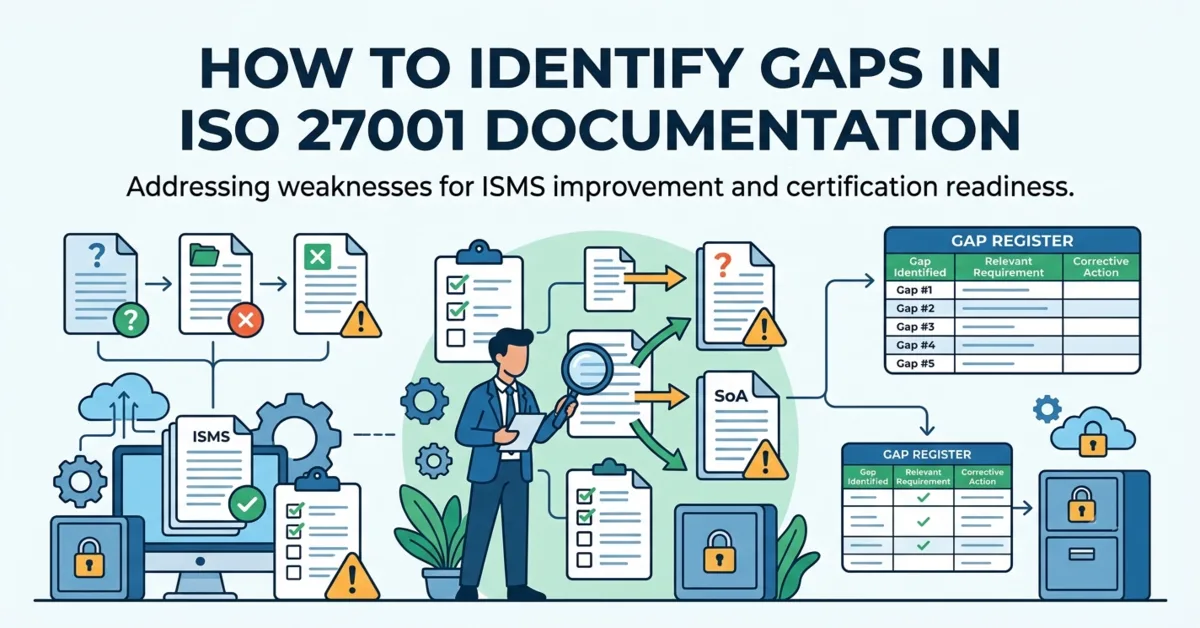
An Information Security Management System (ISMS) relies on documented information to manage security risks, responsibilities, and operational controls. However, documents may become outdated, procedures may not reflect actual practices, and essential records may be missing. Identifying ISO 27001 documentation gaps helps organizations address weaknesses, improve information security, and prepare for certification audits.
A structured review against ISO/IEC 27001 requirements helps determine whether existing documentation supports the organization's ISMS scope and security objectives.
Understand Common Documentation Gaps
Documentation gaps do not always mean a document is missing. They can also occur when policies contain outdated information, procedures lack clear responsibilities, or records fail to demonstrate effective implementation.
For example, an organization may maintain an access control policy but lack evidence of periodic access reviews. Similarly, a risk register may identify security risks without corresponding treatment actions. These inconsistencies can affect ISMS effectiveness and audit readiness.
Review the ISMS Scope and Requirements
Start by confirming the ISMS scope, organizational boundaries, relevant business activities, and applicable requirements. This establishes which processes and documents need review.
Compare existing documented information with relevant ISO 27001 clauses and applicable controls selected through the risk assessment and treatment process. An ISO 27001 documentation checklist helps identify documents that are available, incomplete, outdated, or require development. Reviewing the ISO 27001 documents requirements and records checklist can also help organizations understand the documentation and evidence they need to examine during this review.
Compare Documents With Actual Practices
Check whether documented procedures accurately describe how employees perform their responsibilities. Review policies, interview process owners, and examine records to identify inconsistencies.
For instance, an incident management procedure may define reporting responsibilities, but incident records might not demonstrate consistent investigation and follow-up. This indicates a potential gap between documented processes and implementation.
Depending on the organization's activities, examine information security policies, asset inventories, access management records, incident response procedures, supplier security documentation, training evidence, and corrective action records.
Examine Risk Assessment and Control Evidence
Risk-related documentation connects identified security risks with appropriate treatment measures. Check whether the risk assessment methodology, risk register, and risk treatment plan are consistent and maintained.
Review the Statement of Applicability (SoA) to verify that control selections, justifications, and implementation status are appropriately documented. Compare these records with available evidence demonstrating how relevant security controls operate.
Missing approvals, incomplete records, and outdated risk assessments should be investigated and corrected to maintain consistency between documented decisions and actual practices.
Record Findings and Correct Documentation Gaps
Create a gap register containing the affected document, relevant requirement, identified weakness, potential impact, responsible person, corrective action, and target completion date.
Prioritize findings according to security risk and compliance significance. Assign responsibilities, establish deadlines, and verify whether corrective actions resolve the identified problems. Update affected documents and retain appropriate evidence of changes.
Regular reviews are important whenever business processes, technologies, or information security risks change.
Use Structured Documentation Resources
Organized documentation makes it easier to identify missing information and compare existing materials against applicable requirements. The ISO 27001 documents package provides resources for ISMS implementation, including a manual, policies, procedures, forms, an audit checklist, risk assessment resources, a Statement of Applicability, and a compliance matrix.
Organizations can customize relevant materials according to their scope, processes, and risks. Templates provide a starting point, but they must reflect actual operations and be supported by implementation evidence.
Maintain Accurate ISMS Documentation
Identifying ISO 27001 documentation gaps requires more than checking whether files exist. Comparing requirements with actual practices, documenting findings, and completing corrective actions helps improve consistency and audit readiness. Regular reviews also keep documentation aligned with changing operational needs and information security risks.