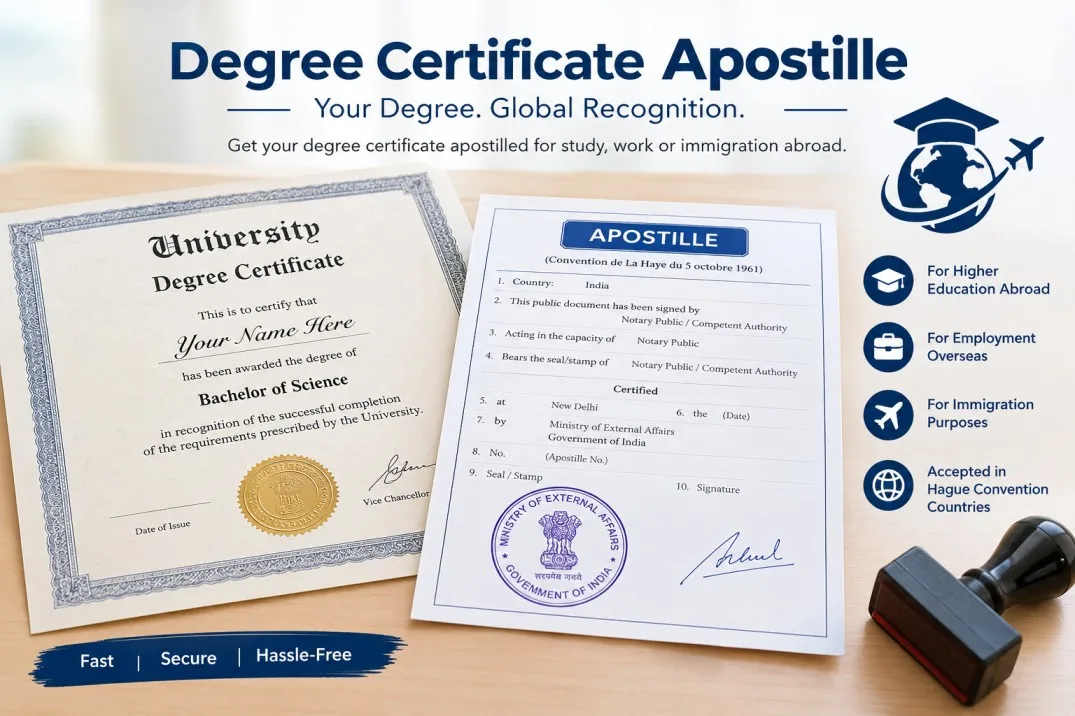
Ask anyone who's recently moved abroad for a job or a master's program, and they'll tell you the same thing, nobody explained the degree certificate apostille process to them properly until they were already stuck in the middle of it. Whether you're based in Delhi, Mumbai, or looking for apostille services in Bangalore, the steps stay pretty much the same. So here's the whole thing broken down, no jargon, no runaround.
What Is a Degree Certificate Apostille?
Think of it as a government stamp of trust. It's a certification attached to your degree that tells any authority abroad, "yes, this is a real document, issued by a real Indian university." This comes from something called the Hague Convention, an old international agreement from 1961 that India signed on to. Because of that, an apostilled degree gets accepted in more than 120 countries without you having to run around embassies for extra approval. Countries outside this convention – UAE and Saudi Arabia are common examples- work differently, and you'll need embassy attestation there instead.
Procedure for Degree Certificate Apostille
There's no shortcut here, unfortunately. It goes roughly like this:
First, your degree goes to the state HRD (or SDM, depending on where you studied) for verification. Second, some universities want to double-check the certificate themselves before it moves ahead- not always, but sometimes. And finally, it lands at the Ministry of External Affairs, where the actual apostille sticker gets applied.
Most people don't do this walk-in anymore. MEA has outsourced the collection part to authorized agencies in most cities, so you'll likely be dealing with one of those rather than showing up at an MEA office yourself. If you're located in Karnataka, plenty of people simply search for apostille services in Bangalore and hand the whole degree certificate apostille process over to a local agency instead of running between offices themselves.
How Much Does It Cost?
MEA's own charge is tiny, roughly Rs. 50 per certificate for the sticker itself. But that's not the full picture. By the time you factor in HRD attestation, notary fees, and whatever the agency charges for handling everything, you're realistically looking at somewhere between Rs. 2,000 and Rs. 4,000 per degree. Prices shift a bit depending on which state you're in and who you go through.
Does the Apostille Expire?
No, it doesn't. Once it's done, it's done; your degree stays apostilled forever for that purpose. The only exception is if a specific visa office or institution wants the document apostilled within a recent window, which happens occasionally but isn't the norm.
How Long Does It Take?
Through a decent agency, expect 3 to 5 working days once your paperwork is submitted. If you try handling it yourself, visiting HRD, then MEA, separately, be ready to wait a lot longer, sometimes two to three weeks, purely because these offices don't run on your timeline.
What Documents Will You Need?
- Your original degree certificate (if it's laminated, that's a problem – MEA generally won't touch laminated documents, so check with your university about a duplicate)
- A copy of your passport
- A couple of passport-size photos
- An authorization letter if you're not submitting it in person
Optional Documents (needed only in certain cases):
- A name-change or marriage certificate, if your name on the degree doesn't match your passport
- A notarized affidavit, in case there's a spelling mismatch between documents
- Your provisional certificate or marksheets, if the university asks for backup proof
- An offer letter or admission letter, sometimes requested by agencies just to confirm the destination country
- A duplicate degree certificate, if your original is laminated and can't carry the apostille sticker
Why Need a Degree Certificate Apostille?
Because a foreign employer or university has zero way of knowing your degree is real without it. The apostille is basically your degree's passport, proof that it's genuine and came from a legitimate source. Skip it, and you risk your documents getting rejected outright during visa processing, job verification, or university admission abroad, no matter how legitimate your degree actually is.
It's a bit of a process, sure. But once you know the order of steps and keep your paperwork ready, it's really not as painful as it first looks.
Conclusion
Getting a degree certificate apostille done isn't complicated once you know what's coming next. The trick is just staying ahead of it; don't wait until your visa deadline is a week away to start the paperwork. Keep your original degree safe, sort out your documents in advance, and either go through the state HRD and MEA yourself or hand it over to a reliable agency if you'd rather skip the running around. If you're in Karnataka, going with trusted apostille services in Bangalore can save you a fair bit of back-and-forth. Either way, this one small stamp ends up saving you a lot of trouble once you land in a new country.