
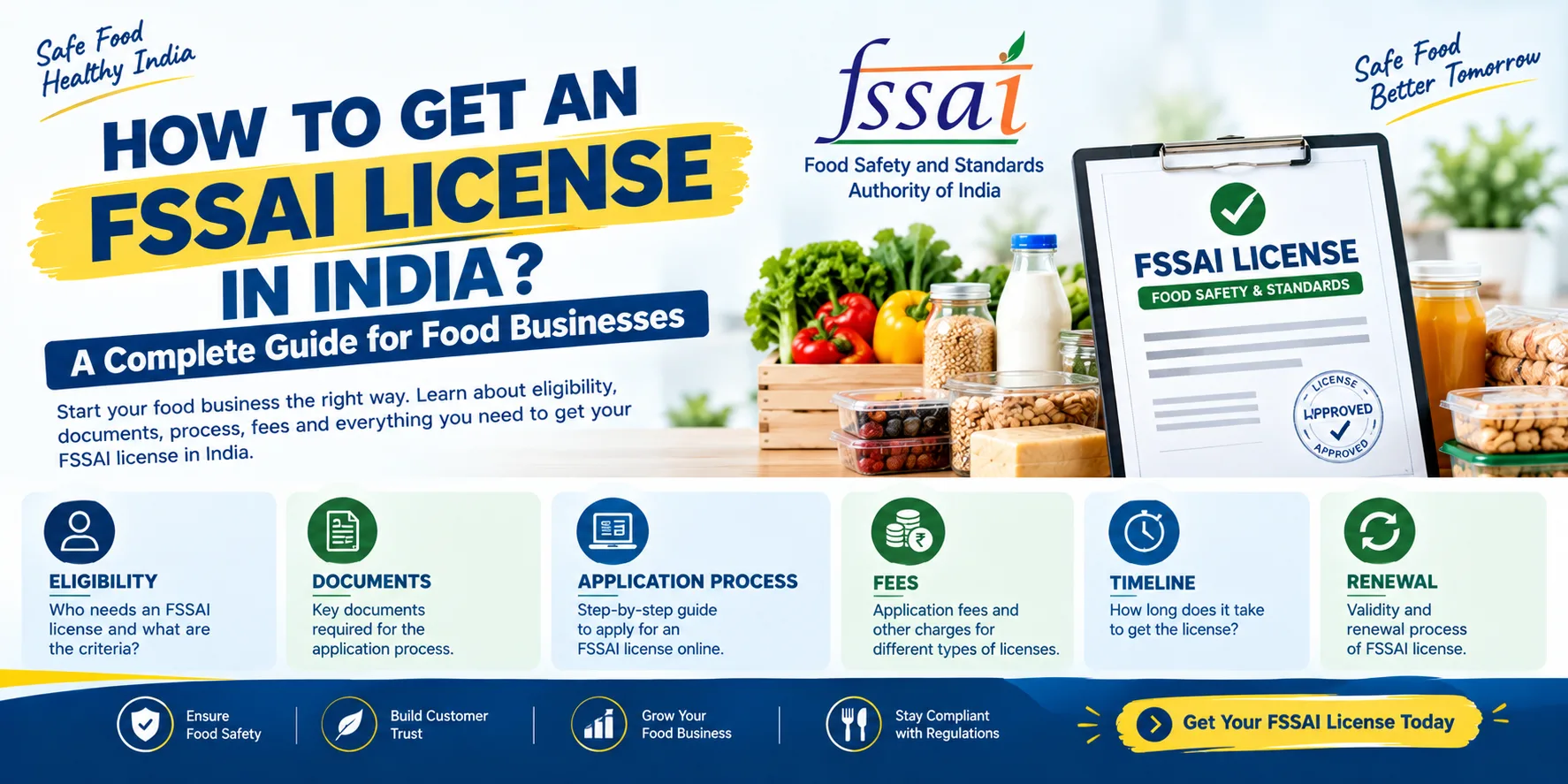
Starting a food business in India can be exciting. Whether you want to open a restaurant, cloud kitchen, bakery, food shop, catering service, or sell packaged food, you need to follow certain legal rules.
One of the most important requirements for a food business is an FSSAI license or registration. FSSAI stands for the Food Safety and Standards Authority of India. Under the Food Safety and Standards Act, food business operators are required to obtain the appropriate FSSAI registration or license.
What Is an FSSAI License?
An FSSAI license is an official approval for a food business. It shows that the business is registered with the food safety authority and is expected to follow food safety requirements.
Small food businesses may need FSSAI Registration, while larger businesses generally require a State or Central FSSAI License depending on their business type and eligibility. FSSAI's official system provides an eligibility checker to determine the appropriate category.
For example, small food sellers, petty retailers, hawkers and temporary food stalls can fall under the registration category when they meet the applicable eligibility conditions.
Who Needs an FSSAI License?
An FSSAI registration or license may be required for many types of food businesses, such as:
- Restaurants and cafes
- Bakeries and sweet shops
- Cloud kitchens
- Food manufacturers
- Food wholesalers and distributors
- Food retailers
- Caterers
- Food storage businesses
- Food transporters
- Online food businesses
- Importers and exporters of food
The exact license depends on the Kind of Business (KoB), location and applicable eligibility criteria. The FoSCoS portal provides different categories for manufacturers, retailers, food services, importers and other food businesses.
Documents Required for FSSAI License
The documents can change depending on your business type. Common documents may include:
- Identity and address proof
- Passport-size photograph
- Business address proof
- Details of the business owner or partners
- Partnership deed or company documents, where applicable
- Details of food products
- Equipment and machinery details for certain manufacturing businesses
- Layout or blueprint of the processing unit for applicable manufacturers
For example, FSSAI's document list for a State License includes Form-B, identity/address proof and, for applicable manufacturing units, a layout plan and equipment details.
How to Apply for an FSSAI License Online?
You can apply through the FoSCoS system, the online food safety compliance platform used by FSSAI.
Here is a simple step-by-step process:
Step 1: Understand Your Business Category
First, identify what type of food business you operate. You should select the correct Kind of Business while applying.
Step 2: Select Your State and Business Type
Visit the FoSCoS portal and select the state where your food business operates. Then choose the relevant business category.
Step 3: Select Registration or License
Based on your business details, the system will indicate whether you need registration or a license. FSSAI provides an eligibility tool to help applicants select the appropriate category.
Step 4: Fill in the Application
Enter your business details, owner information, premises details and food business information carefully.
Step 5: Upload Documents
Upload the required documents according to your business category.
Step 6: Pay the Applicable Fee
Pay the government fee applicable to your selected registration or license category.
Step 7: Track Your Application
After submission, you can track your application through the FoSCoS portal.
Once the application is processed and approved, the applicable FSSAI registration or license is issued.
Is FSSAI License the Only Registration You Need?
No. A food business may need other approvals depending on its activities and location.
For example, a business may also need a shop establishment certificate under the applicable state rules. Similarly, a security agency may need a PSARA licence, but PSARA is related to private security agencies and is not a replacement for an FSSAI license.
If you want to protect your business name or brand, Trademark registration can also be considered. Trademark registration and FSSAI licensing serve different purposes: FSSAI focuses on food safety compliance, while a trademark helps protect a brand or mark.
Therefore, it is important to check which registrations apply to your particular business instead of assuming that one certificate covers everything.
Common Mistakes to Avoid
Many business owners make small mistakes while applying for an FSSAI license. Some common ones are:
- Choosing the wrong business category
- Providing incorrect business details
- Uploading incomplete documents
- Giving incorrect food product information
- Ignoring renewal requirements
- Not checking the eligibility criteria before applying
Taking a little time to check the requirements can help make the application process smoother.
Why Should You Get an FSSAI License?
An FSSAI license helps a food business meet its legal food safety requirements. It also gives customers more confidence that the business is operating under the applicable food safety framework.
For a growing food business, keeping registrations and compliance documents properly updated is an important part of running the business.
Conclusion
Getting an FSSAI license in India does not have to be confusing. Start by understanding your food business, check the correct eligibility category, prepare the required documents and submit the application through FoSCoS.
Remember that other approvals, such as a shop establishment certificate, PSARA licence, or Trademark registration, have different purposes and may apply depending on your business activities.
If you are unsure about the right registration or compliance requirement, CorpBiz can help businesses understand and manage their registration and compliance needs.
Author Profile
Gaurav Sharma is a legal consultant and business compliance expert associated with CorpBiz. With more than 10 years of experience, he helps startups and businesses understand registrations, licenses and legal compliance in India. His areas of expertise include FSSAI licensing, business registration, GeM registration, GMP certification and other business compliance services. He focuses on explaining complex legal processes in simple words so business owners can make informed decisions.