
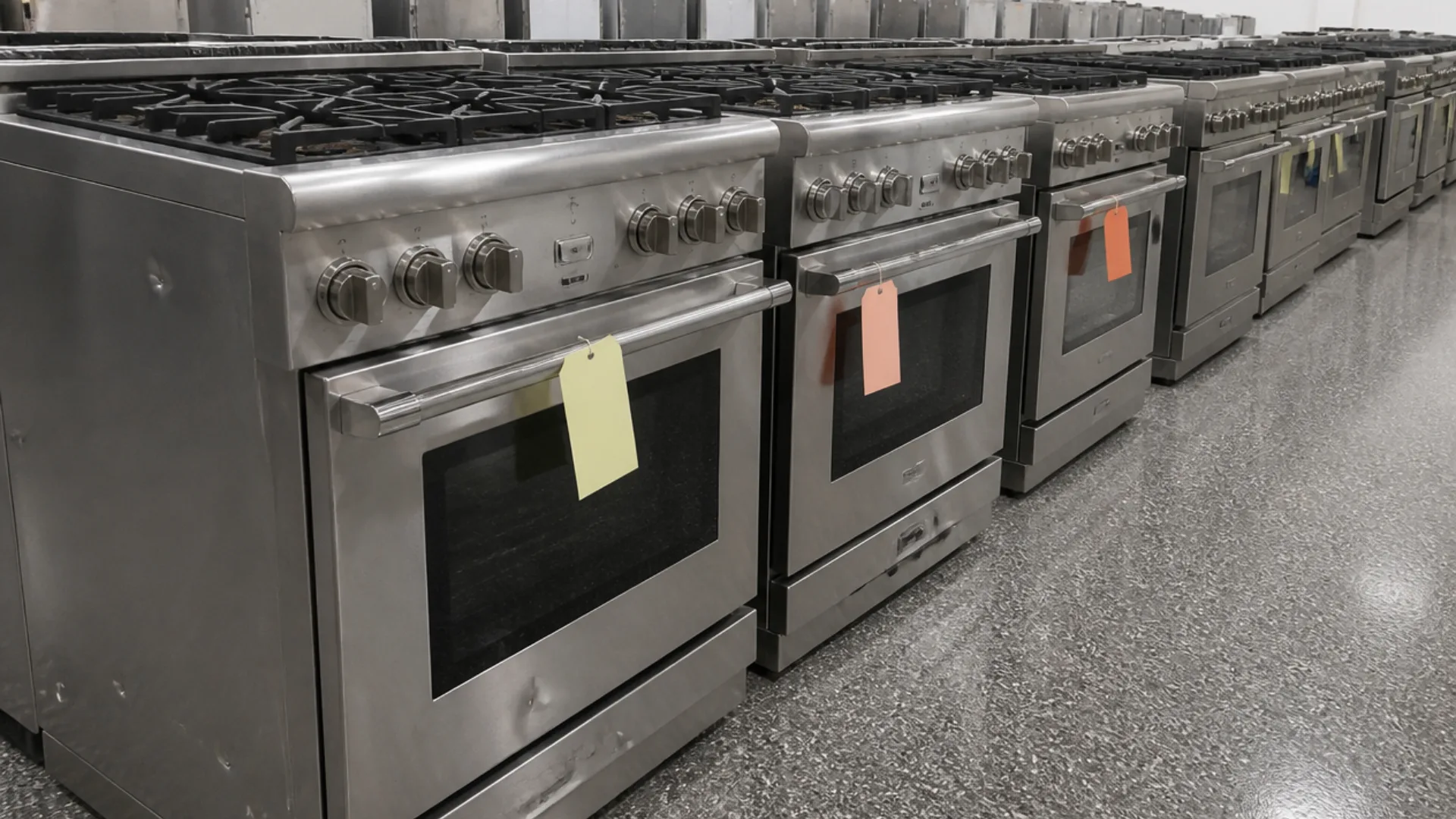
To find a quality scratch and dent gas range, you buy from a dealer who inspects and tests every unit, you check the burners, the oven, and the gas connection area yourself, and you have a licensed pro hook it up. That is the whole process. It is not complicated, but it does ask you to slow down a little, because gas is not something to rush. We bought our gas range this way a few years ago. It retailed at $1,250, and we paid $780 for a scratch and dent unit with a scuff on the left side panel. That side sits against our cabinet. Every burner lit on the first click, the oven held its temperature, and we have cooked on it almost daily since. The savings were real, and the range works like any other.
Key Takeaways
- A quality scratch and dent gas range cooks the same as a full-price one because the cosmetic damage stays on the outer shell and never reaches the burners, valves, or oven
- Freestanding and slide-in gas ranges hide their sides and rear once installed, so most freight damage ends up out of sight
- Gas adds a safety side to the inspection. Ignition, flame quality, the oven igniter, and the area around the gas inlet all need a careful look
- Always have a licensed professional connect the gas line and test for leaks after installation
- Savings on a scratch and dent gas range often run 20 to 45 percent off retail, which can mean $250 to $900 on one purchase
- Appliance Shark carries inspected scratch and dent ranges with written condition notes, tested burners, and clear pricing so buyers know what they are getting
Why a Gas Range Is a Good Scratch and Dent Purchase
Gas ranges are simple, sturdy machines, and that works in your favor when you shop for one at a discount.
Simple Parts, Easy to Test
A gas range has burners, igniters, valves, knobs, and an oven with a bake burner and a broil burner. You can test almost every one of these parts in a short visit to the dealer. There is no compressor, no drum, and no complicated electronics to wonder about. What you see working in front of you is what you get.
Installation Hides the Usual Damage
A freestanding range slides in between two sections of the counter. A slide-in range sits snugly in the same kind of space. Either way, the sides and the back end up tucked out of sight.
Freight damage usually lands on those sides, the back, and the lower corners. That means the dents and scuffs that earn the discount tend to sit on surfaces nobody will see once the range is in place.
The Price Gap Is Worth Noticing
A solid gas range from a trusted brand often retails between $700 and $1,800. Higher-end and professional-style models can run $2,000 to $3,500 or more. At 20 to 45 percent off, the savings add up quickly. A $1,300 range at 35 percent off saves $455. A $2,200 range at 40 percent off saves $880.
Where the Real Risk Lives With Gas
We want to be honest here. With most appliances, the worst case from a cosmetic dent is that it bugs you. With gas, a few spots deserve more attention.
The Gas Inlet and Rear Pipe Area
Gas enters the range at the rear, usually low on the back. If the dent or damage is near that area, have the dealer's technician confirm that the inlet pipe, the manifold, and the fittings are straight and undamaged. A dent on the side panel is a very different thing from a bend near the gas inlet.
The Oven Igniter and Safety Valve
The oven lights using an igniter and a safety valve that controls the gas flow. If the igniter is weak, the oven can take a long time to light or fail to light at all. You should see the oven light within a reasonable time after you turn it on.
Smell and Flame Quality
Never ignore the smell of gas. If you notice a gas smell around a range at the dealer, tell the staff right away and skip that unit. At home, if you ever smell gas, leave the house and call your gas company from outside. A healthy burner flame is mostly blue and steady.
Our Inspection Checklist for a Scratch and Dent Gas Range
Here is what we check, in order, every time.
Step One: Match the Paperwork to the Range
Compare the written condition notes to the actual unit. Every listed dent and scratch should be where the paper says it is. Then look at the parts the notes did not mention, especially the rear panel and the lower back area near the gas inlet.
Step Two: Light Every Burner
Turn each burner on and listen for the clicking of the igniter. Each one should light within a second or two. Watch the flame. It should be steady and mostly blue. Try low, medium, and high settings. A burner that clicks for a long time, pops, or will not light needs a closer look or a pass.
Step Three: Check the Grates, Caps, and Knobs
Make sure every grate is there and sits level. Make sure each burner cap is in place. Turn every knob through its full range. Knobs should feel smooth and positive, not loose or sticky.
Step Four: Test the Oven
Set the oven to 350 degrees and let it preheat. The igniter should glow and the burner should light. The oven should reach temperature in a normal amount of time. Switch to broil and make sure that the burner lights too. An oven thermometer inside will show you whether the temperature is accurate.
Step Five: Check the Oven Door
Look closely at the oven door glass for cracks or chips. Press along the gasket to make sure it springs back. Open and close the door and make sure it swings smoothly and holds in place.
Step Six: Check the Controls and Clock
Test the timer, the clock, and any lights. On a model with digital controls, press every button and watch for error codes.
Step Seven: Look at the Anti-Tip Bracket
Ranges should come with an anti-tip bracket that secures the unit to the floor or wall. Make sure it is included. It is a small piece with a big safety job.
Check Your Space and Gas Setup Before You Buy
Gas ranges have a few setup needs worth confirming ahead of time.
- Fuel type: Natural gas and propane use different settings. Some ranges come with a conversion kit. Ask which fuel the unit is set up for.
- Size: Most ranges are 30 inches wide. Measure your opening and compare it to the spec sheet.
- Style: Freestanding ranges have finished sides. Slide-in ranges have unfinished sides and overlap the counter a bit. Pick the one that fits your kitchen.
- Gas line and outlet: Make sure a gas shutoff valve is in the right spot behind the range.
- Power: A gas range still needs a standard electrical outlet for the igniters and controls.
Have a licensed professional connect the range and test the connection for leaks after installation. This is not a job to skip or to guess at.
Warranty and Return Terms
Ask whether any manufacturer warranty remains and what it covers. Ask whether it passes to you as the new owner. Then ask about the return policy, including what happens if a problem shows up after installation. Get the answers in writing before you pay.
Brands Worth Looking For
- GE and GE Profile: Wide range of styles and a big service network
- Whirlpool: Simple builds and easy-to-find parts
- Samsung: Popular features like dual ovens
- LG: Strong reliability and solid burner performance
- KitchenAid: Professional looks and powerful burners
- Bosch: Clean design and precise controls
- Maytag: Durable and built for heavy use
- Frigidaire: Good value from an established brand
Ready to Find a Scratch and Dent Gas Range? Contact Appliance Shark Today
A quality gas range should not cost a fortune. Appliance Shark carries inspected scratch and dent gas ranges with written condition notes, tested burners and ovens, and honest pricing, so you can save money without guessing about what is inside.
Contact Appliance Shark today, browse their scratch and dent gas range collection now, and find a brand-name range that has been tested and confirmed before it ever reaches your kitchen.
Do you have a range or oven that needs repair? Schedule a Book Repair now and let Appliance Shark's certified technicians bring it back to full working condition with the care your kitchen deserves.
Frequently Asked Questions
Does a scratch and dent gas range cook as well as a new one?
Yes. Cooking depends on the burners, valves, and oven, which are not affected by cosmetic damage to the side panels or frame.
Is a scratch and dent gas range safe?
It can be, when it is inspected and tested by the dealer, checked by you, and connected by a licensed professional who tests for leaks.
What should I check first on a gas range?
Light every burner and test the oven. Then look closely at the rear area near the gas inlet for any damage.
Will the dent show once the range is installed?
Damage on the sides and back is usually hidden by cabinets and walls, so most dents are out of sight.
How much can I save on a scratch and dent gas range?
Savings often run 20 to 45 percent off retail, which is $250 to $900 on many models.