
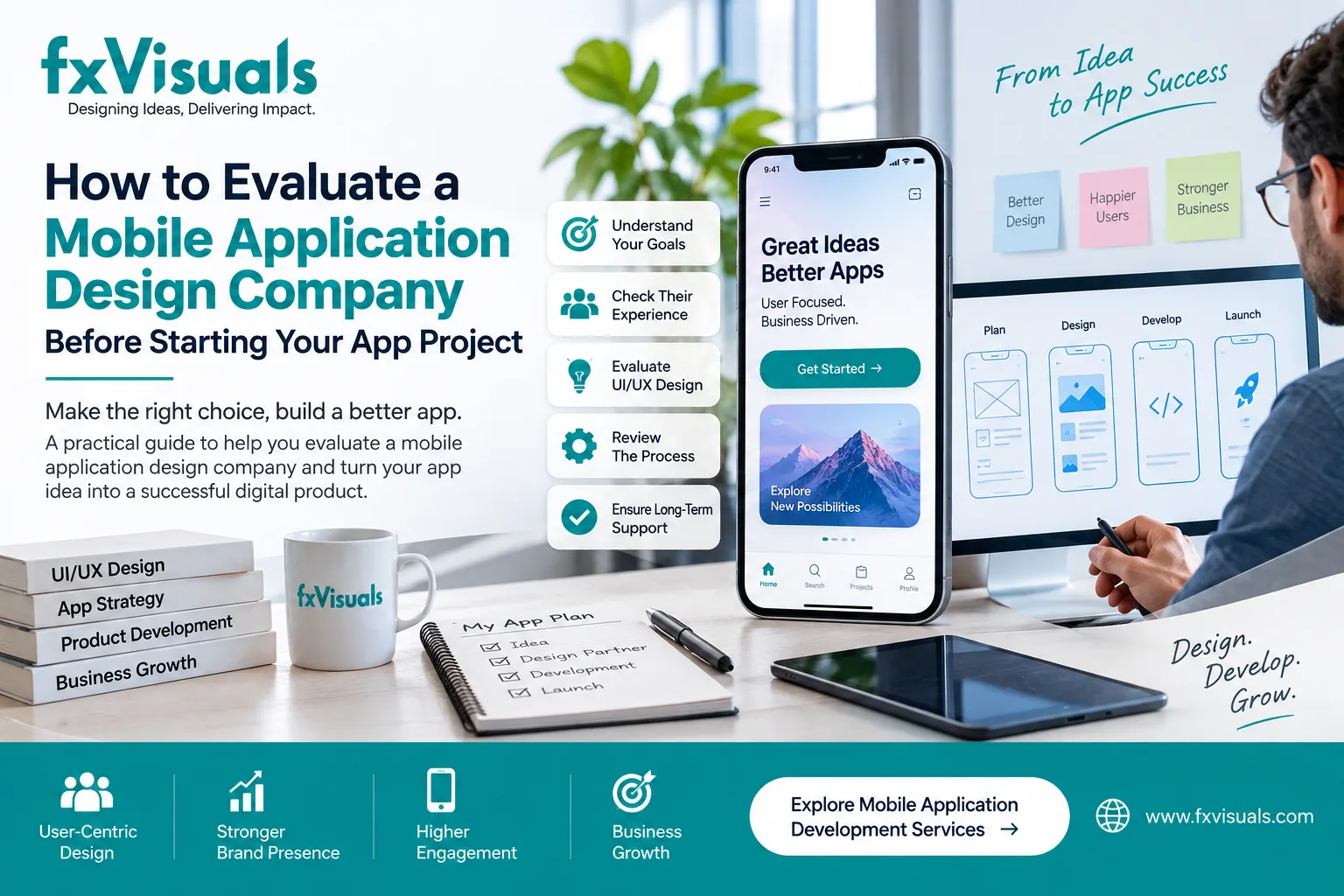
Choosing a mobile application design company based only on portfolio screenshots, a low quote, or a confident sales pitch is one of the most common ways an app project goes sideways. The problems usually don't show up in week one they show up three months in, when the wireframes don't match how users actually behave, developers can't implement what was handed to them, or the "beautiful" design turns out to be difficult to actually use.
App design isn't just about making screens look attractive. A mobile app that actually performs needs to be easy to navigate, designed around real user needs, consistent with your brand, optimized for mobile usability, built around clear business objectives, ready to hand off to development, and flexible enough to evolve after launch. This guide walks through what a US business should evaluate before signing an agreement with a mobile app design company or mobile app design agency.
Planning a mobile app for your business? Explore how fxVisuals can help turn your app idea into a user-focused mobile experience. Explore Mobile Application Development Services →
What Does a Mobile Application Design Company Do?
In plain terms, a mobile application design services provider is responsible for how an app looks, feels, and works before a single line of production code is written. That work typically includes:
- User research
- User journey planning
- Information architecture
- Wireframing
- UI design
- UX design
- Interactive prototypes
- Design systems
- Mobile usability
- Developer handoff
- Design testing
It's worth being clear about the distinction here, because the two terms get used interchangeably: design determines how the application looks, feels, and works for the user, while development turns those approved designs into a functional application. A design company that only produces static images without wireframes, prototypes, or a design system is doing a fraction of that job.
Why Choosing the Right App Design Company Matters
The design phase sets the ceiling for everything that follows. A weak information architecture gets baked into the development timeline. An untested user flow surfaces as low engagement after launch. A design system that was never documented turns every future update into guesswork. Getting this stage right doesn't just affect how the app looks on day one it affects how expensive and how painful every change is after that.
What Should You Look for in a Mobile Application Design Company?
This is the core of the evaluation. Rather than judging a mobile app design company on first impressions, look at four specific areas.
Portfolio Quality
Don't stop at how attractive the portfolio looks. Evaluate:
- Range across different industries
- Range across different app types
- Whether interfaces are genuinely user-focused, not just decorative
- Evidence of real-world functionality, not just concept mockups
- Mobile-first design thinking
- Consistency across screens within the same project
A useful question to ask directly: Does this company have experience designing apps similar to what we want to build?
UX Design Experience
A strong mobile UI UX design company understands user behavior, not just visual trends. Look for evidence of:
- Simple, intuitive navigation
- Clear user journeys from entry point to goal
- Logical screen hierarchy
- Easy onboarding for first-time users
- Accessible interactions
- Conversion-focused experience design
UI Design Capability
Evaluate the visual execution itself:
- Visual hierarchy
- Typography choices
- Color systems
- Button and interaction states
- Icon design
- Spacing and layout discipline
- Responsive layouts across device sizes
- Brand consistency throughout
Good UI supports usability it doesn't just decorate the app on top of it.
Industry Understanding
A team designing a healthcare app needs a different approach than one designing fintech, ecommerce, education, logistics, SaaS, real estate, or restaurant apps. Industry experience helps a design team anticipate the user expectations and business workflows specific to your space, rather than starting from zero.
How to Evaluate a Mobile App Design Company's Portfolio
When reviewing past work, go beyond "does this look good." Ask the company to walk you through the why behind specific design decisions in a project similar to yours — what user problem a particular screen was solving, why a certain flow was structured the way it was, and what changed between the first draft and the final version. A team that can answer this in detail has a real process behind the portfolio. A team that can only describe the visuals is showing you the output without thinking.
What Should a Professional Mobile App Design Process Include?
Before starting, you should understand how the company actually works. A dependable process for a mobile application design agency generally looks like this:
Step 1: Discovery - Understanding business goals, target users, competitors, existing products, key features, and project requirements.
Step 2: User Flow Planning - Mapping how users move through the application from entry to completion.
Step 3: Wireframing - Creating basic layouts before investing time in detailed visual design.
Step 4: UI/UX Design - Developing the visual interface and full user experience.
Step 5: Prototype - Building an interactive version so stakeholders can experience the planned app before development starts.
Step 6: Feedback & Revisions - Gathering input and refining the design accordingly.
Step 7: Developer Handoff - Delivering the assets, specifications, and components developers need to build it accurately.
This process shouldn't sound complicated or drawn out a company that can explain it simply, in this order, is usually one that follows it consistently.
How Important Is UX Research for Your App?
A mobile application is ultimately built for users, not just for the business owner's preferences. A capable mobile application design services partner should be asking questions like:
- Who will use the app?
- What problem does it solve for them?
- What devices do users primarily use?
- What actions should users take, and in what order?
- What could make users abandon the app?
- What information do users need first?
- What does the ideal user journey actually look like?
For a US-focused audience specifically, it's worth noting that user expectations can vary meaningfully by industry, demographic, device preference, and purchasing behavior. A design that performs well for one segment may need real adjustment for another.
Review Their Communication and Project Management
A technically strong team can still create a frustrating project if communication is weak. Before signing, ask:
- Who will manage the project day to day?
- How often will updates be provided?
- How will feedback be collected and tracked?
- What tools will be used for collaboration?
- Who has final approval on designs?
- How are revisions handled and scoped?
- What happens if requirements change mid-project?
This matters even more when working with a remote or offshore design team, where time zones and async communication can amplify small misunderstandings.
Why Prototyping and Usability Testing Matter
Don't wait until development is finished to discover that users don't understand the app. A prototype lets stakeholders review navigation, screen flow, feature placement, forms, buttons, user journeys, and the overall experience before a developer writes a single line of production code. Usability testing at this stage catches problems while they're still cheap to fix, rather than after they've become expensive development rework.
How Should App Design and Development Work Together?
This is where many projects quietly break down. The design phase shouldn't end with a folder of static images. A professional mobile application design company should prepare developers with:
- Design files
- UI components
- Typography specifications
- Color values
- Spacing rules
- Interaction and animation details
- Icons and image assets
- Responsive behavior across breakpoints
- Design system documentation
A clean handoff reduces the back-and-forth misunderstandings that stretch out development timelines and inflate budgets.
Understanding the Technology Requirements
You don't need to be technical to ask the right question here: does the design company understand whether the project is intended for iOS, Android, or both — and whether it's native or cross-platform? The design itself should account for platform-specific user expectations rather than assuming an identical experience works everywhere. iOS and Android users have different conventions around navigation, gestures, and system UI, and a design that ignores that difference usually feels slightly "off" on one platform or the other.
Don't Choose a Company Based Only on Price
The cheapest quote doesn't always represent the lowest overall project cost. A very low-cost design engagement can lead to limited research, poor UX, more revisions, development misunderstandings, usability problems, and eventually redesign costs that erase whatever was saved upfront.
At the same time, the most expensive agency isn't automatically the best choice either. Instead of comparing price alone, weigh the full picture: experience, process, UX quality, communication, deliverables, and cost together.
How Much Does Mobile App Design Cost in the USA?
There's no single honest "average" price for mobile application design services in the USA costs vary based on:
- Number of screens
- App complexity
- UX research requirements
- Prototype requirements
- Number of platforms (iOS, Android, or both)
- Design system requirements
- Custom illustrations or graphics
- Integrations and workflow complexity
- Number of revision rounds included
- Project timeline
- Agency experience level
Treat any quote that skips requirements gathering with some skepticism an accurate estimate depends on understanding the specific project first, not applying a flat rate to every app.
Red Flags to Watch for Before Hiring an App Design Company
Red Flag 1: No Clear Design Process - If a company can't explain how it will approach the project, ask more questions before proceeding.
Red Flag 2: Portfolio With Only Attractive Screens - Beautiful screens don't necessarily prove good UX.
Red Flag 3: No Questions About Your Users - A design company should want to understand your audience before designing for them.
Red Flag 4: Unrealistically Low Pricing - Extremely low pricing can signal limited research, support, or deliverables.
Red Flag 5: No Prototype - Depending on the project, skipping prototyping makes it harder to validate the experience before development begins.
Red Flag 6: Poor Communication - Delayed responses and unclear ownership tend to create bigger project problems later.
Red Flag 7: No Developer Handoff Process - Designs should be prepared so developers can implement them accurately, not guess at intent.
Questions to Ask Before Choosing a Mobile Application Design Company
Bring this list to your first conversation:
- Can you show relevant mobile app projects?
- How do you approach UX research?
- Who will actually work on our project?
- What does your design process look like, step by step?
- Will we receive wireframes and prototypes?
- How many design revisions are included?
- How do you handle user feedback?
- How do you prepare designs for developers?
- Do you design for both iOS and Android?
- How do you estimate project costs?
- What is included in the final deliverables?
- How will communication and approvals work throughout the project?
When Should You Hire a Professional App Design Company?
Professional design support tends to make the most sense when:
- The app is central to the business, not a side project
- The intended user journey is complex
- You're launching a new digital product
- Your existing app's UX is generating user complaints
- Conversion rates within the app are weak
- You're redesigning an outdated app
- Internal design resources are limited
- The project genuinely needs professional UI/UX expertise to succeed
Why Businesses Choose fxVisuals for Mobile Application Solutions
fxVisuals helps businesses transform app ideas into user-focused digital experiences through thoughtful mobile application design and development. The team focuses on understanding business requirements, user journeys, interface design, and the practical requirements needed to move from concept to development - built around the needs of US businesses and the audiences they serve.
A Simple Evaluation Framework
Score each company you're considering across the full picture, not just the portfolio:
Portfolio → UX → Process → Industry Experience → Communication → Technical Understanding → Deliverables → Pricing → Support
A business's best outcome usually comes from weighing the complete project experience against these criteria together, rather than making a decision based on visual quality alone.
Frequently Asked Questions
How do I choose a mobile application design company?
Evaluate portfolio relevance to your industry and app type, UX design expertise, a clearly explained process, communication practices, pricing transparency, deliverables, and how well they handle developer handoff. No single factor should carry the whole decision.
What should I look for in a mobile application design company?
Look for a documented design process, strong UX and UI capability, relevant industry experience, clear communication practices, prototype and usability testing, and a defined developer handoff process.
How much does mobile app design cost in the USA?
Costs vary based on the number of screens, app complexity, platforms, research requirements, and design system needs. An accurate estimate requires understanding your specific project rather than applying a flat industry average.
How long does it take to design a mobile app?
Timelines depend on app complexity, number of screens, research depth, and revision cycles, so they vary meaningfully from project to project a company should be able to give you a realistic range based on your specific requirements.
What is the difference between mobile app design and mobile app development?
Design determines how the application looks, feels, and works for the user; development turns those approved designs into a functional, working application.
Should I choose a mobile app design agency or a full-service app development company?
It depends on whether you need design only or design through to a launched product a full-service mobile application development company can reduce handoff friction since design and development happen under one roof.
Why is UX design important for a mobile application?
UX design determines whether users can actually accomplish what they came to do without it, even a visually polished app can suffer from confusing navigation, poor onboarding, and low retention.
What should be included in a mobile app design project?
Typically: user research, wireframes, UI design, an interactive prototype, a design system, and a complete developer handoff package with specs and assets.
Can a mobile application design company help with both iOS and Android apps?
Yes, most experienced design companies work across both platforms, adjusting for the specific navigation patterns and user expectations of each.
How can I tell if a mobile app design company understands my business requirements?
Their discovery process should go beyond surface-level questions a company that understands your requirements will ask about your users, your competitors, your goals, and how success will be measured before proposing a design direction.
Ready to Discuss Your App Project?
Choosing the right mobile application design company comes down to looking past the portfolio and evaluating the process, the people, and the communication behind it. Ready to evaluate your mobile app project and discuss your requirements? Connect with fxVisuals to explore the right approach for designing and developing your mobile application.