How to Estimate Concrete for Your Next Construction Project
Concrete is one of the most widely used materials in residential and commercial construction. It is essential for building foundations, driveways, patios, walls, steps, and many other structures. Before starting a project, estimating the required concrete quantity is an important step that can help control expenses and reduce unnecessary material waste.
Why Is Concrete Estimation Important?
Ordering too little concrete can interrupt construction and create additional work. Ordering too much may increase expenses and leave excess material that cannot be used. A reliable estimate helps homeowners, contractors, and DIY enthusiasts plan their projects more effectively.
The first step is to measure the area where the concrete will be poured. Accurate measurements make it easier to estimate the volume and determine how much material should be ordered.
Understanding the Basic Concrete Volume Formula
For a rectangular concrete slab, the basic formula is:
Volume = Length × Width × Thickness
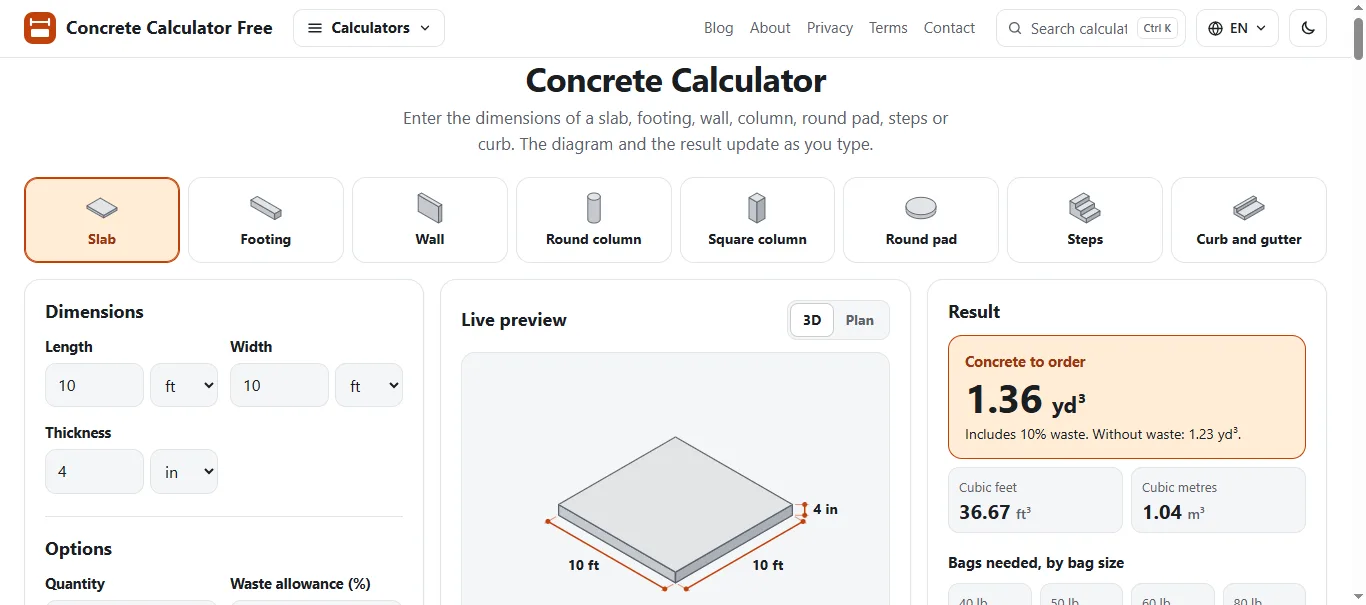
For example, if a slab is 10 feet long, 10 feet wide, and 4 inches thick, convert the thickness into feet before calculating the volume. Four inches is approximately 0.333 feet.
The calculation is:
10 × 10 × 0.333 = approximately 33.3 cubic feet.
Since one cubic yard equals 27 cubic feet, this slab requires approximately 1.23 cubic yards of concrete before adding any waste allowance.
Always use consistent units when performing calculations. If your measurements are in metres, calculate the volume in cubic metres. For other structures, such as circular columns, footings, and steps, different formulas may be necessary.
Use an Online Concrete Calculator
Manual calculations are useful for simple shapes, but estimating concrete for multiple structures can become complicated. An online calculator can simplify the process by calculating quantities from the dimensions you enter.
You can use this Concrete Calculator to estimate concrete requirements for slabs, footings, walls, round columns, square columns, steps, and curbs. The tool supports imperial and metric measurements and displays results in different volume units.
This can be helpful when planning home improvement projects, preparing construction estimates, or checking the approximate quantity of concrete needed before contacting a supplier.
Remember to Include a Waste Allowance
Even accurate measurements may not account for every site condition. Uneven ground, formwork differences, and small measurement errors can affect the final quantity. Depending on the project, it may be appropriate to include an additional allowance.
Review the measurements carefully and confirm the required quantity with your concrete supplier, especially for larger or more complex projects. An online estimate is a planning aid, not a substitute for checking actual site conditions.
Plan Your Construction Project with Confidence
Good preparation makes construction projects easier to manage. Measuring accurately, choosing the correct calculation method, and reviewing the estimated quantity can help reduce avoidable costs and delays.
Whether you are preparing a small garden slab or planning a larger construction project, understanding concrete volume is a valuable practical skill. Use a suitable calculator, double-check your measurements, and confirm your material requirements before placing an order.