
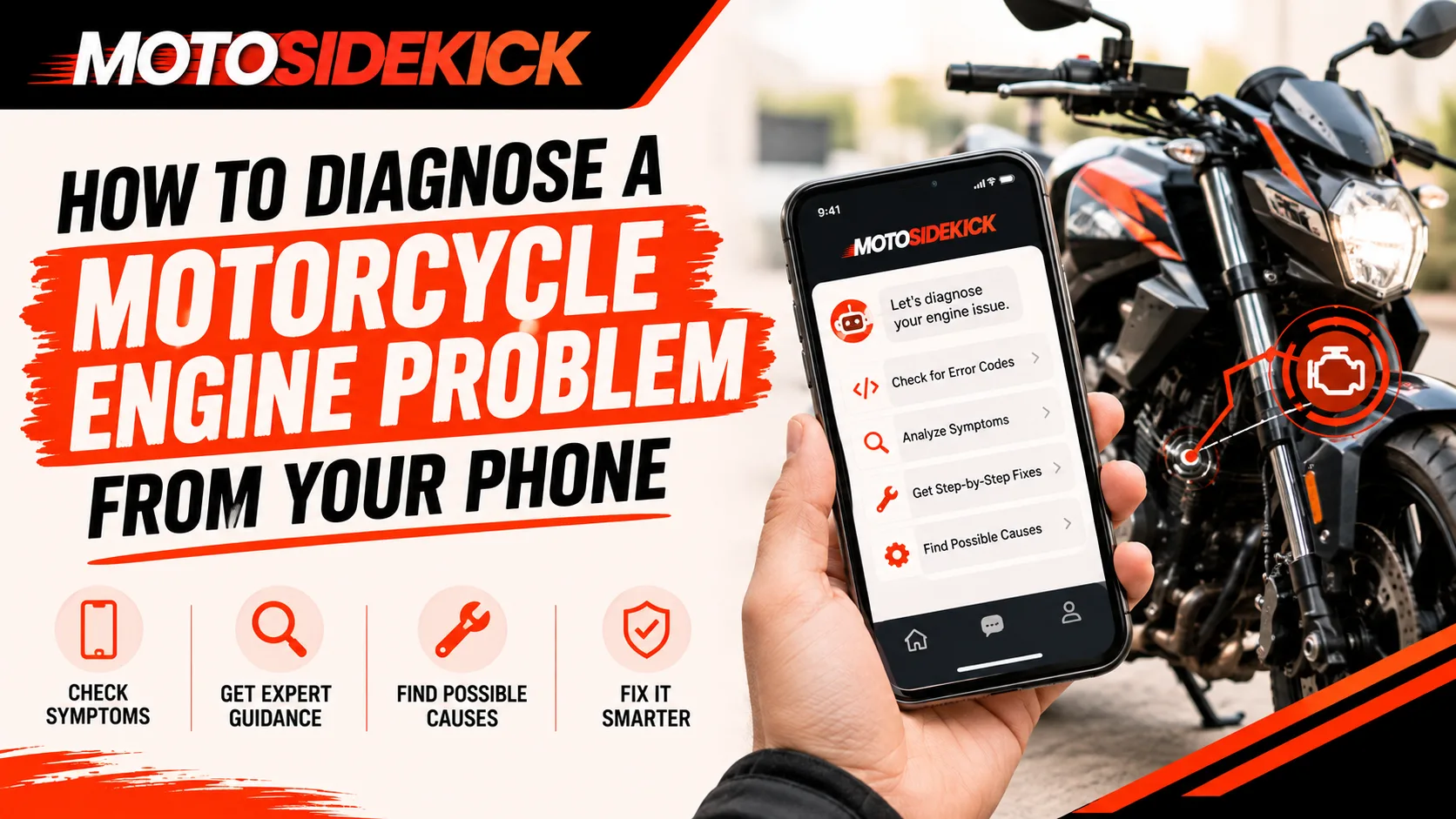
You can diagnose most motorcycle engine problems from your phone by describing the symptoms — sound, smoke, smell, or behavior — to a live mechanic or AI-guided tool that's matched to your bike's exact year, make, and model. MotoSidekick does this through real-time video, voice, or text chat, cross-referencing your answers against OEM service manuals so you get a specific diagnosis instead of a generic guess. No appointment, no towing, no guessing which forum thread actually applies to your bike.
That's the short version. Here's how it actually plays out when a rider is standing in their garage at 9 p.m. with a bike that won't cooperate.
Why Does My Motorcycle Engine Problem Feel So Hard to Diagnose Alone?
A motorcycle engine problem is confusing to diagnose alone because the same symptom can point to five different causes, and most riders don't have a baseline for what's "normal" versus "wrong" for their specific bike. A tapping noise on a Harley V-twin means something different than a tapping noise on a Ducati with a Desmodromic valve system.
This is the exact gap MotoSidekick was built to close. Instead of a rider scrolling through unrelated forum posts about a different year or trim, MotoSidekick's troubleshooting guides and live chat connect the symptom to the actual service procedures for that specific bike.
A motorcycle engine problem usually isn't one mystery — it's a short list of specific, checkable causes once you know which questions to ask.
What Does a Real Engine Diagnosis From Your Phone Look Like?
Here's a scenario that matches how riders actually use the platform. A rider — call him Mike, riding a 2019 KTM 390 Duke — notices his bike is idling rough and occasionally stalling at stoplights. He's not a mechanic. He doesn't own a multimeter. He opens MotoSidekick on his phone in the driveway.
The process follows four steps, the same ones MotoSidekick lists on its How It Works page:
- Enter the bike. Mike enters year, make, and model — 2019 KTM 390 Duke — so every answer that follows is scoped to that exact bike instead of a generic "KTM" answer.
- Select the need. He chooses "diagnose a problem" rather than maintenance or mods.
- Describe the symptom. He explains the rough idle, the stalling pattern, and that it started after a cold morning.
- Get a tailored answer. The guidance comes back matched against the actual KTM service manual and TPS/EFI diagnostic steps — not a generic "check your spark plugs" answer that ignores what model he's riding.
For a bike like this, MotoSidekick's own KTM Diagnostics Guide covers exactly this kind of TPS sensor and EFI fault pattern, which is the kind of brand-specific detail that generic troubleshooting content usually misses.
The difference between guessing and diagnosing is having the right reference for your exact bike in front of you before you start pulling parts off.
How Does MotoSidekick Know the Diagnosis Is Actually Correct for My Bike?
MotoSidekick checks answers against real OEM service manuals and factory torque and spec sheets for the rider's exact year, make, and model before responding. This "year/make/model matched" approach is core to how the platform is built — it's not pulling a generic answer that technically applies to "a motorcycle" and hoping it's close enough.
Three things are checked before a rider gets an answer:
What's CheckedWhy It MattersOEM service manualsTorque specs, intervals, and procedures come from the actual manufacturer documentation for that bike — not a forum guessYear/Make/Model matchA 2015 and a 2022 version of the same model can have different electrical systems or EFI tables, so the match has to be exactMechanic-reviewed promptsThe diagnostic flow itself was built and checked by certified motorcycle mechanics before it ever reaches a riderThis matters most on brand-specific problems. A Harley-Davidson charging failure doesn't troubleshoot the same way a Ducati fuel injection fault does, which is why MotoSidekick maintains separate guides like Harley Electrical Troubleshooting and the Ducati Troubleshooting Guide rather than one catch-all engine article.
What Are the Most Common Motorcycle Engine Problems Riders Bring to MotoSidekick?
Riders come to MotoSidekick with a recognizable short list of engine complaints — rough idle, stalling, hard starting, unusual noise, and loss of power. Most of these trace back to a handful of root causes once the bike's specific electrical and fuel system is accounted for.
A few patterns worth knowing before you even open the app:
- Won't start at all — frequently tied to a parasitic battery drain rather than the engine itself. MotoSidekick's Motorcycle Battery Drain Fix guide walks through finding and fixing that specific issue.
- Rough idle or stalling — often a TPS sensor, idle air control, or EFI calibration issue on fuel-injected bikes.
- Tapping or knocking sounds — can mean something routine (valve clearance due for adjustment) or something urgent (lower-end wear), and the difference usually comes down to when it happens and at what RPM.
- Loss of power under load — commonly fuel delivery or a clogged air filter, but can also point toward exhaust restriction.
- Stalling specifically when cold — frequently a choke, fast-idle, or cold-start enrichment issue rather than a deeper engine fault.
Most "scary" engine symptoms turn out to be a specific, named, fixable issue once a rider describes exactly when and how it happens.
When Should I Use Live Video Instead of Just Describing the Problem in Text?
Live video is the better choice when the problem involves a sound, a visible leak, smoke, or a part that's hard to describe in words — because a mechanic watching and listening in real time can usually narrow the cause faster than a back-and-forth text exchange. MotoSidekick's Live Video Diagnostics feature lets a rider point their phone camera at the bike while a mechanic or AI-guided tool analyzes what it's seeing in real time.
Text or voice chat tends to work better for:
- Questions you already have specific symptoms for ("bike stalls only when warm, not cold")
- Quick confirmation checks ("is this torque spec right for my year?")
- Planning a maintenance task rather than diagnosing something active
Video tends to work better for:
- Unusual noises you can't describe accurately
- Visible smoke, fluid leaks, or something that "looks wrong"
- Confirming a part number or connector by showing it directly
This flexibility — real-time voice or chat alongside live video — is part of why MotoSidekick describes itself as giving riders answers "verified against the correct service manual for your bike," rather than a single rigid format for every kind of problem.
What Happens After the Diagnosis — Do I Still Need a Shop?
Not always. Once a motorcycle engine problem is correctly diagnosed, MotoSidekick can help a rider find the exact-fit part needed for the repair and walk them through the fix step by step, which means plenty of issues never require a shop visit at all. For problems that genuinely need a lift, specialty tools, or a second set of hands, knowing the precise diagnosis before you call a shop still saves time and prevents being quoted for guesswork.
The platform covers this with two connected tools:
- Find Parts, Instantly — once the cause is identified, MotoSidekick matches exact-fit parts to the rider's specific bike with direct purchase links, instead of the rider guessing at a part number from a generic listing.
- Guided Fixes — step-by-step support for the actual repair, install, or maintenance task, not just the diagnosis.
For riders who'd rather hand the whole job to someone else, MotoSidekick also connects riders directly with vetted motorcycle experts through its Experts marketplace, where riders can browse project posts and connect with mechanics who bid their own rates — useful when the fix is correct but still beyond what the rider wants to tackle solo.
A correct diagnosis is what decides whether the next step is a ten-minute fix in your driveway or a short, well-informed conversation with a shop.
How Is This Different From Just Googling My Symptoms or Watching a YouTube Video?
A generic search or video usually covers a different year, trim, or even a different brand entirely, which means the rider has to guess how much of the advice actually transfers to their bike. MotoSidekick's entire structure is built around avoiding that gap — every answer is scoped to the exact bike the rider entered, cross-checked against that bike's actual service documentation, and reviewed by certified mechanics before it's ever shown to a rider.
This is also why MotoSidekick maintains dedicated troubleshooting guides broken out by brand and symptom rather than one long generic article — a Harley charging problem, a Ducati Desmo service indicator, and a KTM TPS fault are genuinely different repairs, and treating them as the same "motorcycle engine problem" is exactly how riders end up buying the wrong part or replacing the wrong component.
Key Takeaways
- A motorcycle engine problem can usually be narrowed down from your phone by describing symptoms to a mechanic or AI-guided tool matched to your bike's exact year, make, and model.
- MotoSidekick checks answers against real OEM service manuals and factory specs before responding, rather than giving a generic answer.
- Live video works best for sounds, leaks, or anything hard to describe in words; text or voice works well for specific, already-identified symptoms.
- Once diagnosed, MotoSidekick can help locate the exact-fit part and guide the actual repair — or connect you with a vetted expert through the Experts marketplace if you'd rather not do it yourself.
- Brand matters: Harley, Ducati, KTM, and BMW engines fail differently, which is why brand-specific guides outperform generic advice.
Frequently Asked Questions
Can MotoSidekick actually diagnose an engine problem, or does it just give general advice? MotoSidekick diagnoses based on your bike's specific year, make, and model, checked against real OEM service manuals and torque/spec sheets — not a general answer meant to apply to any motorcycle.
Do I need any special equipment to get help? No special equipment is required. A rider can use text, voice, or video chat directly from a smartphone, with video chat used specifically for anything that's hard to describe in words, like a noise or a visible leak.
Is this only for certain motorcycle brands? No. MotoSidekick supports diagnostics across major brands and maintains dedicated brand-specific guides — including Harley-Davidson, Ducati, KTM, and BMW — alongside general troubleshooting for any year, make, and model a rider enters.
What if the diagnosis says I need a part — can I get the right one? Yes. Once the cause is identified, MotoSidekick can find exact-fit parts matched to your specific bike with direct purchase links, so you're not guessing at a part number.
Is there a human mechanic involved, or is it only AI? Both. Riders can get AI-powered guidance in real time, or connect with experienced motorcycle mechanics and expert riders for live, 1-on-1 help via video, voice, or text.
About the Author: This guide was prepared by the MotoSidekick team, co-founded by Chris and Andrew Carlone. MotoSidekick is an online motorcycle repair and maintenance platform that helps riders diagnose issues, complete repairs, and upgrade their bikes using real-time video chat, voice, text, and AI-powered guidance, connecting riders with experienced motorcycle mechanics and expert riders nationwide and worldwide. Follow MotoSidekick on Facebook, Instagram, and TikTok, or read more on the MotoSidekick blog.