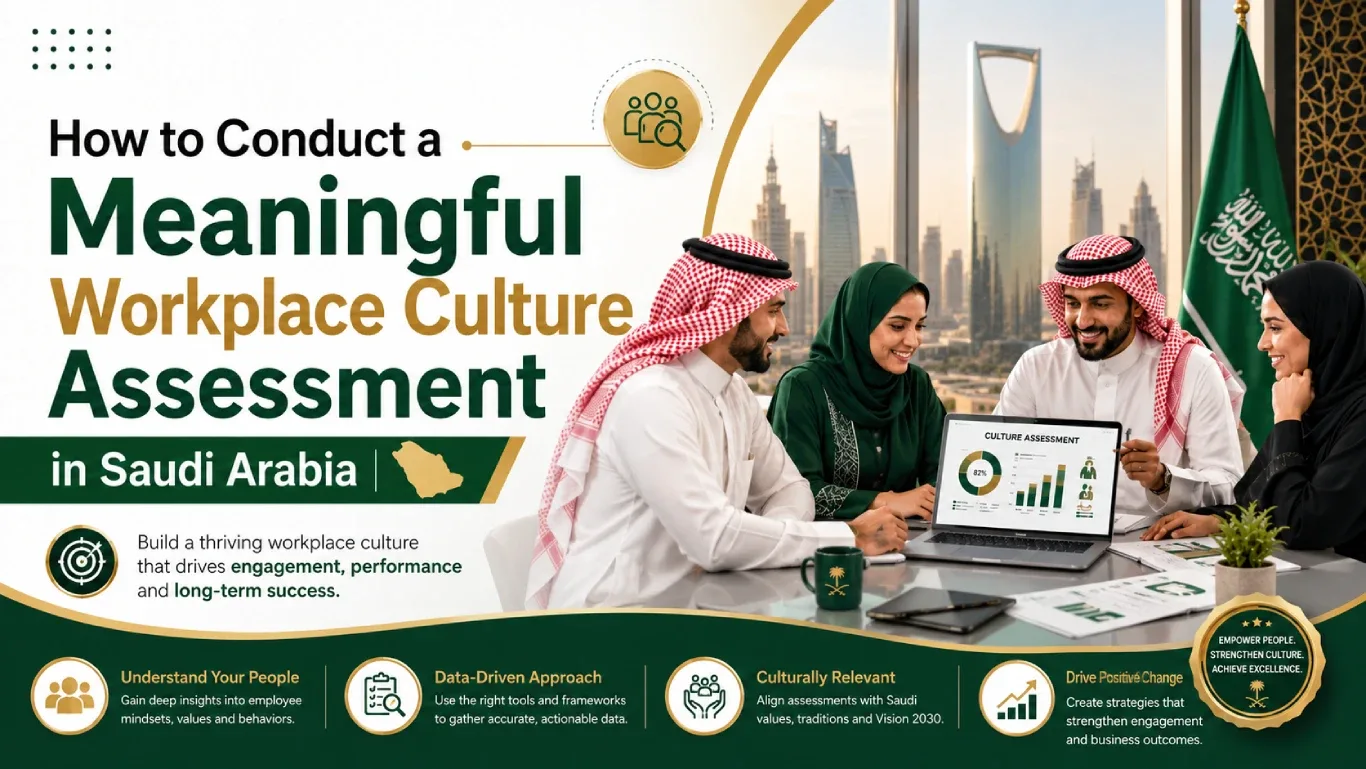
Workplace Culture Assessment in Saudi Arabia: A Strategic Guide for Vision 2030 Organizations
Key Takeaways
- Workplace culture assessment is now a strategic business priority for organizations operating in Saudi Arabia.
- Vision 2030, workforce localization, and digital transformation have increased the need for stronger organizational culture frameworks.
- Traditional employee surveys alone are no longer enough to evaluate workplace culture effectively.
- Saudi organizations require localized culture assessment models that align with labor laws, Saudization goals, and multicultural workforce realities.
- Strong workplace culture directly improves employee retention, productivity, leadership alignment, and organizational performance.
- Organizations that continuously measure and improve workplace culture gain long-term competitive advantages in talent attraction and business sustainability.
Why Workplace Culture Assessment Matters More Than Ever in Saudi Arabia
Saudi Arabia is experiencing one of the fastest workforce and economic transformations in the region. Under Vision 2030, organizations are modernizing operations, expanding globally, adopting digital technologies, and restructuring leadership models at an unprecedented pace.
As businesses evolve, workplace culture has shifted from being an HR discussion to becoming a boardroom priority.
Today, CEOs, CHROs, and business leaders understand that organizational culture directly impacts:
- Employee engagement
- Workforce productivity
- Leadership effectiveness
- Change management success
- Employer branding
- Retention of top talent
- Operational efficiency
A toxic or misaligned culture can silently damage organizational growth, while a high-performing workplace culture can become a major competitive advantage.
For organizations operating in Saudi Arabia’s highly dynamic environment, workplace culture assessment is no longer optional — it is a strategic necessity.
What Is a Workplace Culture Assessment?
A workplace culture assessment is a structured evaluation process used to understand how employees experience the organization on a daily basis.
It measures whether leadership behaviors, company values, communication styles, policies, and employee experiences are aligned with business goals.
The assessment helps organizations identify:
- Cultural strengths
- Leadership gaps
- Employee concerns
- Team collaboration issues
- Engagement barriers
- Inclusion challenges
- Organizational trust levels
- Readiness for transformation
More importantly, it reveals whether workplace culture is supporting growth or preventing it.
Core Areas Evaluated During a Workplace Culture Assessment
Business AreaCulture IndicatorsLeadership EffectivenessTrust, transparency, accountabilityEmployee EngagementMotivation, morale, retentionTeam CollaborationCommunication and alignmentOrganizational ChangeAdaptability and resilienceDiversity & InclusionWorkforce integration and fairnessPerformance CultureProductivity and ownershipCompliance CultureAlignment with labor laws and ethicsEmployee ExperiencePsychological safety and workplace satisfactionA successful assessment uncovers both visible and hidden workplace behaviors that influence long-term organizational success.
Why Workplace Culture Assessments Are Critical in Saudi Arabia
Saudi organizations are currently balancing multiple workforce priorities simultaneously:
- Saudization initiatives
- Leadership modernization
- Digital transformation
- Expansion into international markets
- Employee retention challenges
- Workforce diversification
- Operational restructuring
- Cross-cultural workforce management
Without a strong workplace culture, many of these initiatives fail to achieve sustainable outcomes.
Organizations with healthy workplace cultures consistently experience:
- Lower employee turnover
- Higher productivity
- Stronger leadership alignment
- Better collaboration across teams
- Faster adaptation to change
- Improved employer reputation
- Greater workforce stability
This is why workplace culture has become a measurable business asset rather than simply an HR metric.
What Makes Workplace Culture Assessment Different in Saudi Arabia?
1. Leadership Hierarchies Affect Employee Feedback
In Saudi Arabia, organizational hierarchies often influence how openly employees communicate concerns.
Employees may hesitate to challenge management directly or provide negative feedback about leadership.
Because of this, relying only on anonymous surveys often produces incomplete insights.
An effective assessment should include:
- Confidential leadership interviews
- Focus groups
- HR analytics
- Behavioral observations
- Department-level reviews
- Communication analysis
This multi-layered approach creates a more accurate understanding of workplace realities.
2. Local Labor Laws Must Be Integrated
Culture assessment cannot be separated from compliance and workforce governance.
Organizations must evaluate whether workplace practices align with Saudi labor regulations, including:
- Employee rights
- Workplace conditions
- Inclusion policies
- Work-hour structures
- Grievance procedures
- Leadership accountability
- Gender inclusion initiatives
Ignoring compliance-related cultural gaps can create operational, legal, and reputational risks.
3. Multicultural Workforce Dynamics Matter
Most organizations in Saudi Arabia employ both local and expatriate talent.
This creates unique workplace dynamics involving:
- Communication differences
- Leadership expectations
- Decision-making approaches
- Collaboration styles
- Cultural integration challenges
A strong culture assessment examines whether diversity and inclusion initiatives are genuinely improving workforce integration and employee engagement.
How to Conduct an Effective Workplace Culture Assessment
Step 1: Define Strategic Business Goals
Before collecting data, organizations must clearly define why the assessment is being conducted.
Typical objectives include:
- Improving employee retention
- Strengthening leadership capability
- Supporting organizational transformation
- Increasing engagement
- Reducing workplace conflict
- Enhancing employer branding
- Supporting Saudization efforts
- Improving workforce productivity
Without clear goals, assessments often generate large amounts of data with little strategic value.
Step 2: Evaluate Leadership Alignment
Leadership behavior has the strongest influence on organizational culture.
Companies should evaluate:
- Leadership communication consistency
- Transparency in decision-making
- Employee trust in management
- Leadership accessibility
- Accountability standards
- Coaching and mentoring capabilities
In Saudi organizations, employees closely observe leadership behavior before supporting organizational change initiatives.
When leadership messaging and actual workplace experiences do not align, trust declines rapidly.
Step 3: Use Multiple Assessment Methods
High-quality workplace culture assessments combine both qualitative and quantitative methods.
Recommended Assessment Framework
Assessment ToolStrategic PurposeEmployee SurveysMeasure engagement trendsLeadership InterviewsIdentify alignment gapsFocus GroupsExplore workforce concernsHR AnalyticsConnect culture with business performanceExit InterviewsDetect recurring employee issuesDepartment ReviewsMeasure operational consistencyBenchmark AnalysisCompare industry standardsOrganizations that rely only on surveys often miss critical workplace behaviors affecting performance.
Step 4: Analyze Team Dynamics Across Departments
Workplace culture often differs significantly between departments.
Assessments should evaluate:
- Team collaboration quality
- Communication effectiveness
- Conflict resolution practices
- Management accessibility
- Employee recognition
- Accountability standards
- Decision-making speed
This becomes especially important during mergers, restructuring, or rapid organizational growth.
Step 5: Measure Diversity and Inclusion Effectiveness
Diversity and inclusion are becoming major workforce priorities across Saudi Arabia.
Organizations should assess:
- Equal growth opportunities
- Integration of local and expatriate employees
- Leadership diversity
- Psychological safety
- Employee participation in decision-making
- Cross-cultural collaboration effectiveness
Companies that neglect inclusion challenges often struggle with engagement and employee retention.
Step 6: Turn Assessment Findings Into Action
One of the biggest mistakes organizations make is conducting assessments without implementing meaningful change.
Assessment insights should lead to:
- Executive-level action plans
- Leadership development initiatives
- Organizational restructuring strategies
- Employee engagement programs
- Performance improvement systems
- Continuous culture monitoring
Culture transformation is not a one-time project. It requires long-term leadership commitment and operational ownership.
Common Workplace Culture Challenges in Saudi Arabia
Resistance to Organizational Change
Large transformation initiatives often create uncertainty and employee anxiety when communication is weak.
Leadership Capability Gaps
Many technically strong managers lack modern leadership and people-management skills.
Communication Barriers Across Teams
Multicultural teams may face collaboration challenges that impact productivity and trust.
Employee Retention Issues
Top-performing professionals increasingly prioritize workplace culture when choosing employers.
Limited Feedback Transparency
Employees may avoid speaking openly in highly hierarchical environments.
How Organizations Can Measure Culture Assessment Success
Culture initiatives should create measurable business outcomes.
Key Metrics to Track
KPIBusiness ImpactEmployee RetentionWorkforce stabilityEngagement ScoresEmployee commitmentProductivity MetricsOperational performanceLeadership Trust RatingsManagement effectivenessInternal MobilityCareer developmentChange Adoption RatesOrganizational agilityAbsenteeism TrendsEmployee moraleExecutive leadership increasingly expects workplace culture initiatives to demonstrate measurable ROI.
The Importance of External HR Consulting Expertise
Many organizations partner with HR consulting firms to ensure objective evaluation and effective implementation.
An experienced HR consulting partner can help businesses:
- Assess organizational culture
- Identify leadership gaps
- Build change management strategies
- Improve employee engagement
- Develop diversity and inclusion frameworks
- Strengthen compliance-focused HR systems
- Align workforce strategy with Vision 2030 goals
External expertise becomes especially valuable during periods of rapid expansion, restructuring, or workforce transformation.
Leadership Development After Culture Assessment
A workplace culture assessment is only the beginning of organizational transformation.
Long-term success requires continuous leadership development and workforce alignment.
Organizations that invest in leadership capability building are better positioned to:
- Sustain cultural improvements
- Increase workforce engagement
- Improve organizational agility
- Strengthen operational performance
- Build future-ready leadership pipelines
Leadership development ensures culture improvements become embedded into daily business operations rather than remaining temporary initiatives.
Final Thoughts
As Saudi Arabia continues progressing toward Vision 2030, workplace culture will increasingly determine which organizations thrive in the long term.
Businesses that proactively assess and improve workplace culture gain significant advantages in:
- Talent retention
- Leadership effectiveness
- Employee engagement
- Workforce productivity
- Employer branding
- Organizational transformation
- Sustainable business growth
In today’s competitive Saudi business environment, workplace culture is no longer a secondary HR concern.
It is a strategic business driver.
Organizations that invest in building strong, healthy, and performance-driven workplace cultures will be far better prepared for the future of work in Saudi Arabia.
Looking to Transform Your Workplace Culture?
Rooted HR helps organizations across Saudi Arabia conduct data-driven workplace culture assessments aligned with business strategy, workforce transformation goals, and local workforce realities.
From leadership development and employee engagement to organizational change and workforce integration, Rooted HR supports companies in building sustainable, high-performing workplace cultures for long-term business success.