
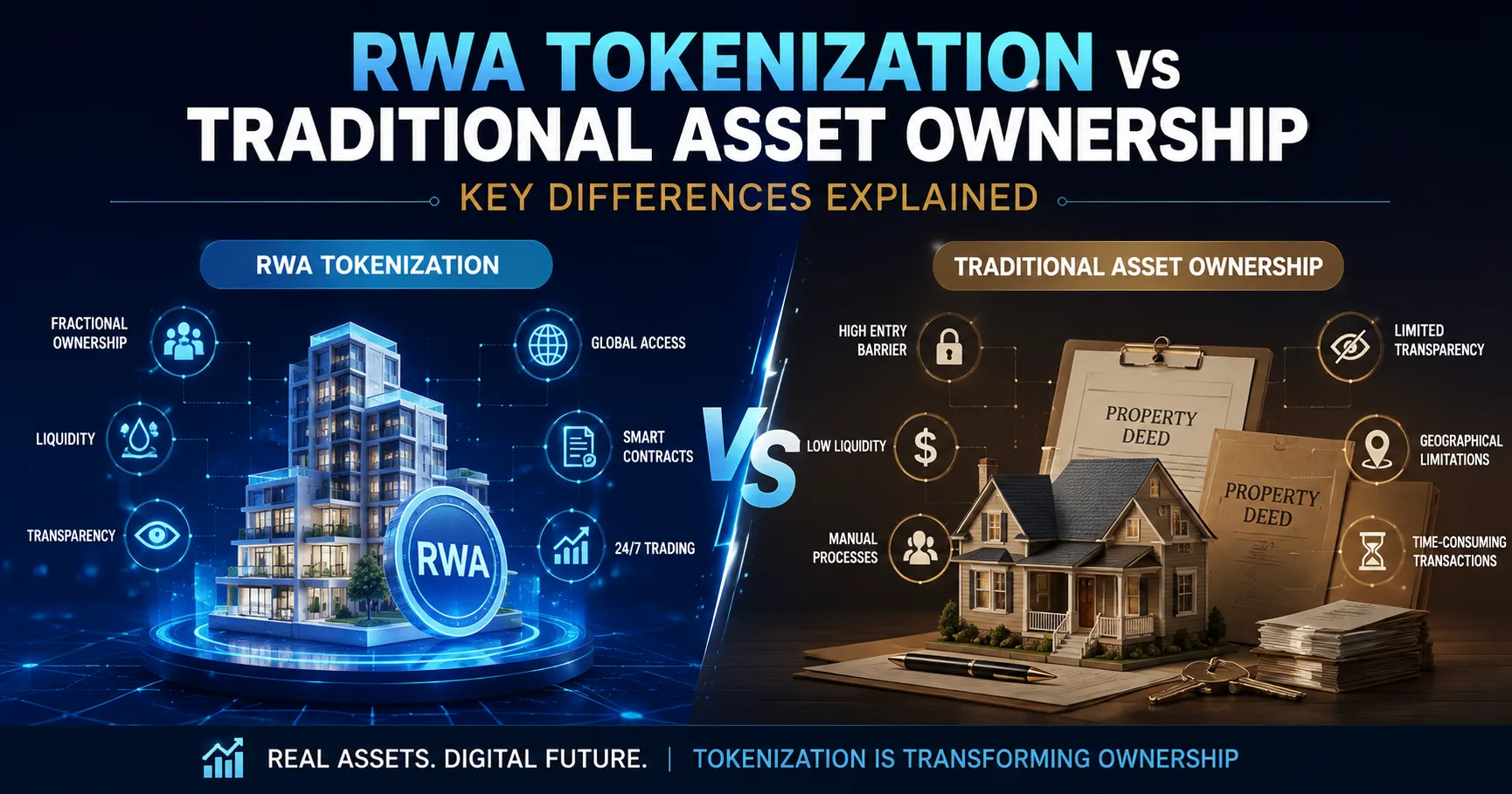
The way people own, invest in, and transfer assets is undergoing a significant transformation. Traditionally, ownership of assets such as real estate, private equity, commodities, artwork, and other valuable holdings has depended on paper-based records, centralized intermediaries, legal contracts, and financial institutions. While this model has served the global economy for decades, it can also involve high transaction costs, limited liquidity, lengthy settlement periods, and substantial barriers to entry.
Real-world asset (RWA) tokenization introduces a blockchain-based alternative. Instead of representing ownership solely through conventional certificates, deeds, or centralized databases, tokenization converts rights associated with an asset into digital tokens recorded on a blockchain. Depending on the legal and technical structure, these tokens can represent direct ownership, beneficial ownership, economic rights, debt claims, or fractional interests in an underlying asset.
The growing interest in tokenized assets is reflected in the expansion of the broader market. Major financial institutions and blockchain companies have explored tokenized funds, bonds, treasuries, real estate, and other assets. Industry forecasts vary substantially, but many expect tokenized real-world assets to become a significant segment of digital finance over the coming decade.
Understanding the differences between RWA tokenization and traditional asset ownership is therefore important for investors, businesses, and entrepreneurs evaluating the future of asset management.
What Is Traditional Asset Ownership?
Traditional asset ownership is based on established legal and financial systems. When someone purchases a property, for example, ownership is generally established through a deed or other legally recognized documentation. The transaction may involve a buyer, seller, lawyers, brokers, banks, government registries, appraisers, and other intermediaries.
The same principle applies to other asset classes. Shares in private companies may be recorded through corporate registries or transfer agents, while ownership of physical commodities may depend on warehouse receipts, contracts, or custody arrangements.
This model provides an important advantage: it operates within well-established legal frameworks. Governments, courts, banks, and financial institutions have developed processes for verifying ownership and resolving disputes.
However, traditional ownership can become inefficient when assets need to be divided into smaller investment interests, transferred across borders, or traded frequently. A real estate investor, for example, may need substantial capital to acquire an entire property. Selling that property can also take weeks or months because of due diligence, financing, documentation, negotiations, and legal procedures.
What Is RWA Tokenization?
RWA tokenization involves creating blockchain-based digital representations of rights connected to real-world assets. The underlying asset does not necessarily become digital. Instead, blockchain infrastructure provides a digital mechanism for representing and managing ownership or economic interests.
Consider a commercial property valued at $10 million. Under a conventional model, an investor might need to purchase the entire property or participate through a traditional investment structure. Under an appropriately structured tokenization model, the economic interests associated with the property could potentially be divided into a large number of digital tokens.
If the legal structure permits it, investors could purchase smaller interests rather than acquiring the entire asset. Smart contracts can automate certain processes involving token issuance, transfers, distributions, compliance rules, and investor records.
This distinction is important because tokenization is not simply about putting an asset "on the blockchain." The legal relationship between the token, the investor, and the underlying asset must be clearly established.
RWA Tokenization vs Traditional Ownership: The Major Differences
The biggest difference between the two models is how ownership and transactions are represented and managed.
1. Accessibility and Fractional Ownership
Traditional ownership often requires substantial capital. Buying a commercial building, private-company stake, or valuable artwork may be financially inaccessible to smaller investors.
Tokenization can introduce fractional ownership. Instead of one investor purchasing an entire asset, a qualifying asset can potentially be divided into many tokenized interests.
For example, a $5 million property could theoretically be represented by 5 million tokens, with each token representing a defined economic or ownership interest. The exact structure depends on the applicable securities, property, tax, and corporate laws.
Fractionalization can lower the minimum investment requirement and potentially broaden access to asset classes that have historically been difficult for smaller investors to access.
2. Liquidity
Liquidity is another major distinction.
Traditional assets such as real estate and private equity are often illiquid. Selling an interest may require finding a buyer, completing due diligence, preparing legal documents, and waiting for settlement.
Tokenization can create infrastructure for more efficient transfers. If compliant secondary markets exist and sufficient buyers and sellers participate, tokenized interests may be transferred more efficiently than traditional ownership interests.
However, tokenization does not automatically create liquidity. A token representing a property is not necessarily liquid simply because it exists on a blockchain. Market demand, investor eligibility, regulatory restrictions, exchange infrastructure, and the quality of the underlying asset all influence liquidity.
3. Transaction Speed and Settlement
Traditional transactions frequently involve multiple parties and administrative processes. A property transaction, for instance, can involve banks, lawyers, registries, brokers, and custodians.
Blockchain-based systems can automate portions of transaction processing and maintain a shared record of token ownership. Smart contracts may allow eligible transfers and settlement to occur automatically once predefined conditions are satisfied.
This can reduce administrative friction, although legal settlement may still require off-chain procedures depending on the asset and jurisdiction.
4. Transparency and Record Keeping
Traditional ownership records are typically maintained by centralized organizations. Different parties may maintain separate databases, requiring reconciliation.
Blockchain networks provide a shared ledger where transactions can be recorded in a tamper-resistant manner. Authorized participants can potentially verify transaction histories and token balances without relying on multiple independent records.
This can improve transparency, particularly for assets involving multiple stakeholders. At the same time, blockchain transparency must be balanced with privacy requirements and regulations governing personal and financial information.
5. Intermediaries
Traditional asset ownership generally depends heavily on intermediaries. Brokers, custodians, banks, transfer agents, lawyers, registrars, and other service providers can each play an important role.
Tokenization can automate selected functions through smart contracts and blockchain infrastructure. For example, a smart contract can enforce transfer restrictions or distribute certain payments according to predefined rules.
This does not mean intermediaries disappear. In regulated tokenization markets, legal professionals, custodians, compliance providers, financial institutions, and administrators can remain essential.
The real change is that technology can reduce repetitive administrative work and make certain processes more programmable.
A Practical Example: Tokenized Real Estate
Real estate demonstrates the potential difference particularly well.
Imagine an office building valued at $20 million. In a traditional structure, investors may participate through a real estate fund, partnership, company, or direct purchase. The investment process can involve substantial documentation and capital.
With tokenization, the ownership or economic interests in the investment vehicle could potentially be represented by blockchain-based tokens. Investors meeting applicable eligibility requirements could purchase fractional interests.
Smart contracts could assist with functions such as token issuance, ownership tracking, distribution calculations, and transfer controls. If a compliant secondary marketplace exists, investors may also have a mechanism for transferring their interests.
The benefit is not merely technological. Tokenization can potentially connect traditionally illiquid assets with programmable digital infrastructure.
Several market participants have already demonstrated this concept. Platforms and financial institutions such as Securitize, Ondo Finance, Centrifuge, and other tokenization-focused organizations have explored tokenized securities, funds, credit products, and other real-world assets.
These examples show that RWA tokenization is moving beyond theoretical discussions toward practical financial applications.
Regulatory and Legal Considerations
One of the most important differences between traditional ownership and tokenized ownership is that blockchain technology does not replace legal ownership frameworks.
A token may represent a security, a beneficial interest, a claim against an entity, or another legal right. The classification depends on the structure and jurisdiction.
For this reason, successful tokenization requires coordination between technology and legal infrastructure. Projects may need mechanisms for Know Your Customer (KYC), Anti-Money Laundering (AML), investor eligibility, transfer restrictions, reporting, taxation, and asset custody.
Regulatory compliance is particularly important for tokenized securities. A technically sophisticated platform can still fail if the underlying legal rights are unclear or if the token distribution violates applicable regulations.
This is why businesses exploring RWA tokenization development services should evaluate both the blockchain architecture and the legal framework surrounding the asset.
Costs: Traditional Ownership vs Tokenization
Tokenization can reduce certain operational costs, but it also introduces new expenses.
Traditional transactions can involve brokerage fees, legal costs, administrative expenses, custodial charges, and settlement fees. Tokenization may reduce some of these costs through automation and digital record keeping.
However, a tokenization platform requires blockchain development, smart contracts, security audits, compliance infrastructure, custody solutions, investor onboarding systems, and potentially secondary-market integration.
Therefore, tokenization should not be viewed simply as a cheaper version of traditional ownership. Its primary value may come from combining fractionalization, programmability, transparency, and digital transfer infrastructure.
Businesses seeking RWA tokenization services should evaluate the complete economic model rather than focusing only on development costs.
Security: Blockchain Does Not Eliminate Risk
Blockchain can provide strong technical properties, but tokenized assets still face significant risks.
Smart contracts can contain vulnerabilities, wallets can be compromised, private keys can be lost, and tokenized assets can be subject to regulatory or operational failures. More importantly, the blockchain record itself does not guarantee that the underlying physical asset exists or that the token holder has the legal rights they expect.
For example, a token may accurately record ownership within a blockchain system while the associated off-chain legal agreement contains inadequate protections.
Effective tokenization therefore requires several layers of security: audited smart contracts, secure wallet infrastructure, reliable asset custody, legal documentation, identity verification, compliance controls, and ongoing monitoring.
Which Model Is Better?
Neither model is universally superior.
Traditional ownership remains highly effective for many assets, especially where established legal processes, direct control, and long-term ownership are the primary objectives.
Tokenization becomes particularly attractive when an asset benefits from fractional ownership, programmable transactions, global digital access, transparent records, or potentially improved liquidity.
The most realistic future is therefore likely to involve a hybrid model. Legal ownership and asset custody may continue to operate within traditional institutions while blockchain networks manage digital representations, transactions, compliance rules, and investor interactions.
The Future of Asset Ownership
RWA tokenization represents a shift from static ownership records toward programmable financial infrastructure. Instead of treating ownership as a document that simply proves possession, blockchain systems can potentially turn ownership rights into digital assets capable of interacting with automated financial applications.
As regulations become clearer and institutional adoption increases, tokenized funds, bonds, real estate, commodities, and private-market investments could become increasingly integrated with digital financial ecosystems.
However, adoption will depend on more than blockchain technology. Investor protection, legal enforceability, interoperability, custody, liquidity, regulatory compliance, and trustworthy asset verification will determine whether tokenization can achieve sustainable mainstream adoption.
Conclusion
RWA tokenization and traditional asset ownership represent two different approaches to managing real-world value. Traditional ownership benefits from mature legal frameworks and established institutions, while tokenization can introduce fractional ownership, programmable transactions, transparent records, and potentially greater accessibility and liquidity. The strongest tokenization models will not attempt to eliminate traditional financial infrastructure but will connect it with blockchain technology in a legally compliant and secure manner. Businesses planning to enter this market can work with experienced providers such as Blockchain App Factory, which provides comprehensive RWA tokenization development services and is positioned to deliver scalable blockchain solutions for businesses exploring tokenized assets.
FAQs
1. What is RWA tokenization?
RWA tokenization is the process of representing ownership or economic rights associated with real-world assets through blockchain-based digital tokens.
2. How is RWA tokenization different from traditional ownership?
Traditional ownership generally relies on centralized legal and administrative records, while tokenization uses blockchain infrastructure to represent and manage defined asset-related rights digitally.
3. Does tokenization guarantee higher liquidity?
No. Tokenization can make transfers more efficient, but actual liquidity depends on market demand, regulations, investor access, and the availability of compliant secondary markets.
4. Can real estate be tokenized?
Yes. Real estate interests can potentially be tokenized through suitable legal and corporate structures, allowing qualified investors to hold fractional interests.
5. Is RWA tokenization secure?
Blockchain can provide strong transaction-record security, but the complete system also requires audited smart contracts, secure custody, legal safeguards, compliance mechanisms, and reliable verification of the underlying assets.