How to Compare Custom Sportswear Manufacturers Before Placing an Order
Choosing a custom sportswear manufacturer is an important decision for any clothing brand, sports team, fitness business, or retailer. The manufacturer you choose can affect product quality, pricing, delivery times, branding, and even how easily you can grow your collection.
Many manufacturers may appear similar when you first compare them. They may offer custom clothing, private labeling, embroidery, printing, and bulk production. However, the actual manufacturing process, quality standards, communication, and production capabilities can be very different.
Before placing an order, it is worth comparing manufacturers carefully instead of choosing based only on the lowest quotation.
This guide explains the main factors businesses should consider when comparing custom sportswear manufacturers.
1. Start With Your Product Requirements
Before comparing manufacturers, clearly define what you want to produce.
For example, you might need:
- Custom sports T-shirts
- Football jerseys
- Gym wear
- Compression clothing
- Running apparel
- Training shorts
- Tracksuits
- Hoodies
- Leggings
- Team uniforms
You should also know your approximate order quantity, preferred fabrics, colors, sizes, branding requirements, and expected delivery date.
A manufacturer that is suitable for producing basic T-shirts may not have the same capabilities for technical performance apparel.
Having clear requirements makes it easier to compare manufacturers on the same basis.
2. Check Their Manufacturing Experience
Experience matters, particularly when your product has specific construction or performance requirements.
Look at how long the manufacturer has been producing apparel and what types of products they regularly manufacture.
Do not focus only on general claims such as "experienced manufacturer." Look for evidence of relevant production experience.
For example, if you want to develop performance sportswear, check whether the manufacturer has experience with sportswear rather than only casual clothing.
Businesses interested in professional sportswear production can review Habit Fit Sports' sportswear manufacturing services to understand the type of products and manufacturing support available.
3. Compare Product Quality
Price is easy to compare. Quality requires more investigation.
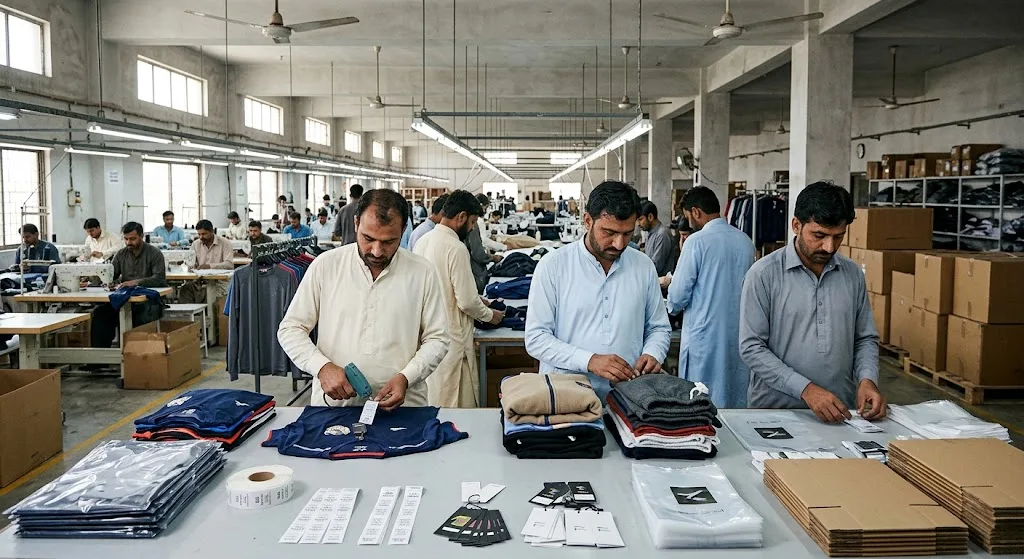
Ask manufacturers about the fabrics they use, stitching standards, printing methods, embroidery, finishing, and quality-control procedures.
If possible, request samples before placing a large order.
A sample can help you check:
- Fabric feel
- Fabric weight
- Stretch
- Stitching
- Fit
- Measurements
- Logo quality
- Printing
- Color accuracy
- Overall finishing
For example, a sports T-shirt may look excellent in a digital mockup but feel uncomfortable when made with unsuitable fabric. A physical sample gives you information that a product image cannot provide.
4. Ask About Fabric Options
Different sportswear products require different materials.
Depending on the product, you may need fabric that offers breathability, stretch, moisture management, durability, or lightweight comfort.
Ask the manufacturer what fabric options are available and whether they can recommend materials based on the intended use of the garment.
Do not simply ask, "What is your best fabric?"
Instead, explain how the product will be used.
For example:
"We are developing lightweight training shirts for gym and running use. We need breathable fabric with good stretch and moisture management."
This gives the manufacturer useful information for recommending suitable materials.
5. Compare Customization Options
A good custom sportswear manufacturer should be able to explain the customization methods available for your particular product.
Common options include:
- Sublimation
- Screen printing
- DTF printing
- Embroidery
- Woven labels
- Printed labels
- Custom tags
- Custom packaging
The best option depends on the artwork, garment, fabric, quantity, and desired appearance.
For example, detailed all-over graphics may require a different production method from a simple embroidered chest logo.
Ask each manufacturer what method they recommend and why.
6. Check Private Label Capabilities
If you are building your own apparel brand, you may need more than a logo on the front of a shirt.
Private-label production can include custom labels, tags, packaging, colors, and other brand elements.
Ask whether the manufacturer can produce garments according to your brand specifications.
This is particularly important for startups because consistent branding across products can help create a recognizable collection.
7. Compare Minimum Order Quantities
Minimum order quantity, commonly called MOQ, is another important factor.
One manufacturer may accept smaller orders while another may require a larger quantity for each style or color.
Ask whether the MOQ applies to:
- Each product
- Each color
- Each size
- Each design
- The complete order
For example, a manufacturer may quote a low MOQ but require a minimum quantity for every color. Understanding the exact terms prevents surprises later.
For a new brand testing its first collection, a manufacturer with suitable production flexibility may be more practical than one designed mainly for very large orders.
8. Compare Pricing Properly
Do not compare manufacturers using the unit price alone.
A quotation should be evaluated against what is actually included.
Check whether the price covers:
- Fabric
- Cutting
- Stitching
- Printing
- Embroidery
- Labels
- Tags
- Packaging
- Sampling
- Other customization
- Production
For example, Manufacturer A may quote $10 per shirt while Manufacturer B quotes $12. If the $10 quotation excludes custom labels and packaging while the $12 quotation includes them, the two prices are not directly comparable.
Ask for a detailed quotation so you can compare the same specifications.
9. Understand Sample Development
Sample development is one of the most useful stages for comparing manufacturers.
Ask:
- Is a sample available before bulk production?
- How are sample changes handled?
- Can measurements be adjusted?
- Can fabric be changed after testing?
- How are approved samples recorded for bulk production?
A manufacturer should have a clear process for turning your requirements into an approved production sample.
Do not approve a large production run without carefully checking the final sample when sampling is part of the manufacturer's process.
10. Evaluate Communication
Communication can have a major effect on a custom apparel project.
You may need to discuss measurements, artwork, fabrics, revisions, production schedules, and packaging. If communication is slow or unclear, small problems can become expensive problems.
When comparing manufacturers, consider:
- Response time
- Clarity of answers
- Understanding of your requirements
- Ability to explain technical details
- Willingness to discuss revisions
- Availability during production
You do not need a manufacturer that simply says "yes" to everything. You need one that can clearly explain what is possible and what needs to be changed.
11. Ask About Quality Control
Quality control should be part of the manufacturing process.
Ask how products are inspected during and after production.
Depending on the product, quality checks may cover:
- Measurements
- Stitching
- Fabric defects
- Printing
- Embroidery
- Labels
- Color consistency
- Finishing
- Packaging
If you are ordering hundreds or thousands of garments, consistent quality becomes particularly important.
A problem affecting one sample is one thing. The same problem repeated across an entire production batch can become a major business cost.
12. Compare Production Lead Times
Ask manufacturers how long production normally takes after the order and specifications are approved.
Make sure you understand the difference between:
Sample time: The time required to develop and approve the sample.
Production time: The time required to manufacture the bulk order.
Shipping time: The time required to transport the finished products to your destination.
These are separate stages.
If you have a fixed launch date, such as a new collection release or sports season, discuss the complete timeline before placing the order.
13. Check Their Ability to Handle Future Orders
Your first order may be small, but your business could grow.
Imagine launching a new sportswear collection and receiving significantly more orders than expected. You may eventually need larger production quantities, additional colors, or new products.
Ask whether the manufacturer can support future production at a larger scale.
A useful manufacturing relationship should not only work for your first order. It should also be capable of supporting your future requirements where possible.
14. Look at Their Product Range
Manufacturers often specialize in particular categories.
One may focus on sportswear, while another may have stronger capabilities in streetwear, activewear, workwear, or other apparel.
If you plan to build a broader clothing collection, consider whether the manufacturer can support multiple categories.
For brands developing casual and fashion-focused products alongside performance apparel, a streetwear manufacturer may be relevant.
For businesses looking for larger activewear collections, wholesale activewear production is another area to consider.
15. Ask About Branding and Packaging
If your products will be sold directly to consumers, packaging can be an important part of the customer experience.
Ask whether the manufacturer can provide:
- Custom woven labels
- Size labels
- Care labels
- Hang tags
- Polybags
- Branded packaging
- Custom boxes
Make sure these requirements are included in the quotation if they are needed.
It is better to finalize these details before production rather than trying to add them at the last moment.
16. Review Their Previous Work
Ask to see examples of products they have manufactured.
Look for products that are similar to what you want to produce.
For example, if you are developing football jerseys, examples of casual hoodies may not tell you much about their ability to produce technical teamwear.
When reviewing previous work, pay attention to:
- Stitching
- Fabric quality
- Printing
- Embroidery
- Finishing
- Construction
- Branding
- Overall consistency
Relevant examples provide more useful information than a large collection of unrelated product photographs.
17. Consider Their Location and Logistics
The manufacturer's location can affect shipping costs, delivery times, communication, and logistics.
For international buyers, ask how finished orders are prepared for shipment and what shipping options are available.
You should understand who is responsible for transportation arrangements and what information you will receive when the order is ready.
The cheapest production price does not necessarily result in the lowest overall cost once shipping and other expenses are included.
18. Compare Manufacturers Using the Same Specifications
One of the biggest mistakes buyers make is asking several manufacturers for prices without giving them the same requirements.
For a meaningful comparison, provide the same information to each manufacturer.
For example:
Product: Performance T-shirt
Fabric: Lightweight polyester
Color: Black
Sizes: S to XXL
Branding: Front logo + back graphic
Label: Custom neck label
Quantity: 500 pieces
Packaging: Individual packaging
Now the quotations can be compared more fairly.
19. Watch for Important Questions Before Ordering
Before confirming an order, make sure you know the answers to basic questions.
Product
- What fabric will be used?
- What are the final measurements?
- What customization method will be used?
- Is the sample approved?
Production
- What is the MOQ?
- What is the production timeline?
- How will quality be checked?
- What happens if there is a production issue?
Cost
- What is included in the quoted price?
- Are sampling costs separate?
- Are labels and packaging included?
- What additional costs could apply?
Delivery
- When will production be completed?
- What shipping method is available?
- Who handles shipping arrangements?
- How will the finished order be packaged?
Getting clear answers before production can prevent many avoidable misunderstandings.
20. Build a Simple Manufacturer Comparison Sheet
A simple comparison table can make the decision process easier.
FactorManufacturer AManufacturer BManufacturer CProduct experienceCheckCheckCheckSample availableCheckCheckCheckFabric optionsCheckCheckCheckCustom brandingCheckCheckCheckMOQCompareCompareCompareUnit priceCompareCompareCompareProduction timeCompareCompareCompareQuality controlCheckCheckCheckPackagingCheckCheckCheckCommunicationEvaluateEvaluateEvaluateThe purpose is not simply to find the cheapest quotation. It is to understand what each manufacturer is offering for the same requirements.
21. Think Beyond the First Order
A manufacturer becomes more valuable when they understand your products and can maintain consistency across future production.
Once a product has been properly developed, future orders can become easier because specifications, measurements, fabrics, artwork, and branding requirements are already established.
This can help a growing brand maintain consistency as its collection expands.
Conclusion
Comparing custom sportswear manufacturers requires more than checking prices. Brands should evaluate product quality, fabric options, customization methods, MOQ, sampling, production timelines, quality control, communication, branding capabilities, packaging, and long-term production capacity.
The best comparison starts with the same product specifications being sent to each manufacturer. This gives you a clearer understanding of what you are actually paying for.
Whether you are launching your first fitness collection or expanding an established apparel business, taking time to evaluate the manufacturing process before placing an order can help you avoid costly mistakes and build a more reliable supply chain.
Habit Fit Sports provides custom apparel manufacturing solutions for businesses developing sportswear and related clothing collections. To explore the company's manufacturing capabilities and available services, visit Habit Fit Sports.