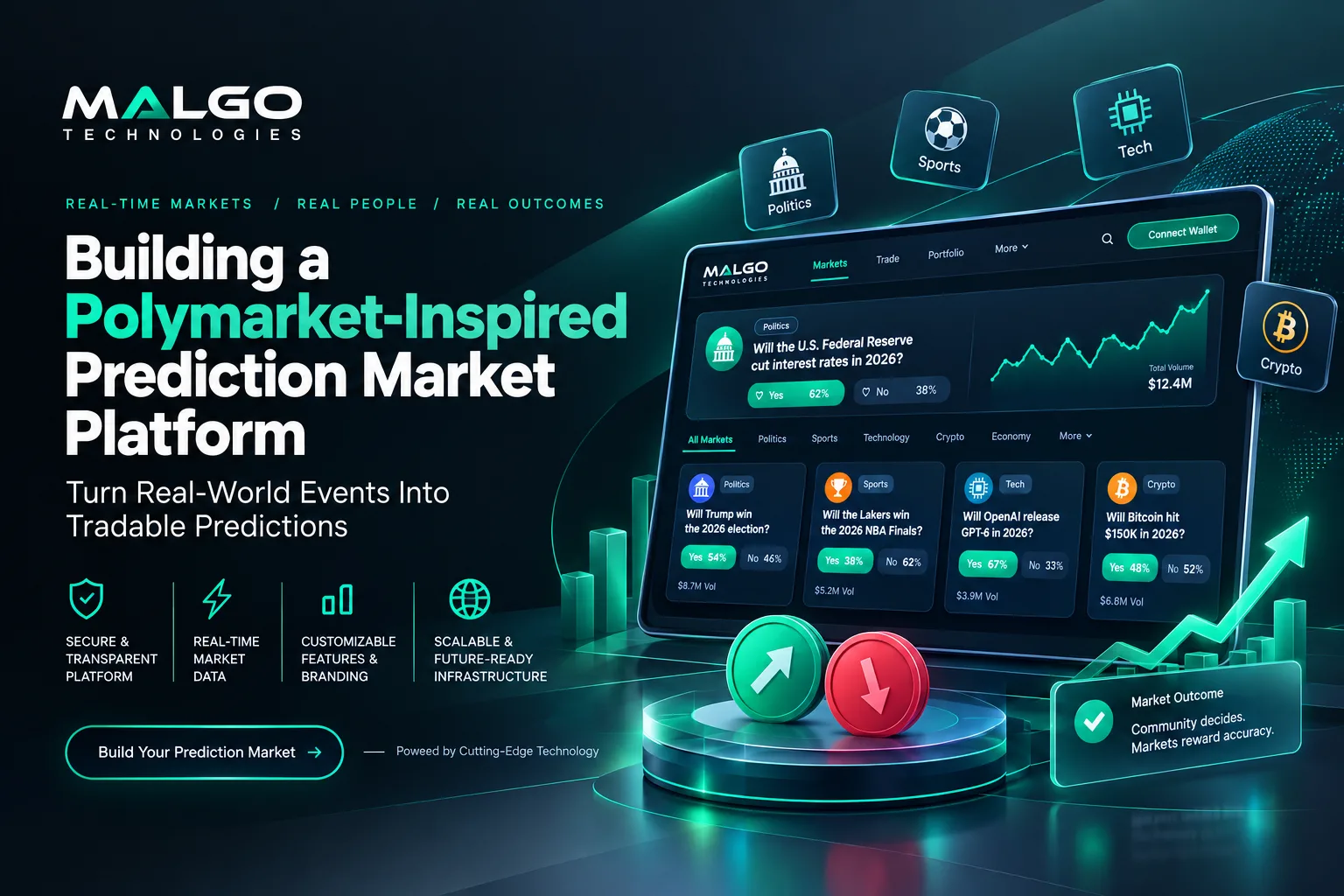
Prediction markets are changing how people interact with real-world events, from elections and cryptocurrency movements to sports outcomes and business trends. Platforms such as Polymarket have demonstrated how blockchain technology, market-driven probabilities, and user participation can come together in a single digital ecosystem. For businesses planning to enter this space, choosing the right technology stack is one of the most important decisions in Polymarket clone development.
A successful prediction market platform needs more than an attractive interface. It requires dependable market operations, secure transaction processing, real-time probability updates, transparent settlement mechanisms, and infrastructure that can support growing user activity. The technologies selected during development directly influence these capabilities.
Understanding the Technical Requirements of a Polymarket Clone
Before selecting programming languages, frameworks, or blockchain networks, define what the platform must accomplish. A Polymarket-style application typically combines frontend interfaces, backend services, blockchain integrations, market data processing, and security controls.
Users should be able to explore prediction markets, review outcome probabilities, place orders, monitor positions, and understand how markets resolve. Administrators also need tools to create markets, manage disputes, monitor suspicious activity, and maintain platform performance.
The technology stack should support these workflows without introducing unnecessary complexity. Rather than choosing technologies because they are trending, evaluate them according to security, maintainability, scalability, and compatibility with the platform's intended business model.
1. Choose a Frontend Framework That Supports Real-Time Interaction
The frontend shapes how users discover markets and make decisions. A prediction market interface must display changing probabilities, order book information, market details, and portfolio updates without becoming difficult to navigate.
React.js is a practical choice for Polymarket clone development because its component-based architecture supports reusable market cards, trading panels, portfolio dashboards, and administrative interfaces. Its ecosystem also provides extensive options for integrating blockchain wallets and real-time data services.
Next.js can complement React by providing server-side rendering, routing, and performance optimization. These capabilities are useful when market pages need to be discoverable through search engines while still delivering interactive trading experiences.
For the styling layer, developers can use Tailwind CSS or a structured component library to maintain visual consistency across desktop and mobile interfaces.
The key consideration is responsiveness. Users should receive clear feedback when placing orders, connecting wallets, or waiting for market updates. An interface that communicates transaction status accurately helps build confidence in the platform.
2. Select a Blockchain Network Based on Platform Requirements
Blockchain selection influences transaction confirmation, smart contract execution, wallet compatibility, and the overall user experience.
Ethereum offers a mature smart contract ecosystem and extensive developer resources. However, its transaction costs and network activity may affect certain trading workflows. Layer 2 networks, including Arbitrum and Polygon, may offer alternatives depending on their current capabilities, liquidity ecosystem, security assumptions, and integration requirements.
When comparing blockchain networks, examine:
- Smart contract security and auditing resources.
- Transaction throughput and confirmation behavior.
- Wallet support and developer tooling.
- Ecosystem liquidity and integration opportunities.
Network reliability and long-term compatibility.
The right choice depends on the platform's trading model and operational requirements. A clone intended for frequent, smaller transactions may have different infrastructure needs from one focused on specialized markets.
Avoid selecting a network solely because it advertises high throughput. Evaluate the complete transaction lifecycle, including execution, confirmation, indexing, and settlement.
3. Build Secure Smart Contracts for Market Operations
Smart contracts can manage critical prediction market functions, including position accounting, collateral handling, outcome settlement, and distribution of eligible claims. Their design must reflect the platform's specific market mechanism.
Solidity is widely used for Ethereum-compatible networks and benefits from established development tools. Hardhat and Foundry are useful options for contract compilation, automated testing, debugging, and deployment workflows.
For a reliable implementation, separate market creation, trading logic, settlement, and administrative permissions into clearly defined components where appropriate. This improves code readability and helps developers identify security-sensitive operations.
Testing should cover more than normal transactions. Include scenarios involving failed settlements, unexpected inputs, permission misuse, reentrancy, rounding errors, and unusual trading sequences.
Independent smart contract audits, automated security analysis, and controlled deployment procedures provide additional safeguards. No audit can guarantee complete security, so ongoing monitoring and a documented incident response process remain essential.
4. Choose a Backend Architecture for Trading and Market Data
Blockchain contracts cannot efficiently handle every application requirement. Backend services are still important for user profiles, notifications, market discovery, administrative workflows, analytics, and data aggregation.
Node.js with TypeScript is a strong option for applications that require asynchronous processing and integration with blockchain APIs. NestJS can provide a structured architecture for larger projects, while Express.js may suit simpler service requirements.
PostgreSQL is appropriate for structured application data, including user settings, market metadata, order records, and reporting information. Redis can support caching, session-related workflows, and temporary data that benefits from fast access.
For live market updates, WebSockets allow the server to push probability changes, order status updates, and portfolio events to connected clients. Message queues or event-driven services can help process blockchain events without making every request wait for background operations.
An important design principle is to distinguish blockchain-confirmed information from application-level data. This reduces inconsistencies and makes transaction states easier to explain to users.
5. Integrate Reliable Oracles and Market Resolution Systems
Prediction markets depend on accurate information to determine whether an event has occurred and which outcome is correct. Market resolution therefore requires careful consideration during architecture planning.
Blockchain oracles can deliver external data to smart contracts, but the appropriate solution depends on the event category. A cryptocurrency-related market, for example, may require different data sources and verification rules from a political or sporting event.
Define resolution criteria before a market opens. Specify the authoritative information source, expected resolution time, handling of ambiguous outcomes, and procedures for disputed results.
Where appropriate, use established oracle infrastructure, independent verification, and controlled dispute-resolution mechanisms. Never assume that external data is automatically accurate simply because it is delivered through an oracle.
Transparent resolution rules are as important as technical reliability because they influence user trust and the perceived fairness of the platform.
6. Strengthen Security, Monitoring, and Deployment
A production-ready platform needs a security strategy that covers the entire application, not just its smart contracts.
Use established authentication standards, role-based access controls, input validation, encrypted communications, and secure secrets management. Apply rate limiting and abuse detection to reduce automated attacks and suspicious activity.
Docker can standardize application environments, while managed cloud infrastructure can support deployment, backups, and operational monitoring. Kubernetes may be appropriate for complex workloads, but smaller platforms can often begin with a simpler deployment architecture.
Monitoring should cover application errors, blockchain transactions, failed orders, data synchronization, and unusual account behavior. Establish recovery procedures and test them before a major incident occurs.
Regulatory requirements also deserve early attention. Depending on the jurisdictions and operating model, prediction markets may trigger specific obligations involving financial services, derivatives, gambling, identity verification, or sanctions compliance. Obtain qualified legal guidance before selecting the final operating structure.
7. Design for Scalability From the Beginning
Scalability is not simply a matter of adding more servers. It requires a system that can handle increased trading activity, expanding market catalogs, and growing volumes of blockchain events without compromising correctness.
Use caching for frequently requested market information, optimize database queries, and separate resource-intensive background jobs from user-facing requests. Event indexing services can make blockchain information easier to search without repeatedly querying contracts for every page load.
Load testing should simulate realistic user behavior, including simultaneous orders, rapidly changing probabilities, and periods of elevated market activity. These tests help identify bottlenecks before they affect actual users.
Choose modular components that can evolve independently as the platform develops. Avoid introducing microservices or complex infrastructure unless the workload justifies them.
Conclusion
Choosing the right technology stack for Polymarket clone development requires balancing user experience, blockchain capabilities, backend performance, market resolution, and security. React or Next.js can support responsive interfaces, Solidity can power compatible smart contracts, and technologies such as Node.js, PostgreSQL, and WebSockets can provide the application infrastructure.
However, no single combination is ideal for every prediction market business. The strongest approach begins with clearly defined product requirements, evaluates technologies against measurable operational needs, and prioritizes security and transparent market behavior from the outset.
By making architecture decisions carefully and validating them through testing, businesses can build a prediction market platform that is easier to maintain, prepared for growth, and designed around user trust.