How to Choose the Right Study Material for SBI Clerk Exam Preparation
Preparing for the SBI Clerk exam requires more than simply studying for long hours. A focused preparation plan, regular practice, revision and the right study resources can make the learning process much more effective. For many aspirants, one of the biggest challenges is deciding which books and study material to use when there are numerous options available in the market.
Good study material should explain concepts clearly, provide sufficient practice questions and help candidates become familiar with the type of questions generally asked in competitive banking examinations. Selecting the right resources at the beginning can save time and help aspirants concentrate on important topics.
Understand the SBI Clerk Exam Before Choosing Books
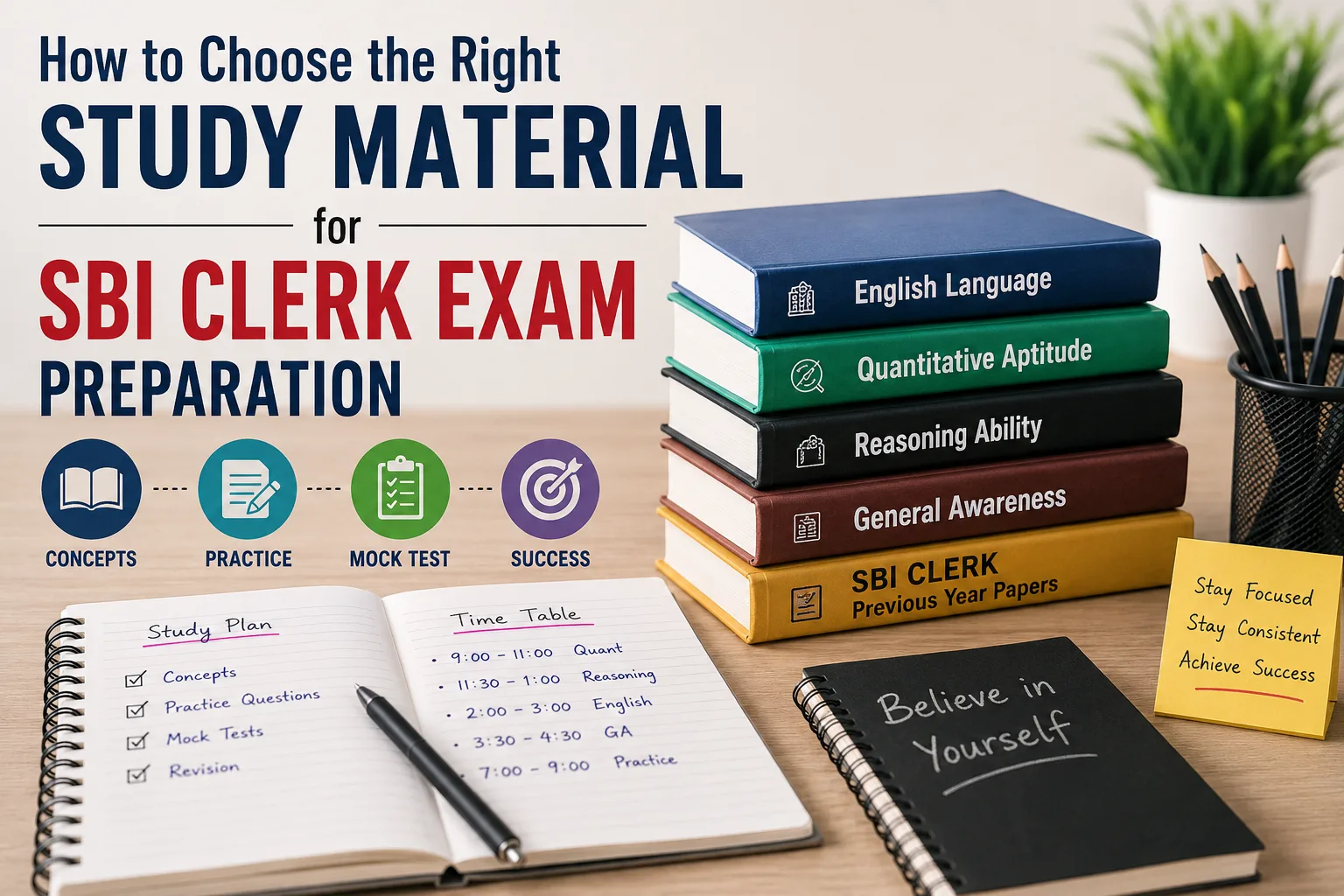
The first step in selecting preparation material is understanding the examination structure. SBI Clerk preparation generally requires candidates to work on areas such as English Language, Numerical Ability and Reasoning Ability in the preliminary stage. Candidates who qualify for the next stage may need to prepare for additional sections, depending on the examination pattern and official notification.
Because each section requires a different approach, using one general book for everything may not always be sufficient. A better approach is to combine concept-based books, practice books, previous-year question resources and mock tests.
Before purchasing any book, candidates should also check the latest SBI Clerk notification and syllabus. This helps ensure that the selected resources are relevant to the current examination requirements.
What Makes Good Study Material for Banking Exam Preparation?
The right Study Material for Banking Exam preparation should be useful for both learning concepts and practising questions. While choosing resources, aspirants should consider the following factors:
1. Updated Content
Competitive examinations can change their question patterns and difficulty levels over time. Therefore, candidates should prefer updated editions that reflect current examination trends.
Older books can still be useful for basic concepts, but they should ideally be supplemented with recent practice questions, current affairs and previous-year papers.
2. Clear Concept Explanation
A good preparation book should explain fundamental concepts in a simple and understandable manner. This is particularly important for candidates who are beginning their banking exam preparation.
For example, Numerical Ability requires knowledge of topics such as percentages, profit and loss, averages, ratio, time and work, data interpretation and simplification. Understanding the basic method before solving multiple questions can improve accuracy.
3. Adequate Practice Questions
Reading concepts alone is not enough for a competitive examination. Candidates need regular practice to improve their speed and accuracy.
The selected Banking Exam Books should therefore contain enough questions with different levels of difficulty. Practising a variety of questions also helps candidates identify the topics where they need additional preparation.
4. Previous-Year Questions
Previous-year questions are valuable because they help aspirants understand the type and level of questions that may appear in an examination.
While previous questions cannot guarantee what will appear in a future paper, they can provide useful insight into recurring concepts, question formats and time-management requirements.
Choosing Books for SBI Clerk Preparation
Candidates looking for Books for SBI Clerk should avoid selecting resources only because they are popular. Instead, the choice should depend on the candidate's preparation level and specific requirements.
A beginner may need books that provide detailed explanations and solved examples. Someone who has already completed the syllabus may benefit more from practice sets, previous-year papers and mock-test resources.
For English preparation, candidates can look for resources covering grammar, vocabulary, reading comprehension, sentence correction and other relevant areas.
For Numerical Ability, books should provide topic-wise explanations followed by sufficient practice questions. Regular practice is especially important because candidates need to solve numerical questions accurately within a limited amount of time.
For Reasoning Ability, aspirants should practise topics such as puzzles, seating arrangements, syllogism, inequalities, coding-decoding, blood relations and logical reasoning. A book with graded practice sets can help candidates gradually move from basic to more challenging questions.
Build a Subject-Wise Study Plan
Buying several books does not automatically improve preparation. Candidates should create a practical plan for using their resources.
For example, a daily preparation routine could include concept learning in one session, question practice in another and revision at the end of the day.
Candidates can divide their preparation into three stages:
Stage 1: Concept Building
Start by understanding the basic concepts of each subject. Avoid rushing through topics simply to complete the syllabus. A strong foundation makes later practice easier.
Stage 2: Intensive Practice
Once the basic concepts are clear, solve topic-wise questions. Keep track of mistakes and note down topics where accuracy is low.
Stage 3: Mock Tests and Revision
After completing a significant portion of the syllabus, begin taking timed mock tests. Analyse each test instead of focusing only on the score. Identify questions that took too much time, concepts that caused mistakes and sections where accuracy needs improvement.
Don't Ignore Current Affairs
Banking exam preparation is not limited to reasoning, numerical ability and English. General awareness and current affairs can also play an important role in banking-related examinations.
Candidates should develop a regular habit of following important national and international developments, banking and financial news, government schemes, economic updates and other relevant events.
Instead of trying to memorise everything at the last moment, maintaining short revision notes can make the process more manageable.
Use Books Along With Other Resources
Books should form an important part of preparation, but they do not have to be the only resource.
A balanced preparation strategy can include:
- Concept-based banking exam books
- Topic-wise practice books
- Previous-year question papers
- Mock tests
- Current affairs notes
- Revision material
- Online practice sessions
The goal should be to use each resource for a specific purpose rather than collecting a large number of books and leaving most of them unused.
How to Avoid Choosing Too Many Books
One common mistake among banking exam aspirants is purchasing multiple books for the same subject. Having too many resources can create confusion and reduce the time available for actual practice.
It is generally more productive to select one reliable resource for concept building and one suitable source for extensive practice. Candidates can then supplement these with previous-year papers and mock tests.
For example, if a candidate already understands basic arithmetic concepts, buying several introductory mathematics books may not be useful. Instead, additional practice sets could provide greater value.
Make Revision a Regular Part of Preparation
Revision should not be postponed until the final weeks before the examination. Regular revision helps candidates retain formulas, rules, vocabulary and important concepts.
Create short notes for frequently forgotten formulas, grammar rules, reasoning approaches and important facts. Revisit these notes periodically.
Candidates can also maintain an error notebook. Whenever a question is answered incorrectly, write down the reason for the mistake. It may be a conceptual error, calculation mistake, misunderstanding of the question or lack of time. Reviewing these mistakes can gradually improve performance.
Where to Find Banking Exam Preparation Books
Aspirants can explore dedicated collections of banking preparation resources to compare different titles according to their requirements. B3Books offers a dedicated collection for banking examination preparation where candidates can explore relevant books and study resources.
Explore Banking Exam Books at B3Books
The collection can be useful for candidates who are looking for Study Material for Banking Exam, Banking Exam Books and Books for SBI Clerk in one place.
Final Thoughts
Choosing the right preparation material is an important part of SBI Clerk preparation, but the effectiveness of any book ultimately depends on how consistently it is used. Aspirants should focus on understanding concepts, solving questions regularly, analysing mistakes and revising important topics.
Instead of collecting numerous resources, choose relevant and updated books that match your preparation level. Combine them with previous-year questions, mock tests and current affairs preparation to create a balanced study routine.
For SBI Clerk aspirants, the objective should not simply be to complete books. The real goal is to develop accuracy, speed, confidence and a strong understanding of the subjects tested in the examination. With the right Banking Exam Books, consistent practice and a structured approach, candidates can make their preparation more focused and productive.