Security Safes Dubai: A Practical Guide to Choosing the Right Safe
Important documents, cash, jewellery, electronics, company records and personal belongings all require different levels of protection. A safe can help reduce the risk of unauthorised access, but choosing the right model involves more than selecting a box with a lock.
The most suitable security safes in Dubai depend on what you need to protect, where the safe will be installed and how frequently it will be accessed. Locking technology, construction, fire protection, size and installation all influence the safe’s overall usefulness. This guide explains the main options and the questions buyers should consider before making a decision.
Why Choosing the Right Safe Matters
A safe is designed to create a secure barrier between valuable items and common risks such as theft, unauthorised access, accidental damage and, in some cases, fire. However, no single safe is ideal for every situation.
A compact home safe may be appropriate for passports, jewellery, emergency cash and personal documents. A business may need a larger unit with stronger construction, controlled access and enough internal capacity for files, cash-handling materials or sensitive records.
The safe’s location also matters. A model placed in a visible, unsecured area may be easier to remove than one that has been professionally anchored to a suitable surface. Similarly, a safe that is difficult to access may encourage users to leave valuables elsewhere, reducing its practical value.
Before comparing products, identify:
- What items need protection.
- How often the safe will be opened.
- Who needs authorised access.
- Whether fire protection is important.
- How much internal storage space is required.
- Where the safe can be installed securely.
This simple assessment helps prevent buyers from choosing a model based only on appearance or price.
Common Types of Safes
Home SafesHome safes are commonly used for passports, identity documents, jewellery, cash, keys and small electronic devices. They are often compact enough for wardrobes, cabinets or dedicated storage areas.
When choosing one, consider the size of the items it must hold rather than focusing only on the external dimensions. A safe that seems large enough at first may become difficult to use once folders, pouches or document envelopes are placed inside.
A home safe should also be positioned discreetly and secured properly. If the unit is portable, anchoring it to a suitable floor or wall can make unauthorised removal more difficult. Installation must take into account the structure of the building and the manufacturer’s instructions.
Office safes are generally selected for business cash, contracts, employee records, backup storage devices and other confidential materials. They may require greater capacity than a residential model and may be accessed by more than one authorised employee.
Businesses should consider how access will be managed when staff members change roles or leave the company. A lock system that allows access codes to be updated can be useful in environments with multiple users, while a mechanical system may be preferred where electronic components are not desirable.
The safe should also be placed where authorised staff can use it efficiently without making its contents visible to visitors or unauthorised personnel.
Document safes are designed around the protection of paper records and other materials that can be damaged by heat, smoke or moisture. They are useful for passports, property documents, contracts, certificates, insurance records and other irreplaceable paperwork.
Capacity and internal layout are important considerations. Shelves, folders and drawers can make it easier to organise documents, but they may reduce the available space for larger items. Buyers should also check what type of protection the product is designed to provide rather than assuming that every heavy safe offers the same level of fire resistance.
Floor and wall safes can be installed within a building structure, helping keep the unit concealed or less visible. Their suitability depends on the construction of the property, available installation space and the type of access required.
These safes normally require more planning than a freestanding model. Installation should not compromise plumbing, electrical systems, structural elements or waterproofing. For this reason, buyers should confirm installation requirements before purchasing.
Hotels, serviced apartments and furnished properties may use compact safes for guest belongings. In these settings, ease of use and reliable access management are important.
The operator should have a clear process for resetting codes, handling forgotten credentials and responding to access issues. A safe used by many different people should be selected with operational convenience in mind, not only its locking mechanism.
Features to Assess Before Buying
Construction and Physical SecurityThe body, door, hinges and locking points contribute to a safe’s resistance to forced entry. A well-built safe should close securely and operate smoothly without excessive movement in the door.
Look for clear information about:
- The materials used in the body and door.
- The number and design of locking bolts.
- Hinge protection.
- Door alignment and closing quality.
- The manufacturer’s installation recommendations.
- Any independently verified security classification, where applicable.
Avoid treating weight alone as proof of quality. A heavy unit may be difficult to move, but weight does not automatically indicate the level of protection it provides.
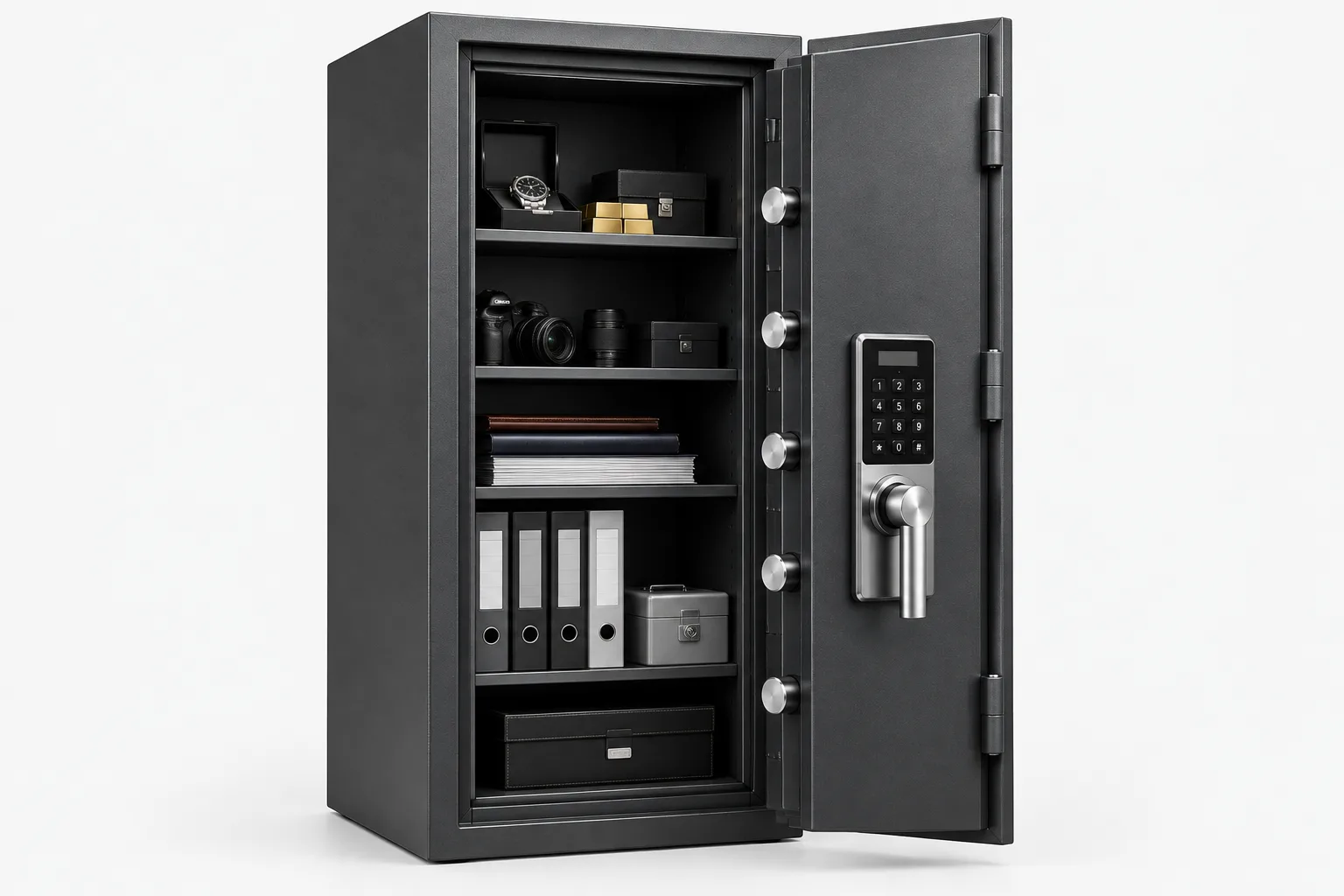
The safe should be large enough for current needs and likely additions. Consider whether you need to store A4 documents, folders, laptops, watches, camera equipment or other bulky items.
It is usually better to measure the largest item that must fit inside and leave practical room for organisation. Overfilling can make documents difficult to retrieve and may lead users to store important items outside the safe.
A safe’s effectiveness is affected by how it is installed. A portable unit may be vulnerable to removal if it is not anchored correctly. Freestanding models should be placed on a stable surface, while wall and floor units require suitable structural conditions.
Before installation, check:
- Whether the mounting surface can support the safe.
- Which fixing points are provided.
- Whether the door can open fully.
- Whether access will remain convenient.
- Whether the installation could affect building services.
- Whether specialist installation is recommended.
In rented properties, buyers should also confirm whether drilling or structural alterations are permitted.
The right access system depends on the number of users and the required level of convenience. A personal safe with one regular user may not need the same access features as a business safe used by several employees.
Some models may offer features such as programmable codes, multiple user credentials, override access or access records. These features can be useful, but they should be evaluated alongside battery management, emergency access procedures and the possibility of forgotten codes.
Fire Protection and Document Security
Fire resistance is a separate consideration from burglary protection. A safe can be difficult to force open but still provide limited protection against high temperatures. If the primary purpose is storing paper documents, buyers should look specifically for information about the product’s fire-protection design and testing.
Paper, digital storage devices and photographic materials may have different protection requirements. Some media can be damaged by heat or moisture even when paper appears unaffected. Anyone storing hard drives, USB devices or other sensitive media should check whether the safe is suitable for those materials.
Fire-resistant construction does not mean that a safe is permanently protected under every fire condition. Buyers should review the manufacturer’s stated limitations and avoid relying on vague descriptions such as “fireproof” without supporting details.
Digital, Electronic and Mechanical Locks
Digital and Electronic Safes
Electronic safes usually allow users to enter a code through a keypad. They can be convenient for frequent access and may make it easier to change credentials when access needs to be updated.
Their practical performance depends on proper battery maintenance and a clear emergency-access procedure. Buyers should understand what happens if the battery becomes weak, the code is forgotten or the electronic system develops a fault.
Digital locks are not automatically more secure than mechanical locks. The overall protection still depends on the safe’s construction, installation and how access credentials are managed.
Mechanical Locks
Mechanical locks do not depend on batteries and can be reliable for users who prefer a traditional system. They may be well suited to situations where the safe is opened infrequently or where long-term simplicity is a priority.
However, mechanical locks may require more time to operate and may be less convenient for multiple users. Their suitability depends on the user’s familiarity with the mechanism and the need for quick, repeated access.
Key Locks and Combined Systems
Key-operated safes can be straightforward, but keys must be stored securely. Leaving a spare key in an obvious location undermines the purpose of the safe. Some models combine a key with another access method, which may provide an additional layer of control.
The best system is the one that authorised users can operate consistently while keeping credentials, keys and emergency procedures secure.
Choosing a Safe for Your Situation
A useful way to narrow the options is to match the safe to the risk and the contents.
For a home, focus on discreet placement, suitable capacity, anchoring and simple access. A small electronic safe may be practical for everyday valuables, while a document-focused model may be more appropriate for passports and important records.
For an office, consider the number of users, access management, internal organisation and whether the safe needs to accommodate cash, files or technology. A business may also need a documented process for changing access when staff responsibilities change.
For a retail or cash-handling environment, ease of access should be balanced with protection and controlled placement. The safe should not be located where customers can observe its use, and access should be limited to authorised personnel.
For documents, prioritise internal dimensions, shelf configuration and verified fire-protection information. For jewellery or small valuables, internal layout and discreet installation may be more important than maximum capacity.
Businesses comparing available models can review safes and security products from Buggy UAE as part of their wider research: https://buddyuae.com/. Buyers should still confirm the exact specifications, lock type, dimensions, installation requirements and after-sales support for the product they intend to purchase.
Buying Considerations in Dubai
When purchasing a safe in Dubai, practical conditions such as building layout, storage space and installation access deserve attention. Apartments, villas, offices, shops and warehouses may each present different requirements.
Consider the following before placing an order:
- Measure the installation area, including door-opening clearance.
- Confirm the safe’s external dimensions and weight.
- Check whether the model suits the items being stored.
- Ask how the unit should be anchored.
- Review battery, key and emergency-access procedures.
- Confirm delivery access, especially for heavier models.
- Ask what warranty and service support are included.
- Verify the return or replacement policy before purchase.
- Request clear information about fire protection if documents are a priority.
Buyers should also avoid selecting a safe solely because it has a digital keypad, attractive finish or low price. Those features may be useful, but they do not replace appropriate construction, installation and access management.
Common Mistakes to Avoid
One frequent mistake is buying a safe that is too small. The unit may hold current belongings but become impractical when additional documents or valuables need to be stored.
Another is placing the safe in a visible or easily accessible location without anchoring it. A strong lock provides limited benefit if the entire unit can be removed.
Some buyers also confuse water resistance, fire resistance and burglary protection. These are different forms of protection and should be evaluated separately according to the risks that matter most.
Finally, avoid ignoring access management. Codes should not be shared casually, keys should be controlled and authorised users should know what to do if the lock, battery or access method fails.
FAQ Section
What type of safe is suitable for a home?
A compact home safe may be suitable for passports, jewellery, cash and personal documents. Choose a model with enough internal capacity, a suitable lock and secure anchoring options.
Are digital safes secure?
Digital safes can provide effective access control when the safe is well constructed, properly installed and maintained. Users should manage codes carefully and understand the emergency-access procedure.
What should I consider when choosing a business safe?
Consider the number of authorised users, the type and volume of items being stored, access management, internal organisation, installation and whether fire protection is required.
Are fire-resistant safes suitable for documents?
A safe specifically designed and tested for document protection may help protect paper records from heat and smoke for a stated period. Review the manufacturer’s specifications rather than relying on general “fireproof” wording.
Does a heavy safe provide better protection?
Weight can make a safe harder to remove, but it is not a complete measure of quality. Construction, locking points, installation and any verified security information should also be assessed.
Should a safe be bolted down?
Anchoring can help reduce the risk of unauthorised removal, particularly for smaller or portable units. The correct method depends on the safe and the building structure, so installation guidance should be followed.