
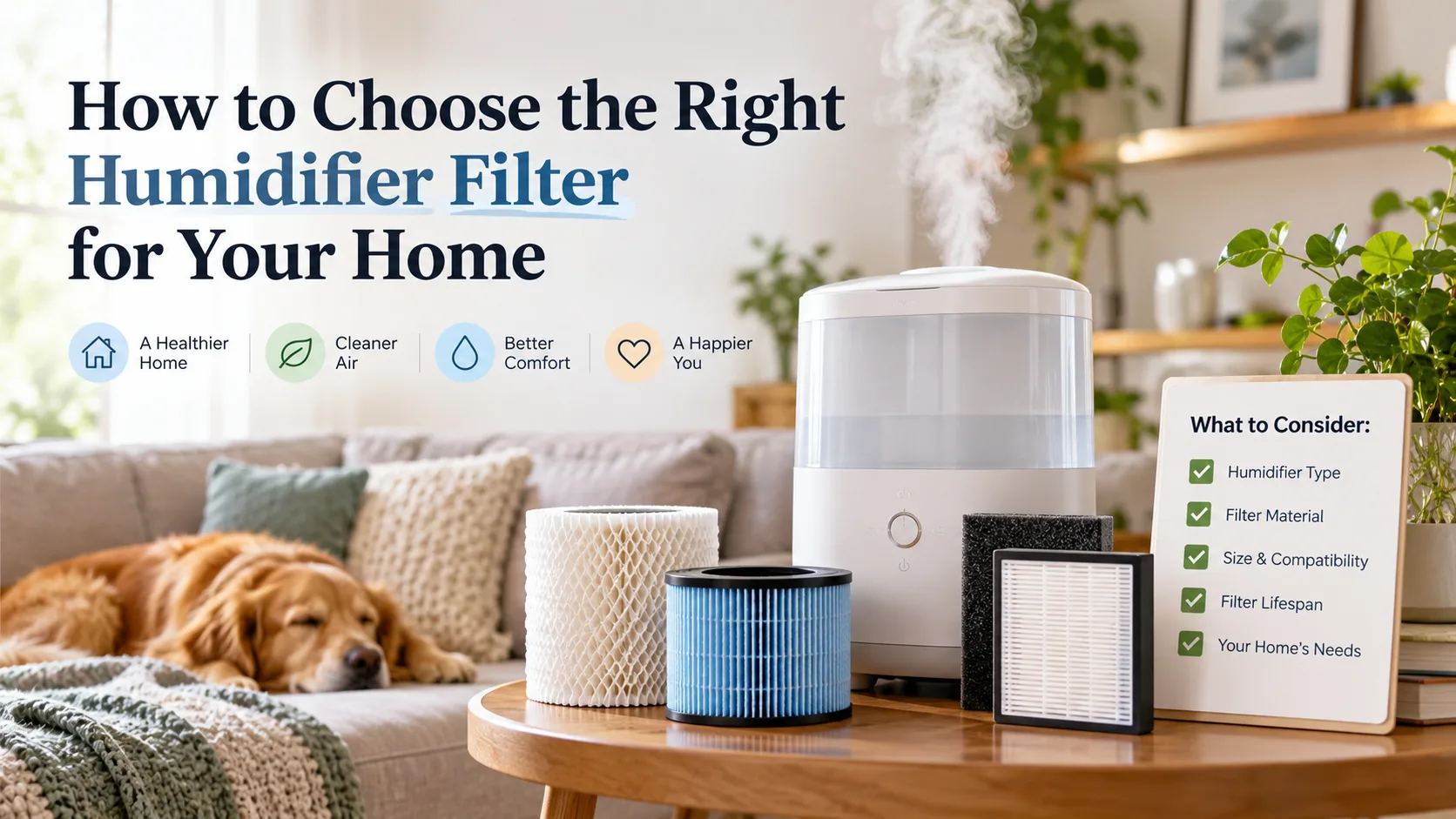
When temperatures drop in Canada, indoor air can become noticeably dry. Heating systems run more frequently, windows stay closed, and many households use humidifiers to add moisture to the air.
But a humidifier can only work as intended when its components are in suitable condition. In models that use replaceable filters or pads, choosing the correct replacement is an important part of regular maintenance.
If you're shopping for a new filter, you might come across terms such as wick filters, humidifier pads, and evaporator pads. Although these products can serve similar purposes, they are not necessarily interchangeable. Here's what to know before buying one.
1. Understand How Humidifier Filters Work
Many evaporative humidifiers use a water-absorbing filter that draws moisture from a reservoir. A fan moves air through the damp filter, allowing some of the moisture to evaporate into the room.
Over time, the filter can collect minerals from the water, dust, and other deposits. This buildup may affect how well water moves through the filter and how efficiently the humidifier operates.
Not every humidifier uses this type of filter. Some ultrasonic models, for example, operate without a traditional wick filter. Always check your appliance's design before purchasing replacement components.
2. What Are Humidifier Wick Filters?
Humidifier wick filters are absorbent components commonly used in evaporative humidifiers. They draw water from the reservoir and provide a surface for evaporation.
Depending on the humidifier model, a wick may be made from treated paper, fabric-like material, or another absorbent structure.
A suitable wick filter should fit the humidifier correctly and match the manufacturer's specifications. Even filters that look similar may differ in dimensions, construction, or compatibility.
3. Humidifier Pads and Evaporator Pads: What's the Difference?
The terms humidifier pads and humidifier evaporator pads are often used for absorbent components in evaporative humidification systems.
Some whole-house humidifiers installed alongside HVAC equipment use an evaporator pad. Water flows over the pad while warm air passes through it, helping moisture enter the home's air circulation system.
Portable humidifiers may use smaller wick-style filters instead.
The terminology can vary between manufacturers, so don't assume that every pad or wick is suitable for every appliance. Check the model number and product specifications before ordering.
4. How to Choose the Correct Humidifier Replacement Filters
Finding the correct humidifier replacement filters starts with identifying your appliance.
Before purchasing, check these details:
- Brand and model: Find the model number on the appliance or in its owner's manual.
- Filter dimensions: Compare the required measurements with the replacement product.
- Filter type: Confirm whether your humidifier uses a wick, evaporator pad, or another component.
- Product compatibility: Check the manufacturer's compatibility information rather than relying on appearance alone.
These checks can help prevent ordering a filter that looks right but doesn't fit or function correctly.
5. When Should You Replace a Humidifier Filter?
There isn't one replacement schedule for every humidifier. The recommended interval depends on the model, water quality, usage, and the manufacturer's instructions.
Here are a few signs that your filter may need attention:
- Mineral deposits or visible discoloration
- A filter that feels stiff, clogged, or heavily coated
- Uneven water absorption
- Reduced humidifier performance
- An unpleasant smell that remains after appropriate cleaning
If the filter is disposable, follow the manufacturer's replacement instructions. Avoid trying to wash or reuse a filter unless the product documentation specifically allows it.
Regular cleaning of the water reservoir and other removable components is also important. Replacing the filter alone does not eliminate the need for general humidifier maintenance.
6. Why Humidifier Maintenance Matters During Canadian Winters
During Canada's colder months, indoor heating can contribute to low humidity, making humidifiers useful in many households.
However, running a humidifier continuously without checking its condition can lead to mineral buildup and other maintenance problems.
Keep the reservoir clean, use water according to the manufacturer's recommendations, and monitor indoor humidity. The US Environmental Protection Agency recommends keeping indoor relative humidity below 60%, ideally between 30% and 50%, to help reduce moisture-related problems.
Following the appliance's maintenance instructions can help keep your humidifier in good working condition throughout the heating season.
7. Where to Find Humidifier Filter Replacements
Once you know your humidifier's brand, model, and required filter type, you can compare suitable replacement options.
Quick Parts Depot is an online retailer serving Canadian customers with replacement parts and home maintenance products.
You can explore the available options in its humidifier filters category:
Browse Humidifier Filters – Quick Parts Depot
Before ordering, verify the product details and compatibility information to make sure the filter matches your humidifier.
Frequently Asked Questions
1. Are humidifier wick filters and evaporator pads the same?
They perform similar moisture-absorption functions in some evaporative systems, but their design and application can differ. Always check the humidifier model before choosing a replacement.
2. How often should I replace humidifier filters?
Replacement intervals vary by appliance, water quality, and usage. Follow the manufacturer's instructions and inspect the filter regularly.
3. Can I reuse a humidifier filter after cleaning it?
Only if the manufacturer says it is washable or reusable. Many disposable filters are designed to be replaced rather than cleaned and reused.
4. Do all humidifiers need replacement filters?
No. Some evaporative humidifiers use replaceable wicks or pads, while certain ultrasonic models do not use traditional filters.
Final Thoughts
Choosing a humidifier filter is easier when you understand how your appliance works. Check the model number, identify the correct filter type, and compare compatibility before ordering.
Whether your humidifier uses a wick filter or an evaporator pad, regular inspection and proper maintenance can help you get more consistent performance during Canada's dry winter months.