Choosing a BIM training program can be confusing, especially for engineering graduates who are entering the Architecture, Engineering, and Construction (AEC) industry for the first time. A quick online search brings up numerous courses, software programs, certifications and training institutes, each presenting a different path into BIM.
The challenge is not simply finding a course. It is understanding which type of training can actually prepare you for the way BIM is used in professional projects.
Students searching for BIM training in India should therefore look beyond course duration, software lists and certificates. The quality of the learning environment, the experience of the trainers, exposure to project workflows and opportunities to apply what is learned can make a significant difference.
Here are some of the most important things to consider before choosing a BIM training program.
Start With the Career You Want to Build
BIM is not a single job role. It is used across architecture, structural engineering, MEP, façade engineering and several other areas of the AEC industry.
Before choosing a course, think about your educational background and the direction in which you want to develop your career.
A civil or structural engineering graduate may be interested in architectural and structural BIM workflows. Mechanical and electrical graduates may find MEP BIM more closely connected to their academic background. Architecture graduates may want to develop stronger capabilities in modelling, documentation and multidisciplinary coordination.
There are also specialized areas such as façade BIM that can provide a more focused career direction.
A good BIM course should therefore do more than teach general software skills. It should help students understand how BIM is applied within the discipline they intend to pursue.
Don't Choose a Course Only by the Software List
Software is an essential part of BIM, but BIM itself is not a software package.
Students commonly encounter tools such as Revit, AutoCAD, Navisworks and Autodesk Construction Cloud while learning BIM. Knowing how to operate these tools is important, but learning commands alone does not explain how a BIM project actually works.
In a professional environment, models need to follow project requirements. Teams work with defined standards, documentation procedures, naming conventions, model reviews, coordination processes and information-sharing workflows.
A learner may know how to model an element in Revit but still struggle to understand where that element belongs within a coordinated project.
This is why good BIM training should connect software learning with the larger project workflow.
Find Out Who Will Actually Train You
The experience of the trainer can significantly influence the way BIM is taught.
Someone who has worked on BIM projects can explain more than the steps required to complete a software exercise. Experienced professionals can explain why a particular workflow is followed, what happens when disciplines conflict, what mistakes occur frequently and how project teams review and correct their work.
This distinction becomes especially important when students start dealing with coordination and documentation.
For example, creating a duct in a model is primarily a modelling task. Understanding whether that duct has enough clearance, whether it conflicts with structural elements, whether it can be installed and how the issue should be communicated involves a much broader understanding of project delivery.
Before enrolling, students should therefore ask about the professional background of the people conducting the training.
Look for Project-Based Learning
Watching someone demonstrate BIM software is very different from completing a project yourself.
Students need opportunities to create models, encounter problems, make corrections and understand why those corrections are necessary. Assignments should gradually move beyond isolated software exercises and introduce learners to the type of work they may encounter in an actual project environment.
Project-based learning can also help students understand how different BIM activities connect.
A model may eventually need to produce drawings and schedules. Models from different disciplines may need to be combined for coordination. A clash may need to be identified, reviewed, communicated and corrected. Project information may need to be updated when revisions arrive.
These connections are difficult to understand when every software exercise is taught separately.
Ask Whether Coordination Is Part of the Training
One of the biggest differences between basic 3D modelling and professional BIM work is coordination.
Buildings bring together architecture, structure, mechanical systems, electrical systems, plumbing and other disciplines. These systems cannot be developed independently without considering how they interact.
A structural beam may interfere with a duct. A pipe route may conflict with another service. Equipment may fit physically inside a room but lack the clearance required for maintenance.
BIM helps project teams identify and resolve many of these issues digitally.
Students considering BIM training should therefore check whether the program introduces multidisciplinary coordination, clash detection, model review and documentation workflows rather than concentrating entirely on model creation.
Consider the Learning Environment
Where and how you learn can also influence your preparation for professional work.
Some students prefer completely online learning because of its flexibility. Others benefit more from an environment where they can interact directly with trainers, ask questions during exercises and receive immediate feedback.
For fresh engineering graduates, learning in an office-like environment can provide another advantage. It introduces them to structured working hours, deadlines, reviews, communication and the general discipline expected in a professional setting.
This can make the eventual transition from college to employment less unfamiliar.
The learning environment should therefore be considered alongside the curriculum when comparing training options.
Don't Let “Near Me” Be Your Only Selection Criterion
It is natural for students to search for a BIM course near me or BIM training near me, particularly when the program requires classroom attendance. Location matters because travelling long distances every day can make a course difficult to sustain.
However, the closest institute is not automatically the most suitable one.
Compare the curriculum, trainers, learning environment, project exposure, software covered, specialization options and internship opportunities before making a decision.
Travelling a little farther for a program that better matches your career goals may be more valuable than selecting a course simply because it is closest to your home.
At the same time, students should be realistic about commuting, accommodation, class schedules and the time required to complete assignments. The best option should provide both quality training and a learning arrangement that can be maintained throughout the program.
Check Whether the Course Includes Internship Exposure
One of the biggest challenges fresh graduates face is the transition from training exercises to professional project expectations.
An internship can help reduce this gap.
During training, students usually work in a controlled environment where tasks are designed for learning. Professional projects are different. They involve deadlines, revisions, quality requirements, communication between teams and responsibility for completing assigned work correctly.
Internship exposure can introduce students to these expectations before they begin applying for full-time positions.
It can also help them understand an important lesson: knowing a software command and knowing how to use that software responsibly on a project are two different things.
Look Beyond the Certificate
Certification is useful because it records that a learner has completed a particular program. But a certificate should not be the only outcome of BIM training.
When graduates attend interviews, employers may want to understand what they can actually do.
Can the candidate explain how a model was developed? Can they describe a coordination problem they encountered? Do they understand drawings and documentation? Can they explain the difference between modelling and coordination? Can they demonstrate work they completed during training?
A portfolio containing models, drawings, schedules, coordinated views, clash reports or other relevant outputs can provide stronger evidence of learning.
The goal should therefore be to finish the program with knowledge, demonstrable skills and greater confidence—not simply another document to add to a résumé.
Evaluate the BIM Training Institute, Not Just the Course
Two institutes can offer courses with similar names while providing very different learning experiences.
When evaluating a BIM training institute, students should investigate its connection with the AEC industry, the experience of its trainers, the structure of its curriculum and the opportunities available for project exposure.
Useful questions include:
- Is the training delivered by professionals with BIM project experience?
- Does the curriculum cover workflows as well as software?
- Are students given assignments and project-based exercises?
- Does the program cover documentation and coordination?
- Will students work with more than one relevant BIM tool?
- Is internship or project exposure available?
- Does the program help students develop a portfolio?
- Is the specialization appropriate for the student's engineering background?
Asking these questions makes it easier to compare programs based on what students will actually learn rather than promotional claims.
Understand What Happens After Training
A BIM course should be the beginning of professional development rather than the end of it.
Graduates may begin in roles such as BIM Modeler, Junior BIM Engineer, Revit Modeler or BIM Technician depending on their discipline, skills and the requirements of the employer.
With project experience, they can gradually develop stronger capabilities in coordination, documentation, model management and digital project delivery. Further experience may eventually open pathways towards roles such as BIM Coordinator, BIM Lead, BIM Manager or other specialized positions.
Progress does not happen simply because someone has completed a course. It develops through continuous learning, project experience and increasing responsibility.
Students should therefore choose training that gives them a strong foundation on which they can continue building.
Why Industry Exposure Matters When Learning BIM
BIM is ultimately used to deliver real projects.
This makes industry exposure particularly valuable during the learning stage. Students can begin to understand why standards exist, how different disciplines interact, how models are reviewed and why seemingly small modelling decisions can affect other project teams.
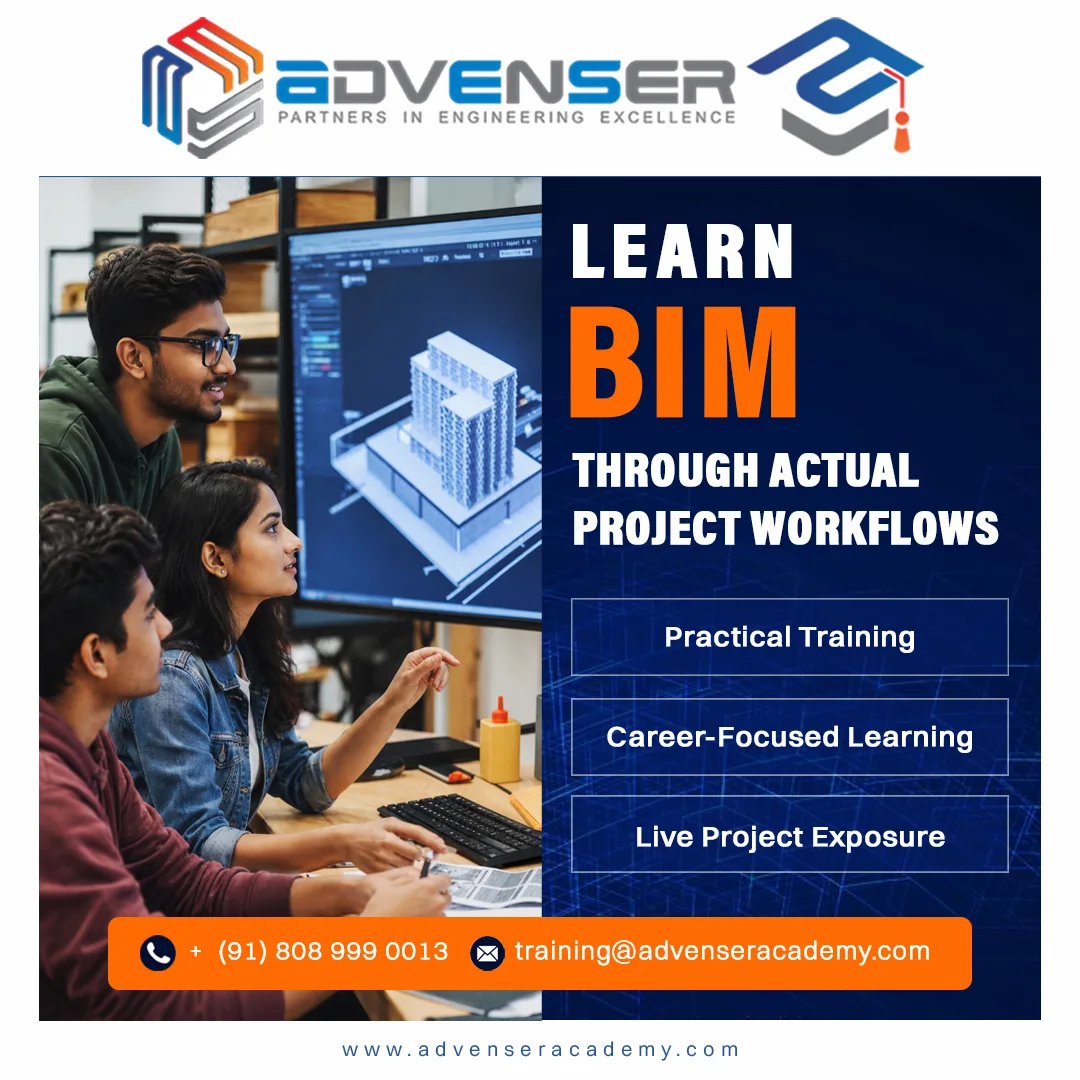
Advenser Academy is the BIM training division of Advenser Engineering Services and provides training guided by professionals with experience in BIM project delivery. Its programs combine structured technical learning with project-based exercises and internship exposure.
Current programs include BIM for Architecture & Structure, BIM for MEP and BIM for Façade Design. The curriculum incorporates tools such as Revit, AutoCAD, Navisworks and Autodesk Construction Cloud, with programs designed around applied BIM workflows rather than a single software package.
Choose Training for What You Want to Become
Searching for BIM training is easy. Choosing the right training requires more thought.
Don't begin by asking only, “How long is the course?” or “Which software will I learn?” Ask what you will be capable of doing when the program is complete.
Will you understand how BIM fits into a real project? Will you know how your discipline coordinates with others? Will you have project work you can discuss during an interview? Will you understand documentation and model quality? Will you have experienced the expectations of a professional project environment?
These questions provide a much better way to evaluate a BIM program.
The right training cannot guarantee a career. What it can do is provide a stronger starting point—helping you develop the technical understanding, project awareness and applied skills required to take your first steps into the BIM industry.