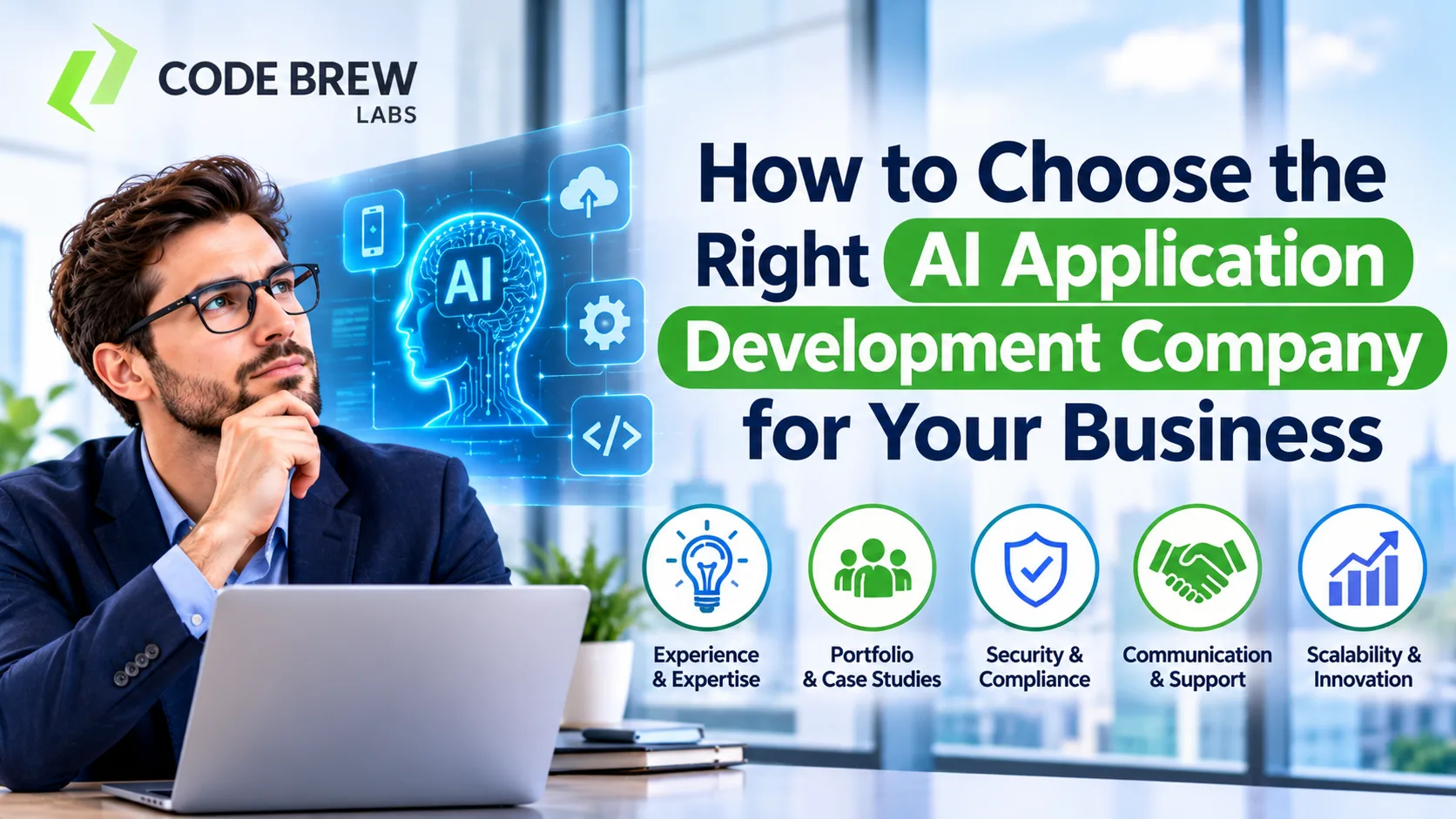
Artificial intelligence is changing how businesses operate, serve customers, and make decisions. From automating repetitive tasks to analyzing large amounts of data, AI applications are helping organizations improve productivity, reduce operational costs, and create better customer experiences.
Businesses across industries such as healthcare, finance, retail, logistics, education, and real estate are increasingly investing in AI-powered applications. However, developing a successful AI application requires more than selecting an AI model or adding intelligent features to existing software. It involves understanding business requirements, choosing the right technology, preparing quality data, building a scalable architecture, and maintaining the application after launch.
This is why choosing the right AI application development company is an important business decision.
A reliable development partner can help turn your business ideas into practical AI solutions that deliver measurable results. On the other hand, choosing a company without the right technical expertise or industry understanding can lead to unnecessary expenses, security problems, and applications that fail to meet business expectations.
In this article, we will explore how to evaluate AI development companies, what services to look for, which questions to ask, and how to select a partner that supports your long-term business goals.
Understand Your Business Requirements Before Choosing an AI Company
Before contacting an AI application development company, it is important to understand what you want to achieve with artificial intelligence.
Many businesses start by looking for AI technologies without clearly identifying the problem they want to solve. This can make the development process complicated and increase project costs.
Start by identifying the challenges within your business that could benefit from AI.
For example:
- A healthcare organization may need AI-powered patient management or diagnostic assistance.
- A financial institution may want automated fraud detection and risk analysis.
- An eCommerce business may require personalized product recommendations.
- A logistics company may need predictive analytics for route optimization.
- A real estate company may want AI-powered property recommendations.
- A customer support team may benefit from intelligent chatbots and automated responses.
Once you identify your requirements, define the expected business outcomes.
Ask yourself:
- What business problem should the AI application solve?
- Who will use the application?
- What data will the application need?
- Do you need a completely new AI application or AI integration into existing software?
- What results do you expect after implementation?
Having clear answers will help you communicate your expectations and find a development company with relevant experience.
Evaluate the Company's AI Development Experience
Experience is one of the most important factors when selecting an AI development partner.
Artificial intelligence includes several technologies, and not every software development company has the technical knowledge required to build production-ready AI applications.
Look beyond the number of years a company has been operating. Evaluate its experience with technologies, business applications, integrations, and real-world AI implementation.
A capable AI development company should understand areas such as:
Machine Learning: Machine learning helps applications identify patterns in data, make predictions, and improve performance through experience.
Generative AI: Generative AI enables applications to produce text, images, summaries, and other content based on user inputs and available information.
Large Language Models (LLMs): LLMs support intelligent search, conversational interfaces, document processing, and context-aware business applications.
Natural Language Processing (NLP): NLP helps applications understand, interpret, and respond to human language.
Computer Vision: Computer vision enables systems to analyze images, videos, and visual information.
Predictive Analytics: Predictive analytics helps businesses forecast trends, identify potential risks, and make informed decisions.
You should also check whether the company has experience developing AI applications for your industry.
Industry knowledge can make a significant difference because healthcare, finance, retail, and logistics have different operational requirements, data structures, and compliance considerations.
Review the Company's Portfolio and Previous AI Projects
A company's portfolio provides useful information about its practical development capabilities.
Instead of relying entirely on website descriptions or marketing claims, review its previous projects and understand what it has actually delivered.
Look for case studies that explain the business problem, development approach, technologies used, and final outcomes.
Pay attention to the following areas:
- Project complexity: Has the company developed applications with advanced AI capabilities?
- Industry experience: Has it worked with businesses similar to yours?
- Technical implementation: Can it demonstrate how AI technologies were integrated?
- Scalability: Have its applications supported growing business requirements?
- Business results: Did the solution improve efficiency, customer experience, or decision-making?
For example, if you want to develop an AI-powered customer service application, look for experience with conversational AI, LLM integration, knowledge management, and automated customer support.
If your business requires predictive analytics, check whether the company has experience with machine learning models, data processing, and model performance evaluation.
A strong portfolio should demonstrate practical problem-solving rather than simply showcasing attractive application interfaces.
Evaluate Its Custom AI Application Development Services
Every business has different operational needs. A ready-made AI tool may solve a basic problem, but organizations with specific workflows often require customized solutions.
A reliable AI application development company should offer services that can be adapted to different business requirements.
Some important services include:
Custom AI Application Development
Custom AI development involves building applications around specific business goals, workflows, and user requirements.
These applications can include intelligent dashboards, automated business platforms, AI-powered mobile applications, and enterprise software.
Generative AI Development
Generative AI solutions help businesses automate content creation, document analysis, customer interactions, and internal knowledge management.
Companies can use these applications to improve productivity and reduce repetitive manual work.
AI Chatbot Development
AI-powered chatbots can understand customer questions, provide relevant information, handle common requests, and support customer service operations.
Advanced chatbots can also connect with internal databases and business systems.
Machine Learning Development
Machine learning solutions analyze business data to identify patterns, generate predictions, and support automated decision-making.
Common applications include demand forecasting, fraud detection, and customer behavior analysis.
AI Integration Services
Businesses do not always need to replace their existing software to introduce artificial intelligence.
AI integration services help connect intelligent capabilities with existing CRM platforms, ERP systems, mobile applications, websites, and enterprise software.
AI Automation
AI-powered automation helps organizations streamline repetitive activities, manage workflows, process documents, and reduce manual intervention.
Check whether the company's services match your immediate requirements and whether it can support additional capabilities as your business grows.
Prioritize Data Security and Privacy
Data security should be a major consideration when selecting an AI development company.
AI applications often process sensitive business information, customer records, financial details, and operational data. If these systems are not designed with proper security measures, businesses may face privacy risks and compliance challenges.
Before selecting a development partner, understand how it manages data throughout the development and deployment process.
Important security considerations include:
- Data encryption during storage and transmission.
- Secure authentication and access controls.
- Role-based permissions.
- Secure API integrations.
- Data backup and recovery procedures.
- Protection against unauthorized access.
- Secure cloud infrastructure.
- Regular security testing.
You should also understand how the company handles third-party AI services.
For example, if your application uses an external LLM provider, ask whether your business data is shared with the provider, how information is processed, and what data retention policies apply.
For regulated industries such as healthcare and finance, compliance requirements must also be considered.
A development partner should understand the relevant regulatory environment and help design an application that supports your organization's security and compliance obligations.
Make Sure the Company Can Build Scalable AI Applications
An AI application should not only meet your current requirements. It should also support future business growth.
As your user base increases, the application may need to process more data, handle additional requests, integrate with new systems, and support more advanced AI capabilities.
This makes scalability an important part of AI application development.
Evaluate whether the company understands:
Cloud-Native Architecture: Cloud infrastructure can help applications handle changing workloads and support business expansion.
Microservices Architecture: Breaking applications into smaller services can make systems easier to maintain, update, and expand.
API-Based Integrations: APIs allow AI applications to communicate with third-party platforms and existing business software.
Database Optimization: Proper database design supports efficient data storage, retrieval, and processing.
Model Optimization: AI models should be optimized to maintain performance while managing computational costs.
Ask the development company how it plans to support increased application usage and future feature requirements.
A company that considers scalability during the planning stage can help prevent expensive architectural changes later.
Understand the AI Development Process
A transparent development process makes it easier to monitor progress, manage expectations, and maintain communication throughout the project.
Before signing an agreement, ask the company to explain its complete development approach.
A typical AI application development process includes the following stages.
Step 1: Requirement Analysis
The development team studies your business objectives, target audience, technical requirements, and expected application functionality.
Step 2: Feasibility Assessment
The team evaluates whether AI is the right solution for your problem and identifies the required data, technologies, and infrastructure.
Step 3: Data Preparation
Data is collected, organized, cleaned, and prepared for AI model development or integration.
Step 4: UI/UX Design
The design team creates application layouts and user experiences that make AI-powered features easy to understand and use.
Step 5: AI Model Development and Integration
Developers build, customize, or integrate AI models based on the application requirements.
Step 6: Application Development
The frontend, backend, databases, APIs, and AI components are connected to create the complete application.
Step 7: Testing and Deployment
The application is tested for functionality, performance, security, and AI accuracy before being deployed.
Step 8: Maintenance and Optimization
After launch, the development team monitors performance, resolves issues, updates AI components, and improves the application as requirements change.
A professional company should explain what will be delivered at each stage and how project progress will be communicated.
Compare Pricing and Understand the Total Development Cost
AI application development costs vary depending on project complexity, required features, data availability, integrations, infrastructure, and development timelines.
A basic AI chatbot may require a smaller investment than an enterprise AI platform with custom machine learning models, multiple integrations, and advanced security requirements.
When comparing development companies, do not focus only on the initial quotation.
Ask for a detailed cost breakdown covering:
- Business analysis and planning.
- UI/UX design.
- AI model development or integration.
- Frontend and backend development.
- Database and cloud infrastructure.
- Third-party API expenses.
- Testing and deployment.
- Maintenance and ongoing support.
You should also consider recurring costs.
For example, applications using LLM APIs may involve ongoing usage charges based on tokens, requests, or subscription plans. Cloud hosting, database services, monitoring, and model maintenance can also contribute to long-term expenses.
The cheapest proposal is not necessarily the most cost-effective option.
A company that provides a clear budget, realistic timeline, and transparent explanation of ongoing expenses is generally a better choice than one offering an unusually low price without explaining the technical scope.
Evaluate Communication and Project Management
Technical expertise alone does not guarantee a successful AI development project.
Communication and project management also play an important role.
You need a development partner that understands your business objectives, responds to questions, provides regular updates, and communicates technical challenges clearly.
During your initial discussions, evaluate:
- How quickly does the company respond?
- Does it understand your business requirements?
- Does it explain technical concepts clearly?
- Does it provide a dedicated project manager?
- Does it share regular progress updates?
- Does it welcome feedback during development?
- Does it follow a structured project management approach?
You should also understand how the company handles changes in project requirements.
AI development can involve experimentation, particularly when building custom models or working with complex datasets. A flexible communication process helps teams manage these changes without losing sight of the overall project goals.
Check Post-Launch Support and AI Model Maintenance
Launching an AI application is not the end of the development process.
AI systems need continuous monitoring and optimization to maintain performance over time.
For example, an AI chatbot may need updates when business information changes. A recommendation engine may require improvements as customer behavior evolves. A predictive model may need retraining when new data becomes available.
Before selecting an AI development company, ask what support it provides after deployment.
Look for services such as:
- Application maintenance.
- AI model monitoring.
- Model performance evaluation.
- Bug fixes and security updates.
- Cloud infrastructure management.
- API and third-party integration updates.
- Model retraining and optimization.
- Technical support and feature enhancements.
It is also important to clarify support agreements, response times, maintenance costs, and ownership of the developed application.
A long-term development partner should help ensure that your AI application continues delivering value as your business requirements evolve.
Why Code Brew Labs Can Be Considered for AI Application Development
Businesses looking for a technology partner should consider companies that combine AI expertise with practical software engineering and enterprise development experience.
Code Brew Labs is a technology development company with experience in custom software and digital product development. With 13+ years of product development experience and dedicated AI capabilities, the company works on technology solutions designed around business requirements.
Its AI development capabilities cover several areas, including:
- Generative AI and LLM integration.
- Custom AI application development.
- Predictive analytics.
- Intelligent workflow automation.
- Recommendation systems.
- Computer vision solutions.
- AI-powered mobile applications.
Code Brew Labs focuses on understanding business objectives before selecting technologies and defining the development approach.
Its solutions can support organizations across industries such as healthcare, FinTech, retail, logistics, real estate, education, and enterprise software.
For businesses planning to implement AI, it is important to consider more than the initial application launch. Infrastructure, data pipelines, system integrations, security, model monitoring, and ongoing optimization all contribute to long-term performance.
Organizations evaluating AI development partners can consider Code Brew Labs based on their project requirements, technical expectations, and desired business outcomes.
Conclusion
Choosing the right AI application development company requires careful evaluation of technical expertise, industry experience, security practices, development processes, pricing, and long-term support.
Start by identifying your business challenges and defining what you expect from an AI-powered solution. Then evaluate potential development partners through their portfolios, technology capabilities, case studies, communication practices, and maintenance services.
Most importantly, look for a company that understands how artificial intelligence fits into your business operations rather than focusing only on adding AI features.
A successful AI application should solve real problems, improve operational efficiency, support better decisions, and deliver measurable business value.
By selecting an experienced and reliable AI development partner, your business can build solutions that meet current requirements while remaining flexible enough to support future growth.
The right partnership can turn artificial intelligence from a technology investment into a practical business advantage.