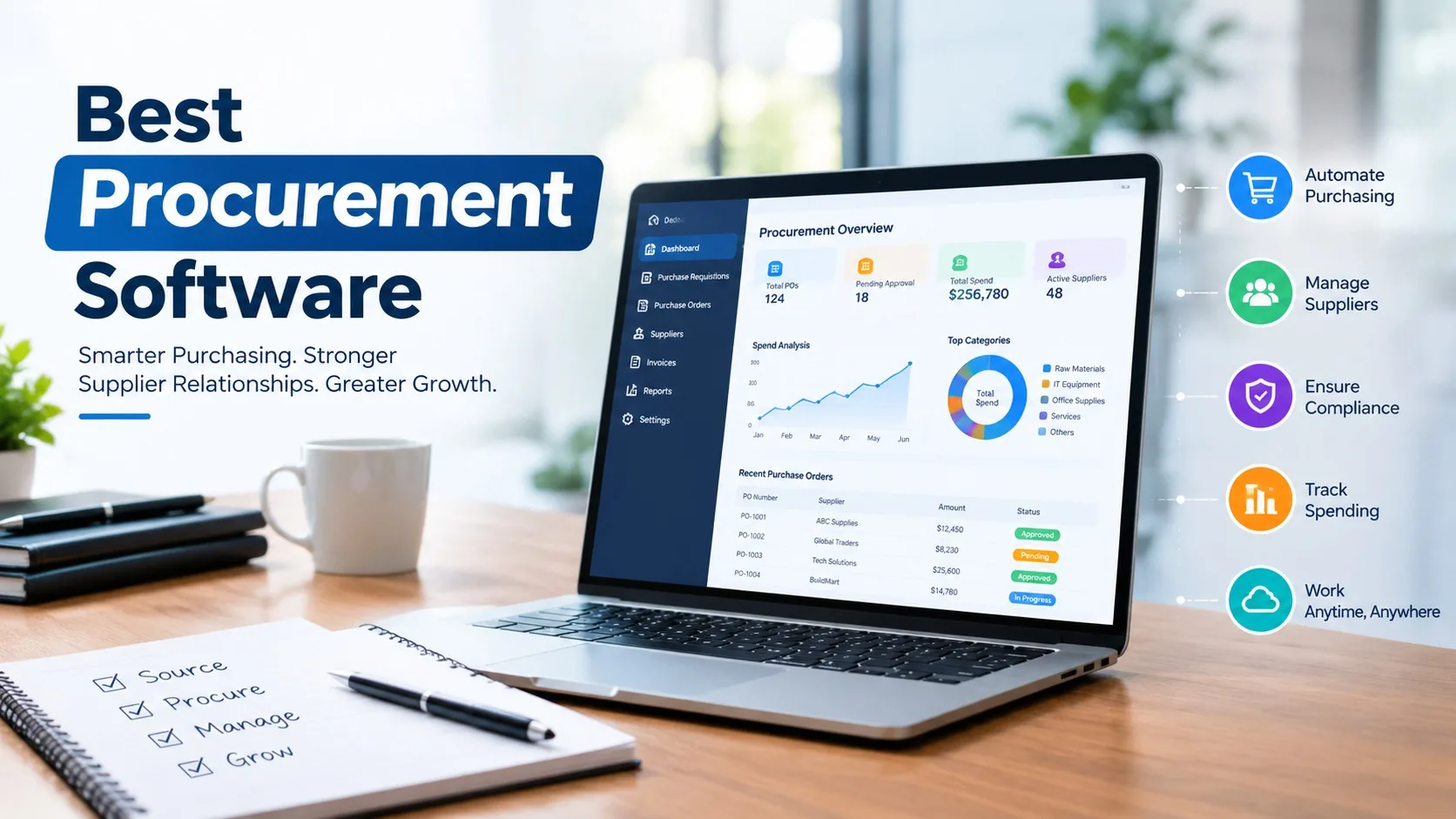
Choosing the right procurement software can have a significant impact on how efficiently a business manages purchasing, suppliers, approvals, invoices, contracts, and spending.
As organizations grow, procurement becomes more complex. Procurement teams may need to manage hundreds of suppliers, multiple departments, purchase requests, quotations, purchase orders, contracts, invoices, and compliance requirements. Managing all these activities through spreadsheets, emails, and disconnected systems can create delays and reduce visibility.
The right procurement software can bring these processes together in one centralized platform. It can automate repetitive tasks, improve supplier collaboration, control business spending, and provide procurement teams with better data for decision-making.
However, there are many procurement software companies and platforms available today. So, how do you choose the best solution for your business?
This guide explains the key factors businesses should consider before selecting procurement software.
What Is Procurement Software?
Procurement software is a digital solution that helps businesses manage and automate purchasing activities.
A modern procurement platform can support the complete procurement lifecycle, including:
- Purchase requisitions
- Supplier management
- RFQs and RFPs
- Quotation management
- Purchase orders
- Approval workflows
- Goods receipt
- Contract management
- Invoice processing
- Accounts payable
- Spend analytics
- Vendor collaboration
- Inventory-related procurement
Instead of managing procurement information across multiple spreadsheets and emails, businesses can use one centralized system to improve visibility and control.
Why Choosing the Right Procurement Software Matters
Not every business has the same procurement requirements.
A small business may need simple purchase approval and supplier management, while a large enterprise may require complex workflows, ERP integrations, multiple approval levels, supplier portals, spend analytics, and advanced automation.
Choosing the wrong platform can result in:
- Low user adoption
- Unnecessary software costs
- Limited functionality
- Difficult implementation
- Integration problems
- Manual work continuing alongside the software
- Poor visibility into procurement performance
The right solution should fit your current requirements while also being capable of supporting future business growth.
10 Factors to Consider When Choosing Procurement Software
1. Understand Your Procurement Requirements
Before comparing software providers, identify your existing procurement challenges.
Start by documenting your current purchasing process.
Ask questions such as:
- How are purchase requests submitted?
- How are purchases approved?
- How are suppliers selected?
- How are quotations compared?
- How are purchase orders created?
- How are goods received?
- How are invoices verified?
- How are contracts managed?
- How is procurement spending tracked?
You should also identify which processes are currently manual.
For example, if your procurement team spends hours every week collecting quotations through email, quotation automation should be an important requirement.
If invoice verification is causing delays, accounts payable and three-way matching capabilities may be more important.
Understanding your requirements makes it easier to create a shortlist of suitable procurement software solutions.
2. Look for End-to-End Procurement Management
A good procurement platform should connect multiple stages of the purchasing lifecycle.
Instead of purchasing separate tools for every activity, look for a solution that supports processes such as:
Purchase Request → Approval → Sourcing → Quotation → Purchase Order → Goods Receipt → Invoice → Payment
This end-to-end approach can reduce data duplication and improve visibility across procurement and finance teams.
A platform with strong procurement management software capabilities should allow users to track transactions throughout their lifecycle.
3. Evaluate Purchase Requisition Features
Purchase requisitions are often the starting point of the procurement process.
A good purchase requisition software module should allow employees to create and submit requests easily.
Look for features such as:
- Digital request creation
- Approval workflows
- Department-level approvals
- Budget controls
- Supporting document uploads
- Request tracking
- Notifications
- Purchase request history
The easier the process is for employees, the more likely they are to use the organization's approved procurement workflow.
4. Check Supplier and Vendor Management
Supplier management is one of the most important parts of procurement.
When evaluating the best vendor management software, check whether it allows you to:
- Create supplier profiles
- Manage supplier documents
- Track supplier performance
- Monitor supplier activity
- Manage supplier contracts
- Maintain communication records
- Review supplier purchasing history
A centralized supplier database can help procurement teams make more informed sourcing decisions.
Vendor Portal
A vendor portal can further improve supplier collaboration.
With a secure vendor portal login, suppliers can potentially:
- Receive procurement requests
- Submit quotations
- Upload documents
- Respond to RFPs
- View purchase orders
- Submit invoices
- Communicate with procurement teams
This reduces dependency on scattered email communication.
5. Check RFQ and RFP Capabilities
Businesses frequently need to request prices or proposals from multiple suppliers.
For simple purchases, an RFQ may be sufficient. For complex requirements, an RFP may be more appropriate.
Look for software that supports:
- RFQ creation
- Supplier invitations
- RFP management
- Supplier responses
- Bid comparison
- Evaluation workflows
- Supplier communication
- Document management
RFP automation software can be particularly useful for organizations that manage frequent or complex sourcing events.
6. Evaluate Quotation Management
Comparing supplier quotations manually can be time-consuming and error-prone.
Quotation management software should help procurement teams collect, organize, and compare supplier quotations in one place.
Important comparison factors may include:
- Price
- Quantity
- Delivery timeline
- Taxes
- Discounts
- Payment terms
- Warranty
- Supplier conditions
A centralized quotation process can help teams make faster and more consistent purchasing decisions.
7. Look for Procure-to-Pay Automation
If your goal is to automate the complete procurement lifecycle, evaluate the platform's procure to pay software capabilities.
A strong procure-to-pay workflow should connect:
Requisition → Approval → Purchase Order → Receipt → Invoice → Payment
This can help reduce manual handoffs between procurement, receiving, and finance.
It also makes it easier to track where a purchase currently stands.
8. Check Accounts Payable and Invoice Management
Procurement software should work effectively with finance processes.
Look for accounts payable software capabilities such as:
- Invoice capture
- Invoice approval
- Purchase order matching
- Goods receipt matching
- Duplicate invoice detection
- Payment status tracking
- Invoice history
Three-way matching is especially useful for businesses that want stronger controls around supplier payments.
The system can compare:
Purchase Order + Goods Receipt + Invoice
If the information does not match, the transaction can be flagged for review.
9. Evaluate Contract Management
Supplier contracts contain important commercial information that procurement teams need to monitor.
When evaluating contract management software, check whether it supports:
- Contract storage
- Contract search
- Renewal reminders
- Expiration alerts
- Supplier agreements
- Pricing terms
- Contract milestones
- Document management
A centralized contract repository can help prevent missed renewals and improve visibility into supplier agreements.
10. Look for Spend Analytics and Reporting
A procurement platform should not only process transactions. It should also help businesses understand their spending.
Modern spend analytics tools can provide information about:
- Supplier spending
- Category spending
- Department spending
- Purchase trends
- Purchase order values
- Invoice values
- Procurement savings
- Supplier performance
Dashboards and reports help procurement leaders identify opportunities for cost optimization and better supplier negotiation.
Consider AI-Powered Procurement Capabilities
AI is becoming an increasingly important part of modern procurement technology.
When comparing top procurement software, check whether the platform provides AI-powered capabilities that can support procurement teams.
AI can potentially help with:
Supplier Recommendations
AI can analyze supplier information and historical purchasing data to help identify suitable suppliers.
Intelligent Search
Users can find procurement information more quickly using natural-language or intelligent search capabilities.
Spend Analysis
AI can identify purchasing patterns and unusual spending behavior.
Automated Data Processing
AI-powered automation can reduce repetitive data-entry and document-processing tasks.
Procurement Insights
AI can help procurement teams identify trends and potential areas for improvement.
The goal should not simply be to choose software because it includes AI. Businesses should evaluate whether the AI features solve real procurement problems.
Evaluate Integration Capabilities
Procurement rarely operates as an isolated function.
Your procurement software may need to integrate with:
- ERP systems
- Accounting software
- Inventory systems
- Finance platforms
- Project management systems
- HR systems
- Payment systems
- Business intelligence tools
For example, connecting procurement with inventory can help purchasing teams understand stock requirements before placing orders.
Integration with finance can help streamline invoice processing and payment workflows.
Before selecting a platform, ask vendors about available APIs, integrations, data synchronization, and implementation requirements.
Consider Inventory and Asset Management
Businesses that purchase physical products, equipment, or materials should consider how procurement connects with inventory.
Integration with best inventory management software capabilities can provide visibility into:
- Current inventory
- Reorder requirements
- Goods received
- Purchase requirements
- Stock movement
Organizations that manage equipment or fixed assets should also consider integration with asset management software.
This can help connect procurement decisions with the lifecycle of purchased assets.
Consider Ease of Use
Even feature-rich software will not deliver value if employees find it difficult to use.
During software evaluation, consider:
- User interface
- Navigation
- Mobile accessibility
- Request creation process
- Approval experience
- Supplier experience
- Dashboard usability
- Search functionality
- Training requirements
Ask for a product demonstration and allow actual procurement users to test the system.
The best procurement software should make everyday procurement tasks easier rather than adding complexity.
Evaluate Customization and Workflow Flexibility
Every organization has different procurement policies.
For example, one company may require approval from a department manager, while another may require approval from finance and procurement.
Look for software that supports configurable workflows.
Important customization areas may include:
- Approval levels
- Purchase categories
- Departments
- Budgets
- Supplier workflows
- Notifications
- Forms
- Procurement rules
- Reports
Flexible workflows make it easier to adapt the software to your organization's processes.
Compare Procurement Software Pricing
Procurement software pricing can vary based on the platform, number of users, modules, transaction volume, deployment model, customization, and integrations.
Before comparing prices, understand what is included.
Ask vendors about:
- License or subscription costs
- Number of users
- Implementation fees
- Customization
- Integrations
- Data migration
- Training
- Customer support
- Maintenance
- Additional modules
Do not select software based only on the lowest price.
Instead, calculate the potential return on investment.
For example:
Software Cost vs. Savings from Automation + Reduced Errors + Better Spending Control + Time Saved
A platform with a higher initial cost may provide greater long-term value if it significantly improves procurement efficiency.
Cloud vs. On-Premises Procurement Software
Deployment requirements should also be considered.
Cloud Procurement Software
Cloud-based procurement platforms can offer:
- Remote accessibility
- Easier updates
- Scalability
- Lower infrastructure requirements
- Faster deployment
On-Premises Procurement Software
On-premises deployment may be preferred by organizations that require greater control over infrastructure, data, or internal systems.
The right option depends on your organization's security policies, IT infrastructure, compliance requirements, and business strategy.
Some platforms provide multiple deployment options, giving organizations greater flexibility.
Check Security and Data Protection
Procurement systems contain sensitive business information, including supplier data, pricing, contracts, invoices, and purchasing records.
Before selecting a solution, evaluate:
- User access controls
- Role-based permissions
- Data encryption
- Authentication
- Audit trails
- Backup procedures
- Data storage
- Security certifications
- Compliance requirements
Ask the software provider how procurement data is protected and who can access different types of information.
Evaluate Scalability
Your procurement requirements today may be different from your requirements in the future.
As your organization grows, you may need:
- More users
- More suppliers
- More departments
- More transactions
- More approval workflows
- Additional integrations
- Advanced reporting
The procurement platform should be capable of scaling with your business.
A scalable system can prevent the need for another software migration when procurement requirements become more complex.
Compare Procurement Software Companies
There are many procurement software companies offering platforms for businesses of different sizes and industries.
Instead of comparing vendors only on feature lists, create a structured evaluation scorecard.
You can compare vendors based on:
Evaluation AreaImportanceProcurement workflow automationHighSupplier managementHighPurchase requisitionsHighRFQ/RFP managementHighQuotation managementHighProcure-to-payHighAccounts payableHighContract managementMedium/HighSpend analyticsHighIntegrationsHighAI capabilitiesMedium/HighEase of useHighSecurityHighScalabilityHighPricingHighCustomer supportHigh
This makes the selection process more objective.
Common Mistakes to Avoid
Businesses can make several mistakes when selecting procurement software.
Choosing Based Only on Price
The cheapest solution may not provide the functionality or scalability your business needs.
Buying Too Many Features
More features do not always mean better software. Focus on capabilities that solve actual procurement problems.
Ignoring User Experience
If employees struggle to use the platform, adoption may remain low.
Not Checking Integrations
A procurement platform that cannot connect with your existing business systems may create additional manual work.
Ignoring Future Growth
Choose a solution that can scale with your business.
Not Involving Procurement Users
Procurement professionals who will use the platform every day should be involved in the evaluation process.
Why Businesses Can Consider ZYNO Procurement
ZYNO Procurement is designed to help businesses manage and automate procurement operations through a centralized platform.
The solution supports key procurement processes such as:
- Purchase requisition management
- Supplier management
- RFQ and RFP management
- Quotation management
- Procure-to-pay workflows
- Purchase orders
- Vendor portal
- Contract management
- Accounts payable
- Goods receipt workflows
- Inventory management
- Spend analytics
- Procurement dashboards
- ERP integrations
ZYNO Procurement also provides AI-powered capabilities that can help businesses improve procurement visibility and make more informed purchasing decisions.
By bringing multiple procurement activities together, businesses can reduce fragmented workflows and create a more structured purchasing process.
Procurement Software Selection Checklist
Before making a final decision, use this checklist:
Business Requirements
- Have we documented our procurement challenges?
- Have we identified manual processes?
- Have we defined our procurement goals?
Features
- Purchase requisition
- Supplier management
- RFQ/RFP
- Quotation management
- Purchase orders
- Procure-to-pay
- Accounts payable
- Contract management
- Spend analytics
- Inventory integration
Technology
- ERP integration
- API availability
- Cloud/on-premises options
- Security controls
- Scalability
- Reporting
Commercial
- Pricing is clear
- Implementation costs are understood
- Support costs are understood
- Customization costs are understood
- ROI has been estimated
Final Thoughts
Choosing the best procurement software for your business requires more than comparing feature lists or software prices.
The right platform should solve your current procurement challenges, improve operational efficiency, provide better spending visibility, strengthen supplier relationships, and support future business growth.
Look for a solution that combines purchase requisitions, supplier management, quotation and RFP workflows, procure-to-pay automation, accounts payable, contract management, spend analytics, and integrations in one connected environment.
Most importantly, evaluate the software based on your actual business requirements and involve the people who will use the platform every day.
For organizations looking to modernize procurement operations, ZYNO Procurement provides an integrated platform designed to help businesses automate procurement workflows, improve visibility, and build a more efficient and data-driven procurement process.