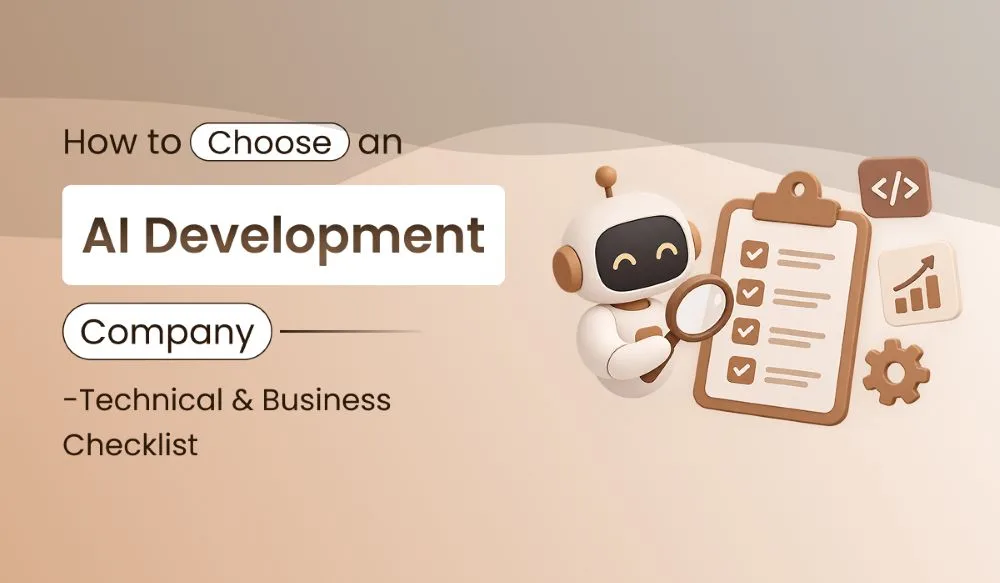
Almost every software company can put “AI” on a services page. That does not mean every team can take an AI feature from a polished demo to a reliable product connected to your real data, permissions, APIs, and users.
This checklist is designed for founders, product leaders, and businesses comparing AI development partners. It focuses on the questions that become expensive to discover after a contract is signed.
Before You Hire an AI Development Company
A vendor cannot give you a meaningful architecture, timeline, or fixed scope if the requirement is simply “we want AI.” Start with the business workflow and define where AI enters it — the six factors below turn that into something a vendor can actually quote.

Better request: “We need an internal support assistant that answers from our product documentation, respects team permissions, cites its sources and escalates when evidence is weak.” That is much more useful than “build us a ChatGPT chatbot.”
Look for Production AI Proof, Not AI Vocabulary
A convincing AI demo is relatively easy to create. Production software has to survive incomplete data, permission rules, API failures, unexpected prompts, model changes, latency, cost limits, and users who do not behave like a demo script.

A Strong AI Development Company Starts With Architecture
“We use the latest model” is not an architecture. The company should be able to explain why the problem needs an LLM, RAG, an agent, traditional automation, machine learning, deterministic software — or a combination.

Not every workflow needs an autonomous agent. If you are unsure where agents genuinely fit, read our guide on AI agents for business before you shortlist vendors.
Model selection matters. System design matters more. Your users experience the complete application — not the model benchmark.
Ask About RAG Development Capability
RAG is often described as “upload documents, create embeddings and ask questions.” Real business knowledge is messier: sources change, permissions differ, documents conflict, tables break, pages duplicate, and retrieval can return the wrong evidence.

Technical question worth asking: “How will you know whether a bad answer came from retrieval, source data, the prompt or the model?” A team that operates RAG systems should have a way to investigate that distinction. For a service-level view of this kind of work, see Primocys’s RAG development services.
“It Looks Good in the Demo” Is Not an AI Acceptance Test
Traditional QA can verify that a button works. AI quality also requires testing the behavior of probabilistic outputs against representative scenarios.

Red flag: if a vendor promises a universal “99% AI accuracy” before defining the task, test dataset and measurement method, ask exactly what that percentage means.
Ask What the AI Is Allowed to See — and What It Is Allowed to Do
AI security isn't just an API-key question. The application may combine private documents, user identity, business systems, and tool access. Authorization has to survive all the way through that chain.
SECURITY & CONTROL
- Authentication & RBAC: Who is the user, and which data, tools, and actions are available to that role?
- Data Boundaries: How are tenants, workspaces, departments, or customer datasets isolated?
- Prompt Injection: How will the system treat untrusted content and instructions that try to override application rules?
- Tool Permissions: Does the agent receive broad system access, or only narrowly defined operations required for the workflow?
- Human Approval: Which high-impact actions stop for confirmation before money, records, messages, or external systems are changed?
- Logs & Auditability: Can operators investigate what context, tools, and decisions contributed to important actions?
For regulated or sensitive use cases, ask how the proposed architecture supports your specific legal, privacy, security, and data-residency requirements. Avoid vendors that casually promise blanket compliance or certification without understanding the complete deployment and operating environment.
An AI Development Company Needs Strong Engineering Too
Most useful AI products are software products with AI inside them. They still need frontend, backend, databases, APIs, authentication, permissions, billing, notifications, admin tools, deployment and observability.
01. Backend Engineering
Can the team build reliable APIs, queues, background jobs, databases and business logic around the AI?
02. Web & Mobile
Can AI be integrated into the actual product experience rather than living in a disconnected prototype?
03. Business Integrations
Can they work with CRM, ERP, email, cloud storage, databases, internal APIs or domain-specific systems?
04. Identity & Permissions
Can the team carry application authorization into retrieval and AI actions?
05. Async & Long-Running Work
Can the system safely handle jobs that take longer than a normal request-response cycle?
06. Observability
Can operators inspect application errors, model calls, tool execution, latency and cost after launch?
If the AI has to work inside software you already run, look at how the vendor approaches AI integration for existing software. For a wider product build, the same team should also be credible in custom software development, not only in model calls.
Compare AI Development Company Proposals by Scope
Two vendors can quote dramatically different amounts because they are not pricing the same system. Ask what is included before deciding one company is expensive or cheap.

Ask for Operating-Cost Thinking, Not Just Development Cost: A responsible proposal should at least identify the variables that drive ongoing AI cost: model choice, tokens or media processed, retrieval infrastructure, vector storage, document ingestion, tool calls, concurrency, observability and third-party APIs.
For detailed budgeting, see Primocys’s AI Agent Development Cost guide, the broader AI development cost breakdown and the guide to AI integration cost for existing software rather than forcing every project into one universal price.
Clarify Source Code Ownership Before Development Starts
“You own the project” is too vague. Put the actual handover and intellectual-property terms in the agreement.

Contract checklist: source code/IP terms, repositories, deployment access, documentation, third-party licenses, data handling, credentials, termination/handover process and any ongoing support obligations.
A Good AI Development Partner Supports You After Launch
Models, provider APIs, pricing, source knowledge and user behavior change. A vendor-selection process should include what happens after the first production release.

12 Warning Signs When Comparing AI Development Companies
These patterns show up repeatedly during AI vendor evaluation and are worth checking before a contract is signed.
- Every problem is immediately described as an AI agent.
- The proposal names models but not workflows or integrations.
- The vendor cannot explain how AI output will be evaluated.
- RAG is presented as only “upload PDFs to a vector database.”
- They promise a fixed accuracy percentage without a test definition.
- They ignore permission-aware retrieval for private business data.
- No discussion of fallback or human approval.
- Third-party AI/API costs are hidden or unexplained.
- Source-code and IP terms are vague.
- The team has AI demos but little surrounding software capability.
- Security claims rely entirely on the model provider.
- There is no credible answer for monitoring and support after launch.
A Practical AI Development Company Evaluation Scorecard
Weight the categories according to your project. A healthcare AI assistant and an internal marketing tool should not use exactly the same procurement priorities.

Important: the lowest-priced company can still score highest if your scope is narrow and their approach is appropriate. The purpose of the scorecard is not to reward complexity; it is to make hidden differences visible.
20 Questions to Ask an AI Development Company Before Signing
Use these questions in your vendor calls. A strong team will answer with specifics, not slogans.

Conclusion: AI Development Company Selection: Evidence First
Run this AI development company checklist against every proposal before you sign: production evidence, architecture reasoning, RAG and data handling, evaluation method, security controls, integration depth, cost clarity, IP terms and post-launch support. A vendor that can walk you through each of these with specifics — not slogans — is the safer long-term partner, whatever their price point.
Use the 100-point scorecard and the 20 questions above to run your own AI vendor evaluation, then talk to Primocys about your AI project if you want a second opinion on a proposal before you commit.
Planning an AI Project?
Share your idea, workflow or an existing vendor proposal. We’ll review the scope, flag the risks and tell you what to build, buy or skip.