
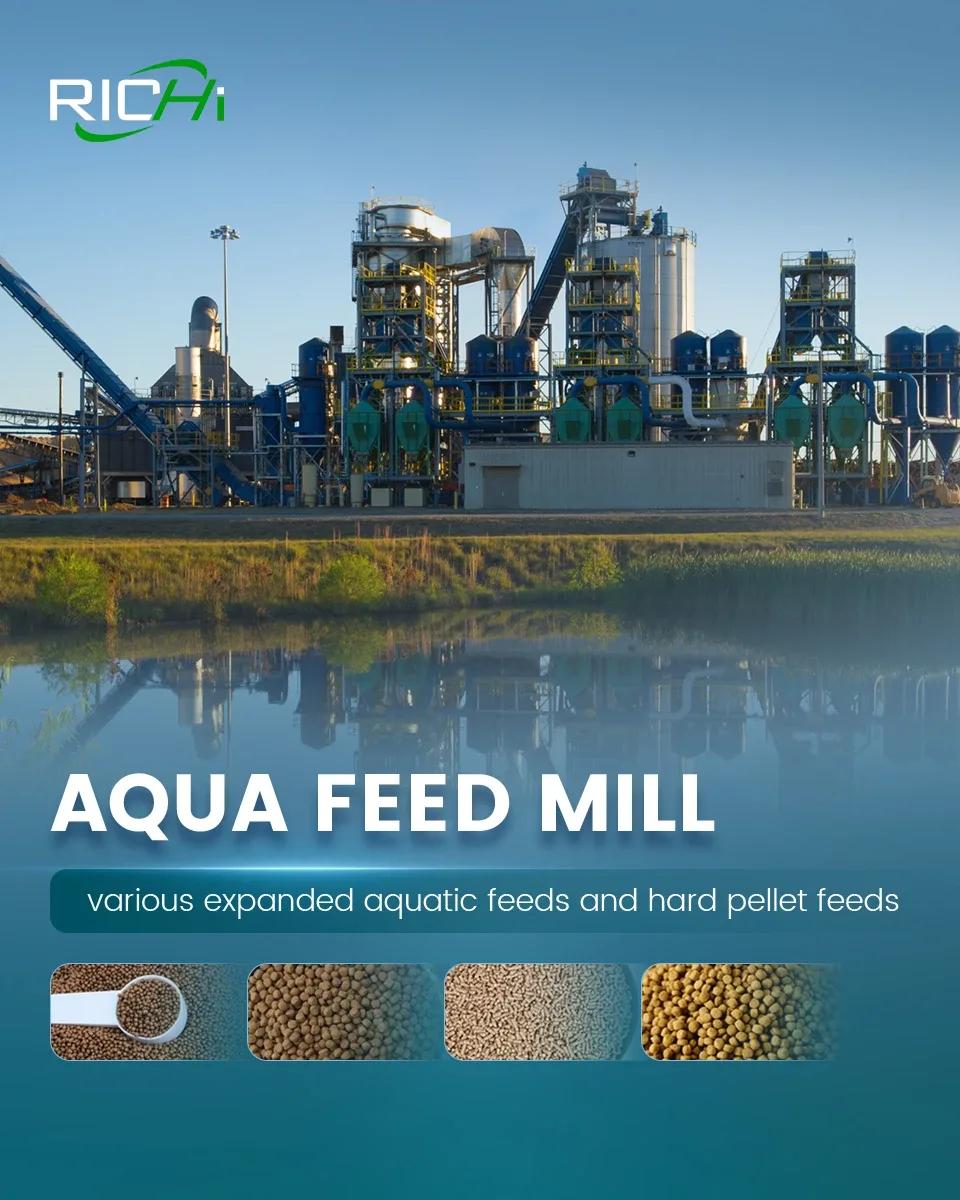
The rapid development of aquaculture has created a growing need for nutritious, stable, and cost-effective commercial fish feed. As fish farms become more intensive, farmers increasingly rely on professionally manufactured feed to support fish growth, improve feeding efficiency, and simplify daily farm management. Among different aquatic feed products, floating fish feed is widely used because the pellets remain visible on the water surface after feeding.
Floating feed is generally produced through extrusion technology. The manufacturing process starts with raw material receiving and storage, followed by cleaning, grinding, batching, mixing, conditioning, extrusion, cutting, drying, cooling, coating, screening, and packaging. Each stage influences the final product, so the equipment must be properly selected and integrated.
A well-designed floating fish feed production plant can combine these processes into an efficient and scalable manufacturing system. Depending on market requirements, the plant can be designed for different production capacities, pellet diameters, fish species, feed formulas, automation levels, and factory layouts.
This article explains the complete floating fish feed manufacturing process and the major considerations for establishing a commercial aquatic feed production facility.
What Is Floating Fish Feed
Floating fish feed is an extruded aquatic feed product designed to remain on the water surface for a certain period after feeding.
The floating property is mainly created during extrusion.
A typical feed formula can include protein meals, grains, starch-rich ingredients, oils, vitamins, minerals, and functional additives. After preparation and mixing, the feed mixture is conditioned with heat and moisture.
Inside the extruder, the material experiences mechanical shear, pressure, heat, and moisture.
Starch gelatinizes and the feed mixture becomes plasticized.
The material is then pushed through an extrusion die.
When it exits the die, the pressure decreases rapidly. Water inside the hot material expands into steam and forms tiny pores.
These pores lower the density of the pellet.
If the pellet density is lower than water, the pellet floats.
The extrusion process therefore plays a central role in producing floating feed.
Why Floating Feed Is Widely Used
Feed is one of the largest operating expenses in intensive aquaculture.
Efficient feed management is therefore essential.
Floating pellets are easy to observe because they remain on the water surface.
Farmers can monitor fish feeding activity and adjust the quantity of feed accordingly.
If fish consume pellets quickly, the feeding quantity can be adjusted upward according to the feeding plan.
If pellets remain uneaten, the farmer can reduce the next feeding quantity.
This visibility provides an important advantage compared with feed that immediately sinks.
Major advantages include:
- Easy observation of feeding behavior
- Convenient feed quantity management
- Reduced risk of excessive feeding
- Flexible pellet specifications
- Compatibility with automatic feeders
- Convenient handling and transportation
Applications of Floating Fish Feed
Floating feed can be manufactured for many aquaculture species.
Tilapia
Tilapia farming is one of the major applications for floating feed.
Different formulations can be developed for different growth stages.
Catfish
Floating catfish feed allows farmers to observe feeding behavior more easily.
Carp
Floating pellets can be formulated for carp and other related freshwater species.
Ornamental Fish
Small floating pellets can be manufactured for ornamental fish.
Other Fish Species
Depending on nutritional requirements and feeding characteristics, floating feed can also be produced for many other freshwater and marine species.
The formula should be developed according to the target species.
Raw Materials for Floating Fish Feed
Raw materials influence both the nutritional quality and processing characteristics of the final product.
Protein Ingredients
Protein is essential for fish growth.
Common sources include:
- Fish meal
- Soybean meal
- Rapeseed meal
- Sunflower meal
- Peanut meal
- Other plant protein meals
- Selected animal protein sources
The required protein content varies according to fish species and growth stage.
Starch-Rich Materials
Starch is important for extrusion and pellet expansion.
Common sources include:
- Corn
- Wheat
- Cassava
- Rice products
- Other cereals
During extrusion, starch gelatinization contributes to pellet structure and expansion.
Oil and Fat Sources
Fish oil and vegetable oil provide energy and essential fatty acids.
Oil may be added before extrusion or applied after extrusion through a coating system.
Vitamins and Minerals
Vitamin and mineral premixes provide essential micronutrients.
Accurate dosing and uniform mixing are important because these ingredients are often included at relatively low levels.
Functional Ingredients
Depending on the product, manufacturers may use probiotics, enzymes, amino acids, antioxidants, and other functional additives.
Raw Material Receiving
The production process begins with raw material receiving.
Incoming ingredients should be inspected before being accepted.
Important inspection factors include:
- Moisture
- Freshness
- Cleanliness
- Odor
- Physical condition
- Foreign materials
Consistent raw material quality helps maintain stable production and final feed quality.
Raw Material Storage
After inspection, raw materials are transferred to suitable storage facilities.
Bulk ingredients can be stored in silos.
Smaller ingredients can be stored in warehouses or ingredient bins.
Storage facilities should be clean, dry, and well ventilated.
Moisture management is particularly important because excessive moisture can encourage mold growth and reduce ingredient quality.
An organized inventory system also helps ensure continuous production.
Cleaning Process
Raw materials may contain stones, dust, metal particles, fibers, and other impurities.
Cleaning equipment removes these contaminants before grinding.
Typical cleaning equipment includes:
- Vibrating screens
- Rotary screens
- Magnetic separators
- Air aspiration systems
Cleaning improves feed safety and protects the machinery that follows.
Grinding Process
After cleaning, raw materials are ground into suitable particle sizes.
Hammer mills are commonly used.
Grinding improves particle uniformity and can contribute to better mixing and extrusion.
Proper grinding can improve:
- Mixing efficiency
- Material flow
- Extrusion stability
- Pellet uniformity
The appropriate particle size depends on the feed formula and target pellet size.
Smaller pellets generally require finer particles.
However, excessive grinding can increase energy consumption, so the particle size should be optimized according to the production requirements.
Batching and Weighing
The ground ingredients are accurately weighed according to the feed formula.
Accurate batching is essential for nutritional consistency.
Automatic batching equipment can improve precision and reduce human error.
For factories producing multiple products, computerized recipe management can simplify formula changes.
Mixing
The accurately weighed ingredients enter a mixer.
The mixer distributes all components evenly throughout the batch.
Uniform mixing is especially important for vitamins, minerals, amino acids, and other micro-ingredients.
A homogeneous mixture ensures better consistency in the finished feed.
Conditioning
Before extrusion, the feed mixture is conditioned.
Controlled heat and moisture are added.
Conditioning prepares the material for extrusion and can improve:
- Starch gelatinization
- Material flow
- Extrusion stability
- Pellet expansion
- Processing efficiency
The appropriate conditioning parameters depend on the raw material composition, formula, moisture content, and target product.
Floating Fish Feed Extrusion
Extrusion is the central stage of floating feed production.
The conditioned material enters the extrusion chamber.
Rotating screws transport the material forward.
As it moves through the chamber, it is exposed to pressure, heat, moisture, and mechanical shear.
Starch gelatinizes and the feed becomes plasticized.
The material is then forced through the die.
As it leaves the die, the pressure drops rapidly.
Water inside the hot material expands into steam.
This creates a porous internal structure.
The porous structure reduces pellet density and creates buoyancy.
A cutter then cuts the extruded product into pellets.
Controlling Pellet Expansion
Manufacturers need to carefully control several extrusion parameters.
Moisture
Moisture affects viscosity, pressure, and expansion.
Too little moisture may result in unstable extrusion.
Too much moisture may reduce expansion and increase drying requirements.
Temperature
Temperature affects starch gelatinization and pellet structure.
Stable temperature control contributes to consistent pellet quality.
Screw Speed
Screw speed influences residence time, mechanical shear, throughput, and expansion.
Pressure
Pressure influences material transformation inside the extrusion chamber.
Die Design
The die determines pellet diameter and influences extrusion behavior.
Feed Formula
The quantity and type of starch-rich ingredients strongly influence expansion.
These variables need to be optimized together.
Pellet Density and Floating Ability
Pellet density has a direct relationship with floating performance.
If the density is too high, the pellet may sink.
If expansion is excessive, the pellet may become fragile.
The goal should therefore be suitable buoyancy rather than maximum expansion.
A high-quality floating pellet should balance:
Buoyancy + Durability + Water Stability + Digestibility + Palatability
Pellet Size
Pellet diameter should be matched to the target fish.
Small fish require small pellets.
Juvenile fish need medium-sized pellets.
Large fish can consume larger pellets.
The extrusion die determines diameter, while the cutter determines pellet length.
By changing dies and cutter settings, one production system can manufacture multiple pellet specifications.
Drying Process
Freshly extruded pellets contain significant moisture.
A dryer removes excess moisture using controlled hot air.
Drying must be carefully controlled.
Insufficient drying can reduce storage stability.
Over-drying can increase energy consumption and potentially affect product quality.
The dryer should therefore be matched to the extrusion output.
Cooling Process
After drying, pellets remain hot.
The cooling system reduces their temperature.
Cooling stabilizes the pellets before screening, coating, and packaging.
It also reduces the risk of condensation inside bags.
Oil Coating
Some feed formulas require additional oil after extrusion.
Oil coating can:
- Increase energy density
- Improve palatability
- Add selected nutrients
- Improve product characteristics
Some heat-sensitive ingredients may also be applied after extrusion.
Uniform coating is important for consistent product quality.
Screening Process
After cooling and coating, the pellets pass through a screening machine.
Screening removes:
- Fine particles
- Broken pellets
- Oversized pieces
This improves product uniformity and appearance.
Depending on the production system, fines may be recycled.
Packaging
Qualified pellets are transferred to the packaging system.
Automatic packaging machines can weigh and seal bags accurately.
Package sizes can be selected according to customer requirements.
Small bags can be used for retail customers.
Large bags can be suitable for commercial aquaculture farms.
Proper packaging protects feed against moisture, contamination, and physical damage.
Complete Equipment Configuration
A complete floating fish feed production plant can contain several interconnected processing systems.
Raw Material Handling System
Conveyors, bucket elevators, silos, and storage bins move raw materials between processing sections.
Cleaning System
Screens and magnetic separators remove impurities.
Grinding System
Hammer mills reduce ingredient particle size.
Batching System
Automatic weighing equipment ensures formula accuracy.
Mixing System
Mixers create a homogeneous feed mixture.
Conditioning System
Conditioners prepare the mixture for extrusion.
Extrusion System
Fish feed extruders transform the conditioned mixture into expanded floating pellets.
(Learn about RICHI floating fish feed extruder machine )
Cutting System
Pellet cutters determine pellet length.
Drying System
Dryers remove excess moisture.
Cooling System
Coolers reduce pellet temperature.
Coating System
Coating machines apply oil and other liquid ingredients.
Screening System
Screens separate qualified pellets from fines.
Packaging System
Packaging machines weigh and seal finished products.
Small-Scale Floating Feed Production Plant
A small production system can be designed for individual farms, cooperatives, and small commercial businesses.
A compact configuration may include:
- Grinder
- Mixer
- Extruder
- Dryer
- Cooler
- Packaging machine
This type of plant requires less investment and factory space.
However, good process control remains essential.
Medium-Scale Floating Feed Plant
Medium-sized factories can supply local and regional aquaculture markets.
A typical system may include automatic batching, larger grinding equipment, continuous mixing, extrusion, drying, cooling, screening, and packaging.
Higher automation can improve productivity and reduce labor requirements.
Large Commercial Production Plant
Large-scale facilities require comprehensive process integration.
A commercial factory may include:
- Automatic raw material receiving
- Large storage silos
- Computerized batching
- High-capacity grinding
- Continuous mixing
- Advanced extrusion
- Multi-stage drying
- Efficient cooling
- Oil coating
- Automatic screening
- Automatic packaging
Multiple extrusion systems can be installed when different products need to be manufactured at the same time.
How to Select Production Capacity
Production capacity should be based on market demand and future growth.
Investors should evaluate:
- Local aquaculture production
- Fish feed demand
- Target customers
- Expected sales
- Raw material availability
- Investment budget
- Factory area
- Labor costs
- Future expansion
The capacity of each section should be matched.
For example, the drying system should have sufficient capacity to handle the output of the extruder.
Quality Control
Quality control should be implemented throughout the manufacturing process.
Raw Materials
Check moisture, freshness, cleanliness, and nutritional consistency.
Grinding
Monitor particle size.
Batching
Verify ingredient weights.
Mixing
Check mixture uniformity.
Extrusion
Monitor:
- Temperature
- Moisture
- Pressure
- Screw speed
- Production rate
Finished Product
Evaluate:
- Pellet diameter
- Pellet length
- Density
- Floating ability
- Water stability
- Durability
- Moisture
- Nutritional composition
A comprehensive quality control system helps maintain consistent product quality.
Floating Performance and Water Stability
Floating ability is important, but it should be evaluated together with water stability.
The pellets should remain intact long enough for fish to consume them.
If they break apart too quickly, nutrients can be released into the water.
This can increase feed waste.
However, excessive hardness is also undesirable.
An ideal pellet should balance water stability, durability, digestibility, and palatability.
Improving Production Efficiency
Manufacturers can improve efficiency by optimizing the complete process.
Important measures include:
- Selecting stable raw materials
- Optimizing particle size
- Improving batching accuracy
- Increasing mixing uniformity
- Controlling conditioning moisture
- Optimizing extrusion parameters
- Improving dryer efficiency
- Reducing material handling losses
- Automating packaging
- Implementing preventive maintenance
Centralized control systems can help operators monitor important production parameters.
Energy Efficiency
Energy consumption is a major operating consideration.
Grinding, extrusion, drying, cooling, and conveying are significant energy-consuming operations.
Energy efficiency can be improved by:
- Using efficient motors
- Optimizing extrusion conditions
- Managing feed moisture
- Improving dryer insulation
- Reducing unnecessary material movement
- Using automated control systems
- Maintaining equipment regularly
Lower energy consumption can help improve production economics.
Equipment Maintenance
Regular maintenance helps ensure reliable operation.
Hammer mill hammers and screens should be inspected regularly.
Mixers should be cleaned and checked.
Extruder screws and dies should be monitored for wear.
Cutters should be adjusted properly.
Dryers and coolers should be inspected for airflow.
Conveyors should be checked for wear and blockages.
Critical spare parts should be available to reduce downtime.
Turnkey Fish Feed Factory Solutions
A complete fish feed project involves multiple engineering activities.
A professional turnkey supplier can provide:
- Process design
- Factory layout
- Equipment selection
- Equipment manufacturing
- Transportation
- Installation
- Commissioning
- Operator training
- Spare parts supply
- Technical support
A turnkey solution allows the complete production line to be designed as one integrated system.
This helps ensure that grinding, mixing, extrusion, drying, cooling, screening, and packaging capacities are properly matched.
(click here to investigate: RICHI MANUFACTURE )
Different Floating Feed Products
A modern factory can manufacture different products according to market demand.
Feed can be customized by:
- Fish species
- Growth stage
- Pellet diameter
- Protein level
- Energy content
- Functional requirements
Manufacturers can produce starter feed, juvenile feed, grower feed, and finishing feed.
Different dies can be installed to produce different pellet diameters.
This gives manufacturers greater flexibility when developing their product portfolio.
Future Trends
The aquatic feed industry is increasingly focused on automation, sustainability, and energy efficiency.
Alternative protein sources such as insect meal, algae, and microbial protein are receiving increasing attention.
Automation is also becoming more advanced.
Modern production systems can monitor temperature, moisture, pressure, production rate, and other parameters in real time.
Energy-efficient extrusion and drying technologies can help manufacturers reduce operating costs.
Feed formulas are also becoming more specialized.
Manufacturers can develop feeds for specific fish species, growth stages, and farming environments.
How to Start a Floating Fish Feed Business
Before investing in a production plant, investors should conduct detailed market research.
First, identify the main fish species in the target region.
Second, estimate current and future feed demand.
Third, investigate local raw material availability and pricing.
Fourth, determine the desired production capacity.
Fifth, establish pellet sizes and nutritional requirements.
Finally, design the factory layout and select the appropriate equipment configuration.
Investors should also reserve space for future expansion.
A flexible production facility can make it easier to increase capacity or introduce new feed products later.
Conclusion
A modern floating fish feed production plant is a complete manufacturing system that integrates raw material handling, cleaning, grinding, batching, mixing, conditioning, extrusion, cutting, drying, cooling, coating, screening, and packaging.
Extrusion is the central processing stage because it creates the expanded structure responsible for pellet buoyancy. However, final product quality depends on the performance of the entire production line.
High-quality raw materials provide the foundation. Accurate grinding, batching, and mixing ensure formula consistency. Proper conditioning prepares the feed for extrusion, while controlled drying and cooling provide suitable storage characteristics. Screening and packaging then prepare the finished pellets for transportation and sale.
For investors, choosing the right production plant requires consideration of fish species, market demand, raw material availability, production capacity, pellet specifications, factory space, automation, energy efficiency, maintenance, and future expansion.
With professional process design and properly matched equipment, a floating fish feed production plant can manufacture nutritious and stable pellets for different fish species and growth stages. As global aquaculture continues to develop, efficient floating feed production will remain an important part of the aquatic feed industry and provide opportunities for manufacturers to build scalable and competitive fish feed businesses.