Starting up a food delivery application in one city may not be easy, but expanding this app in multiple cities is a completely different scenario. Every new market comes with its own set of restaurants, customer requirements, delivery logistics, costs and regulations. If you're planning to develop a food delivery app with AI, scalability needs to be part of the product strategy from the beginning, not something added when order volumes increase.
Startups, restaurant chains, and cloud kitchens should consider building an app that will work well in diverse markets without requiring you to develop different technologies and logistics for each of your cities.
This consideration is especially relevant for the USA, where customer requirements, delivery logistics, and competitive landscape might significantly differ between major metropolitan cities and suburban markets.
Let's look at what it takes to build a delivery platform that can grow across cities and eventually support international expansion.
1. Start With an Architecture That Can Grow
The technical foundation determines how easily your platform can handle additional cities, restaurants, customers, and delivery partners.
A common mistake is building everything into one large application. This might work during an early launch, but changing one part of the system can become difficult as the business grows.
A better approach is to use a modular architecture or, where justified, a microservices architecture.
Think of the platform as a group of connected departments. Each handles a specific responsibility:
- User accounts and authentication.
- Restaurant and menu management.
- Order processing.
- Payments and refunds.
- Driver allocation and dispatch.
- Delivery tracking and notifications.
- Promotions and customer loyalty.
These components communicate through well-defined interfaces. This makes it easier to improve one service without disrupting the entire platform.
Cloud infrastructure is equally important. Services such as AWS, Google Cloud, or Microsoft Azure can support scalable hosting, databases, monitoring, and automated infrastructure management.
Food delivery demand isn't consistent throughout the day. Lunch hours, dinner periods, weekends, and special events can create sudden traffic increases.
Your infrastructure should support automatic scaling, load balancing, database optimization, and reliable background processing to handle these peaks.
Consider a multi-tenant design.
This allows multiple cities to operate through the same platform while maintaining their own configurations. For example, New York and Chicago can use the same application infrastructure but have different delivery zones, restaurant listings, fees, and operational rules.
To learn more about this food delivery app development, click the link below and watch the video
Click here
2. Build Features Around Different City Requirements
A scalable platform should not assume that every city operates in exactly the same way.
Delivery in Manhattan is different from delivery in suburban Texas. One market may have dense restaurant clusters and short delivery distances, while another may involve longer journeys and greater dependence on drivers using personal vehicles.
Your platform should support city-level configuration without requiring developers to change the core application every time a new market launches.
Important capabilities include:
City and Zone Management
Administrators should be able to define delivery boundaries, service areas, operating hours, minimum order values, and delivery fees.
Restaurant and Menu Management
Restaurants need control over menus, item availability, prices, operating hours, and location-specific promotions.
A restaurant chain operating across several US states may offer different menus or pricing depending on the market.
Multi-Currency and Multi-Language Support
If international expansion is part of the roadmap, the platform should support multiple currencies, regional number formats, time zones, and languages.
For example, a US launch may use English and US dollars, while expansion into Europe could require additional languages, euros, local payment methods, and GDPR-related considerations.
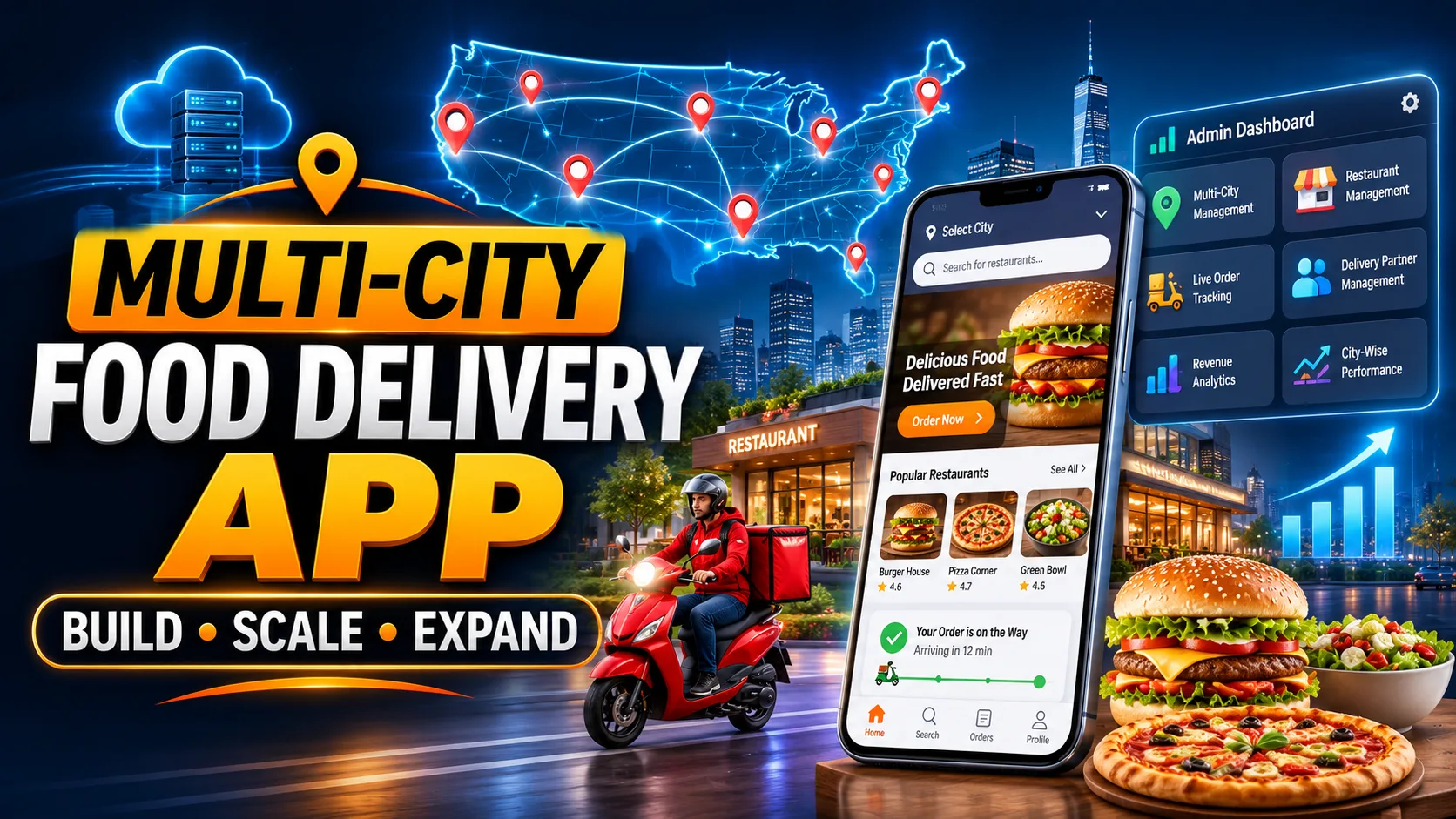
Flexible Admin Dashboard
Your operations team needs a central dashboard with city-level and platform-wide visibility.
It should support restaurant approvals, driver management, order monitoring, refunds, promotions, customer support, and performance reporting.
Three Connected Applications
Most delivery platforms require separate interfaces for:
- Customer app: browsing restaurants, placing orders, paying, and tracking deliveries.
- Restaurant app: accepting orders, managing menus, and updating preparation status.
- Driver app: receiving delivery requests, navigating routes, and updating delivery progress.
All three should communicate with the same backend infrastructure.
3. Where AI Can Make a Practical Difference
AI can be useful in food delivery, but it should solve operational problems rather than exist simply as a marketing feature.
Here are six areas where it can add value.
1. Demand Forecasting
AI models can analyze historical orders, weather conditions, holidays, local events, and time-of-day patterns to estimate upcoming demand.
This helps operations teams plan driver availability and restaurant capacity.
2. Delivery Time Predictions
Instead of relying on fixed delivery estimates, machine learning models can consider restaurant preparation times, traffic, weather, and driver availability.
Customers receive more realistic arrival estimates.
3. Route Optimization
AI-assisted routing can help drivers select efficient routes, especially in busy US cities where traffic and parking can affect delivery times.
4. Personalized Recommendations
The platform can recommend restaurants, dishes, and offers based on previous orders and customer preferences.
Done well, this improves discovery without overwhelming users with irrelevant suggestions.
5. Fraud Detection
Machine learning can identify unusual ordering patterns, suspicious payment activity, repeated refund abuse, and potentially fraudulent accounts.
High-risk transactions can be flagged for additional review.
6. Driver Allocation
Predictive systems can help match orders with available drivers based on location, delivery distance, capacity, and expected preparation time.
The objective is simple: reduce unnecessary waiting, improve delivery efficiency, and make better use of available resources.
4. Plan Logistics and Operations for Every Market
Technology alone cannot deliver food. Your operational model needs to work just as well as your software.
Start with driver onboarding and management. The platform should support registration, identity checks, applicable eligibility verification, availability management, performance tracking, and payment records.
Dispatch logic also needs flexibility.
For example, in a dense city such as New York, the system may prioritize nearby drivers and shorter delivery distances. In suburban markets, it may need to consider longer routes, wider delivery zones, and driver availability across larger areas.
Real-time tracking is another essential feature. Customers should be able to see order progress, while restaurants and operations teams need visibility into driver location and delivery status.
Restaurant partnerships deserve equal attention.
Establish clear processes for restaurant onboarding, order acceptance, preparation times, cancellations, refunds, and customer complaints.
As the business expands, standardized operating procedures will help maintain consistent service quality across markets.
5. Understand Compliance and Local Payment Requirements
Multi-city expansion brings regulatory responsibilities that shouldn't be treated as an afterthought.
In the USA, requirements can vary across states, counties, and cities. Depending on the business model, you may need to examine:
- Business registration and local operating requirements.
- Food safety and restaurant licensing obligations.
- Worker classification and applicable labor rules.
- Consumer protection and refund policies.
- Sales tax and other applicable tax obligations.
- Data privacy and payment security requirements.
For data protection, consider applicable US state privacy laws as well as international requirements such as the EU's General Data Protection Regulation (GDPR).
Payment processing also needs localization.
In the USA, credit and debit cards, digital wallets, and tipping are important parts of the customer experience. Your checkout flow should support transparent delivery fees, taxes, tips, and refunds.
International markets may require bank transfers, cash-on-delivery options, regional digital wallets, different currencies, and local payment providers.
Work with legal, tax, and compliance professionals familiar with each market before launching there. Requirements depend on location and the structure of your business.
6. Expand City by City, Not Everywhere at Once
A multi-city platform should be built for expansion, but that doesn't mean launching in ten cities simultaneously.
A phased rollout is generally more manageable.
Phase 1: Select Your First Market
Choose a city where you can establish restaurant partnerships, attract customers, and recruit enough delivery partners.
Consider competition from established services such as DoorDash and Uber Eats. Your platform needs a clear reason for customers and restaurants to choose it.
Phase 2: Validate the Business Model
Measure whether orders are generating sustainable economics.
Track metrics such as:
- Daily and monthly order volume.
- Average delivery time.
- Customer acquisition cost.
- Repeat purchase and retention rates.
- Restaurant acceptance and cancellation rates.
- Driver utilization.
- Cost per order and contribution margin.
Phase 3: Create a Repeatable Playbook
Document what worked in the first city.
Include restaurant onboarding, driver recruitment, marketing, customer support, delivery zone setup, and operational procedures.
Phase 4: Expand in Stages
Use the same foundation to enter the next city, adjusting local settings rather than rebuilding the platform.
This approach makes expansion more predictable and helps identify problems before they spread across multiple markets.
7. Understand the Budget, Team, and Development Partner
The cost of building a multi-city food delivery platform depends on its complexity, integrations, and expected scale.
As a broad planning estimate, an initial custom MVP might require approximately 3–6 months of development. A more advanced multi-city platform with sophisticated dispatch, AI capabilities, extensive integrations, and international support can take considerably longer.
Budget considerations include:
- Customer, restaurant, and driver applications.
- Backend architecture and cloud infrastructure.
- Payment gateway integrations.
- Mapping and location services.
- AI and analytics capabilities.
- Security, testing, and compliance.
- Ongoing maintenance and technical support.
Your development team should ideally include product managers, UI/UX designers, backend and mobile developers, cloud engineers, QA specialists, and security expertise.
When evaluating development partners, look for experience in marketplace applications, real-time logistics, payment integrations, scalable cloud architecture, and production support.
Ask for a clear project scope, milestone-based delivery plan, security practices, infrastructure cost estimates, and post-launch support arrangements.
A development partner should understand the operational side of food delivery, not just know how to build mobile applications.
Conclusion: Build for Expansion From the Beginning
Building a food delivery app for multiple cities requires more than adding new locations to a map.
You need flexible architecture, reliable logistics, localized customer experiences, practical AI capabilities, and a repeatable expansion strategy.
The smartest approach is to launch in one carefully selected market, validate the business model, and use those lessons to expand into the next city.
If you're planning to expand a food delivery business, which challenge concerns you most: technology scalability, driver logistics, restaurant partnerships, or maintaining profitability across different cities?
I'd be interested to hear your experience in the comments.
#FoodDeliveryApp #AppDevelopment #AIinFoodDelivery #FoodTech #DigitalTransformation