
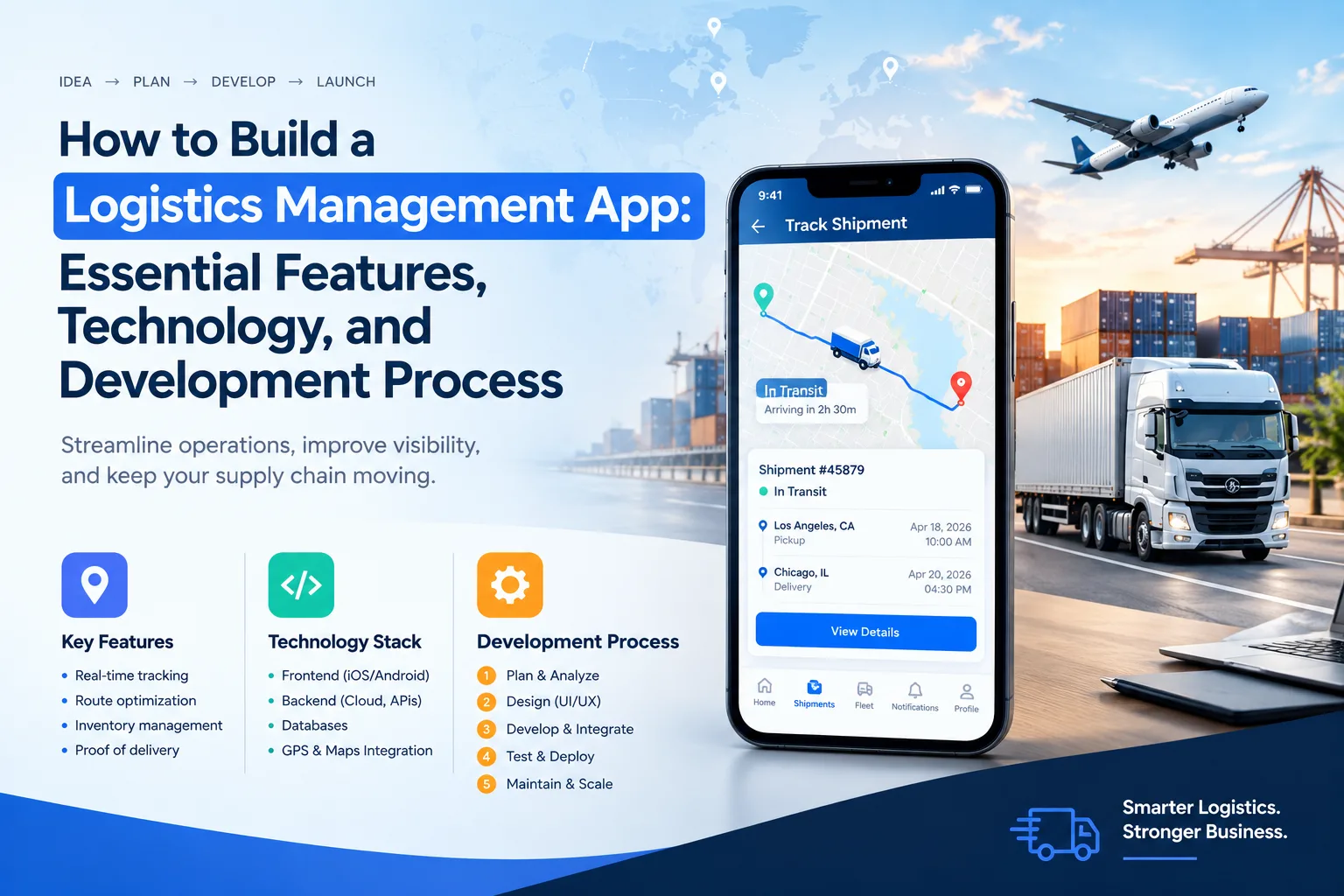
Managing deliveries, tracking shipments, coordinating drivers, and controlling transportation costs can become complicated as a logistics business grows. When teams rely on spreadsheets, phone calls, and disconnected systems, delays and communication gaps can affect both operational efficiency and customer satisfaction.
A logistics management app helps businesses bring these activities into one digital platform. It can connect dispatchers, drivers, warehouse teams, fleet managers, and customers while providing better visibility into daily operations.
For businesses planning to modernize their supply chains, logistics app development involves more than creating a tracking interface. It requires a clear understanding of business workflows, essential features, technology choices, integrations, and long-term operating costs.
This guide explains how to build a logistics management app, what features to prioritize, which technologies to consider, and how to estimate the development budget.
What Is a Logistics Management App?
A logistics management app is a digital solution designed to manage and monitor transportation, deliveries, fleet operations, and shipment-related activities from a centralized platform.
Depending on business requirements, the application may serve different users:
- Fleet managers: Monitor vehicles, fuel usage, driver assignments, and maintenance schedules.
- Dispatchers: Assign deliveries, plan routes, and manage changing schedules.
- Drivers: Receive delivery instructions, update shipment statuses, and capture proof of delivery.
- Customers: Track shipments, receive notifications, and view estimated delivery times.
- Administrators: Review operational reports, manage users, and monitor business performance.
A logistics application can operate independently or connect with existing transportation management systems (TMS), warehouse management systems (WMS), enterprise resource planning (ERP) platforms, and customer relationship management (CRM) software.
The right approach depends on whether the business needs a new application, an extension of its current systems, or a complete logistics platform.
Essential Features of a Logistics Management App
The most effective applications focus on solving operational problems rather than adding features without a clear purpose.
1. Real-Time GPS Tracking
GPS tracking helps dispatchers and customers monitor vehicle locations and shipment progress. Location updates can improve visibility, support delivery coordination, and help teams respond to unexpected delays.
Developers should consider location permissions, battery consumption, connectivity limitations, and privacy requirements when implementing tracking.
2. Route Planning and Optimization
Route planning helps dispatchers organize deliveries based on destinations, traffic conditions, delivery windows, vehicle capacity, and driver availability.
For businesses handling multiple deliveries each day, efficient routing can reduce unnecessary travel and improve resource utilization. Advanced optimization may require mapping services and routing APIs.
3. Driver and Fleet Management
A dedicated driver interface can display assigned deliveries, navigation details, pickup instructions, and delivery schedules.
Fleet management features may include vehicle availability, maintenance reminders, fuel records, driver documentation, and service histories.
4. Shipment and Order Management
A centralized dashboard helps teams create shipments, assign orders, update delivery statuses, and manage exceptions.
Status updates such as order assigned, picked up, in transit, and delivered make it easier for staff and customers to understand shipment progress.
5. Notifications and Proof of Delivery
Automated notifications can inform customers about dispatch, delays, and completed deliveries. Proof of delivery can include digital signatures, photographs, timestamps, or confirmation codes, depending on operational needs.
These features help reduce manual communication and provide a record of completed transactions.
6. Analytics and Reporting
Operational reports can highlight delivery performance, fleet utilization, order volumes, fuel expenses, and delayed shipments.
Useful metrics include on-time delivery rate, average delivery time, cost per delivery, and vehicle downtime. Businesses should define their performance indicators before building dashboards so the collected data supports actual decisions.
Technology Stack for Logistics Software Development
Choosing the right technology stack affects application performance, integration capabilities, security, and future maintenance.
A typical logistics platform includes several interconnected components.
Mobile application: Native technologies such as Swift for iOS and Kotlin for Android, or cross-platform frameworks such as Flutter and React Native.
Backend infrastructure: Technologies such as Node.js, Python, Java, or .NET can support business logic, user management, shipment processing, and API services.
Database: PostgreSQL, MySQL, or other suitable databases can store shipment records, user information, vehicle details, and operational data. Location-heavy applications may require specialized geospatial capabilities.
Cloud infrastructure: Cloud platforms such as AWS, Microsoft Azure, or Google Cloud can support hosting, storage, monitoring, and application scaling.
Third-party integrations: Mapping services, payment gateways, notification providers, barcode scanners, and existing enterprise systems may be integrated according to business requirements.
A logistics software development company should recommend technologies based on the expected workload, security needs, integration requirements, and available technical expertise—not simply because a particular framework is popular.
Step-by-Step Logistics App Development Process
A structured development process helps businesses control scope, validate requirements, and reduce avoidable rework.
Step 1: Define Business Requirements
Identify the main operational challenges the app should solve. Determine whether the priority is delivery tracking, dispatch management, fleet monitoring, warehouse coordination, or end-to-end logistics visibility.
Document user roles, existing workflows, integrations, and expected outcomes.
Step 2: Research Users and Plan Features
Understand how dispatchers, drivers, administrators, and customers will use the application.
Separate essential launch features from future enhancements. A smaller initial release can make it easier to validate the product before investing in advanced functionality.
Step 3: Design the User Experience
Create wireframes and prototypes for the main screens. Driver interfaces should be simple and easy to use while working in the field, whereas dispatch dashboards may need maps, filters, shipment lists, and operational summaries.
Testing these designs with intended users can reveal usability problems before development begins.
Step 4: Develop the Application
Build the mobile interfaces, backend services, databases, and integrations. Establish secure authentication, access permissions, error handling, and reliable data synchronization.
Offline capabilities may also be necessary when drivers work in areas with limited network coverage.
Step 5: Test and Validate
Test the application across relevant devices and operating conditions. Validate location updates, routing, shipment status changes, notification delivery, security controls, and integration reliability.
Realistic testing should include poor connectivity, incorrect addresses, canceled orders, delayed deliveries, and other operational exceptions.
Step 6: Launch and Improve
Deploy the application, train staff, and monitor its performance. Use feedback and operational metrics to prioritize improvements.
Ongoing maintenance is important because mapping services, operating systems, business processes, and integration requirements can change over time.
How Much Does Logistics App Development Cost?
The cost of building a logistics management app depends on its functionality, number of user roles, platform requirements, third-party integrations, and backend complexity.
The following are illustrative development budget ranges in USD, not verified market averages or vendor quotations.
Application typeEstimated development costBasic logistics app$15,000–$35,000Mid-level logistics management app$35,000–$80,000Advanced logistics platform$80,000–$200,000+Planning your app? Get a free consultation today.
A basic solution may include shipment records, status updates, and simple tracking. A mid-level product may add driver management, dispatch dashboards, notifications, and mapping integrations. An advanced platform may require multi-fleet support, complex routing, enterprise integrations, extensive reporting, and sophisticated access controls.
Factors That Affect Development Costs
- Feature complexity: Advanced routing, live tracking, and automated workflows require additional engineering.
- Platform selection: Separate native applications can increase development effort compared with a suitable cross-platform solution.
- Integrations: Connecting ERP, WMS, TMS, payment, and mapping systems adds implementation and testing work.
- Data and security: Access controls, audit logs, data protection, and operational reliability influence architecture and testing.
- Ongoing expenses: Cloud hosting, mapping API usage, maintenance, monitoring, and support create recurring costs.
To manage the budget, begin with the essential workflows, request a detailed project estimate, and account for post-launch expenses before approving the development plan.
How to Choose a Logistics App Development Company
Selecting the right partner is an important step because logistics applications must work reliably across different users, locations, and operational conditions.
Before hiring a logistics app development company, evaluate its experience with mobile applications, mapping integrations, real-time data, backend architecture, and enterprise software.
Ask potential partners how they approach:
- Project discovery and feature prioritization
- GPS tracking and route integration
- Data security and system reliability
- Testing under real-world operating conditions
- Integration with existing business software
- Maintenance, technical support, and future upgrades
It is also useful to review comparable projects, clarify source-code ownership, and request a breakdown of deliverables, timelines, and payment milestones.
For example, Apptunix is one provider businesses can consider when researching application development partners. Comparing its relevant capabilities and proposed approach with other providers can help determine whether a team fits the project's technical and commercial requirements.
Frequently Asked Questions
1. How long does it take to build a logistics management app?
A basic application may take around 3–5 months, while a more complex platform may require 6–12 months or longer. Integrations, testing, and changing requirements can affect the timeline.
2. Can a logistics app work without an internet connection?
Yes. Developers can implement offline data storage for selected functions, allowing drivers to record delivery updates when connectivity is unavailable. The application can synchronize those updates when a connection returns.
3. Should a logistics business build a custom app or use existing logistics software?
Existing logistics software may suit businesses with standard requirements and limited customization needs. Custom development can be more appropriate when a company needs specialized workflows, unique integrations, or greater control over its platform.
4. What is the difference between logistics software and a logistics app?
Logistics software is the broader category of systems used to manage transportation, inventory, shipments, and supply chain activities. A logistics app is a specific application or interface within that broader system, often designed for mobile users.
5. How can businesses reduce logistics app development costs?
Prioritize essential features, reuse suitable existing services, define requirements early, and launch an MVP before expanding. Include hosting, third-party services, and maintenance in the total budget.
Final Thoughts
Building a logistics management app can help businesses improve shipment visibility, coordinate drivers, streamline dispatch operations, and make better use of fleet resources. However, success depends on selecting features that solve real operational problems and implementing them through a reliable, secure, and scalable architecture.
A practical approach to logistics software development starts with clear requirements, a focused first release, appropriate technology choices, and realistic cost planning. Businesses should also evaluate how the application will integrate with existing systems and evolve as operational needs change.
Planning to build a logistics management app? Start by identifying your biggest operational challenges, listing the essential features, and setting a realistic budget. Then consult an experienced development team to assess the technology, timeline, integrations, and support required to turn your idea into a working solution.