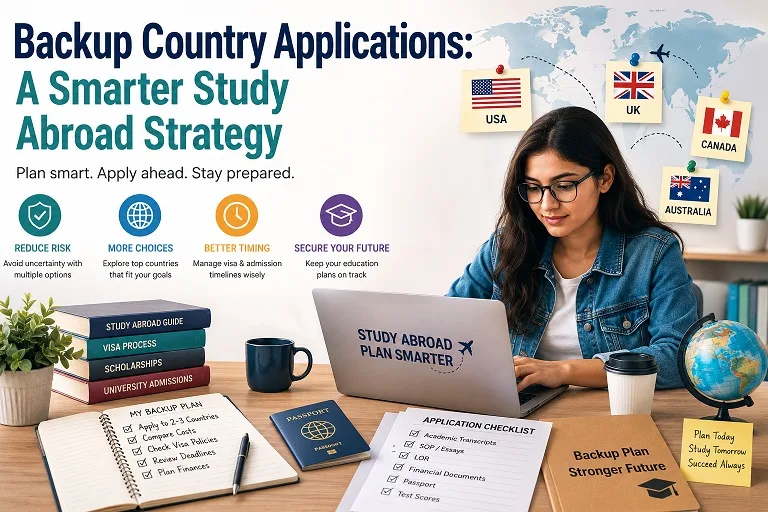
Applying to study abroad is no longer just about finding the perfect university. Students also have to think about what happens if their first-choice destination becomes difficult to reach.
That is why a backup plan for country applications is becoming a practical part of international education planning. Instead of relying entirely on one destination, students can keep one or two alternative countries ready while maintaining their main application as the priority.
The strategy sounds simple, but it requires discipline. Applying to too many countries can create more work, higher costs, and weaker applications. The real advantage comes from choosing alternatives carefully.
Start With One Clear First Choice
A backup strategy works best when students know what they are trying to protect.
The first-choice country should be selected for a meaningful reason. It might have the strongest program for a chosen subject, better affordability, attractive career opportunities, or family connections. Once that choice is clear, students can identify what could prevent the plan from working.
Visa uncertainty may be one concern. Cost could be another. Application deadlines, admission requirements, or post-study work policies may also affect the decision.
This changes the question from "Which countries should I apply to?" to "Which alternatives would still work if my first plan changes?"
That distinction matters. A student interested in engineering, for example, does not need five unrelated destinations. Two alternatives with strong engineering programs and manageable admission requirements may provide a much more useful safety net.
Choose Backup Countries for a Reason
A secondary country should not simply be somewhere the student would be willing to live.
The research points toward a primary-secondary structure. Students maintain a genuine first choice while selecting one or two alternatives based on factors such as application friction, visa predictability, cost, and program suitability.
This approach also helps control the workload. Every additional country can mean another application form, document set, essay, financial requirement, and deadline.
Think of the process like packing for a long journey. Taking one extra jacket makes sense if the weather could change. Carrying five suitcases "just in case" creates a problem of its own.
The same principle applies to applications. A small, carefully selected backup can provide flexibility. An oversized application list can reduce the quality of every submission.
Students should therefore compare their options before committing. The cheapest destination may not have the right course. The easiest application may lead to higher living costs. A country with attractive post-study opportunities may have requirements that make the visa process less predictable.
The strongest backup is one that remains attractive even if it becomes the final destination.
Consider a 2+2 Route When Direct Entry Feels Risky
Students applying within the United States have another option: the 2+2 pathway.
Under this model, a student begins at a community college and completes the first two years before transferring to a four-year university. The approach can reduce initial costs and create more time to settle academically and financially.
For some students, this is not a fallback at all. It is a deliberate way to break a major decision into smaller stages.
But the details matter. Students should check whether a pathway guarantees admission to the partner university or only guarantees that credits can transfer. Credit transfer alone does not necessarily mean the student will be admitted to the intended four-year program.
It is also worth checking whether the agreement is current and how successfully students in the intended major have transferred recently.
A lower-risk pathway only works when the terms are clear.
Protect the Quality of Every Application
The biggest danger of a multi-country strategy is not having too few options. It is having too many.
Students still need strong academic records, carefully prepared documents, and convincing applications for every destination. A secondary application should never look like something assembled at the last minute.
This is particularly difficult when application work overlaps with regular coursework. Students may be preparing personal statements and financial documents while also handling assignments, projects, and examinations.
Academic support can help reduce that pressure. Resources such as Expertsmind.com’s subject expert network can give students access to subject-specific assistance when application deadlines compete with their academic workload.
The aim is not to outsource the application process. It is to protect the academic performance that supports the application in the first place.
Decide Before the Offers Arrive
A backup plan becomes much more useful when students decide their priorities before receiving multiple offers.
Cost should be considered alongside program quality. Visa conditions matter alongside university reputation. Distance from home may matter more to one family than post-study opportunities do.
Writing these priorities down early can make the final decision much easier.
It also prevents a common problem: choosing an offer simply because it arrived first or because the admission itself feels like an achievement.
The point of applying to multiple countries is to create meaningful choice. That choice only helps when students know how they will evaluate it.
Flexibility Is Becoming Part of Study-Abroad Planning
The growing use of backup applications reflects a wider change in how students approach international education. A single destination no longer has to determine whether an entire admission cycle succeeds or fails.
Students can still aim high. They can still have a dream university and a preferred country. But they can also prepare for changing visa rules, financial constraints, processing delays, or unexpected admission outcomes.
That is not a sign of uncertainty about their goals. It is a way of protecting those goals.