
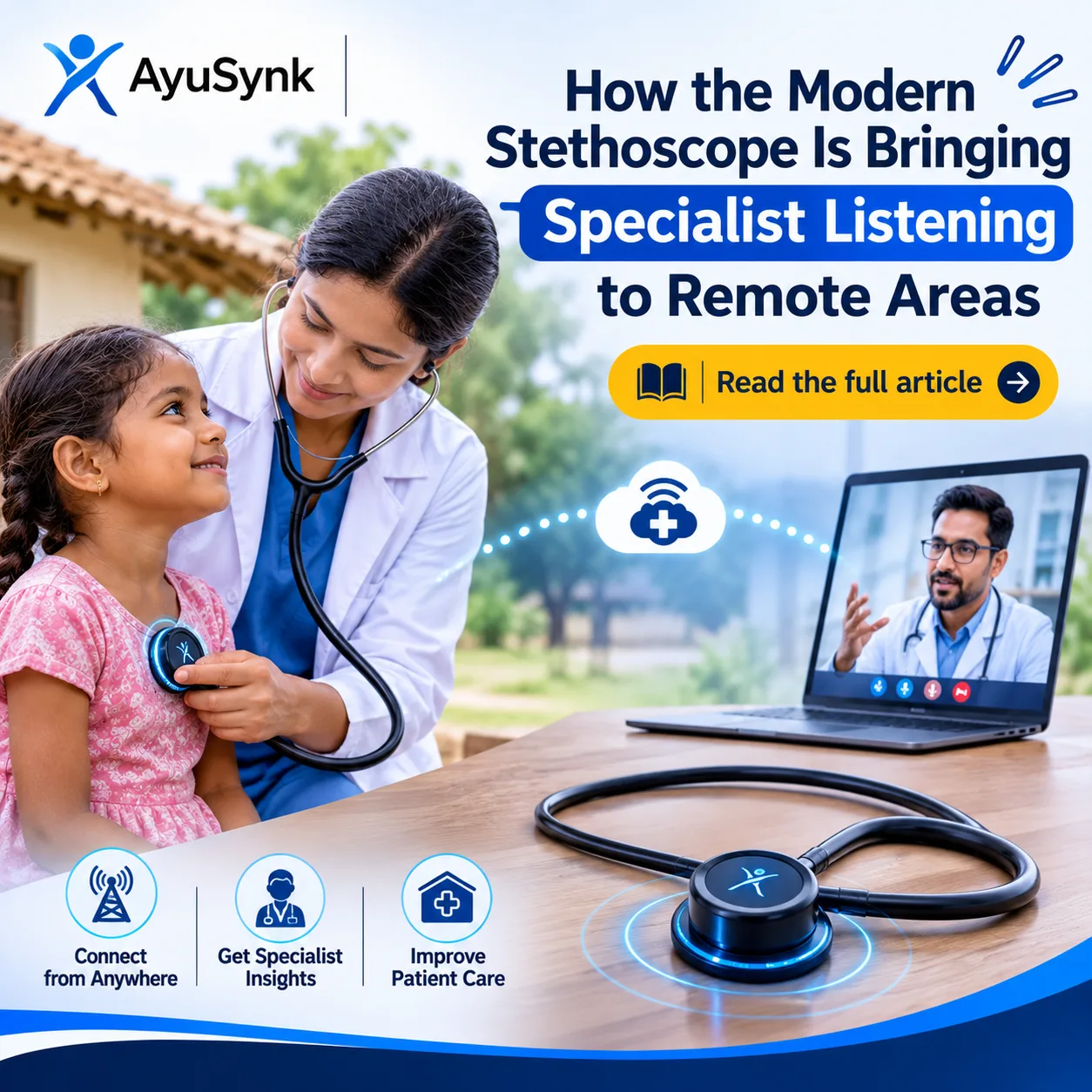
In many parts of India, the person who first examines a sick patient is not a specialist. It is a nurse, a community health worker or a village doctor with limited resources. The specialist who could interpret a worrying heart sound or a wheezy chest may be in a district hospital hours away, or in another city entirely.
For decades, the stethoscope has helped doctors listen. But it has always required the listener and the patient to be in the same place. That is now changing. A modern stethoscope can capture heart and lung sounds digitally and send them to a specialist who listens from somewhere else. This practice is called tele-auscultation.
This article looks at how it works, where it helps, where it falls short, and what health teams should ask before they adopt it.
The Distance Problem in Healthcare
Why distance mattersA specialist cannot examine a patient they cannot reach. Travel takes time and costs money, and some patients are too unwell to make the journey. Others simply do not go, because the trip is too difficult, and their condition goes unchecked until it becomes serious.
What a phone call cannot doA health worker can describe symptoms over the phone, but a description of a sound is a poor substitute for the sound itself. “A bit of a murmur” or “some crackles” can mean different things to different listeners. Specialists want to hear it for themselves.
What Is a Modern Stethoscope?
Beyond the traditional designA traditional stethoscope is acoustic. Sound travels through tubing to the listener’s ears. It is simple and reliable, but it cannot amplify sound beyond what the design allows, remove background noise or store what was heard.
What the digital version addsA modern stethoscope converts body sounds into a digital signal. That signal can be amplified, filtered, shown as a waveform, recorded and shared. The AyuSynk 2 Pro Advance from AyuSynkai, for example, lists up to 60x amplification, noise reduction, separate heart and lung filters and a frequency range of 20 Hz to 20,000 Hz.
What stays the sameThe clinician still decides what the sound means. The device improves how the sound is captured and shared. It does not diagnose.
How Tele-Auscultation Works
Step 1: A trained person captures the soundA nurse, health worker or doctor places the stethoscope on the patient’s chest. The device captures the sound and converts it into a digital signal.
Step 2: The sound is cleanedRemote clinics and busy wards are rarely quiet. Noise reduction and heart and lung filters help the listener focus on the relevant sound.
Step 3: The app takes overThe stethoscope connects to a phone or tablet, usually over Bluetooth. The AyuSynk 2 Pro Advance works with the AyuShare app, which is available on Android and iOS. The app records the sound and shows it as a waveform.
Step 4: The specialist listensThe recording, or a live stream, is sent to the specialist. The product page says live streaming is included for two years. The specialist can replay the sound, slow it down (the device lists playback down to 0.25x) and study the waveform before responding.
Step 5: A decision is madeThe specialist may advise treatment, ask for further tests or recommend that the patient travel for an in-person visit. In each case, the decision is better informed than it would have been without the recording.
Where It Helps Most
Rural and remote clinicsA health worker with a modern stethoscope can seek a specialist opinion without sending the patient away immediately. This can reduce unnecessary trips and help identify the patients who really need to travel.
Follow-up care after treatmentAfter surgery or a hospital stay, patients often need monitoring. Recorded sounds let doctors compare a patient’s condition across visits, without requiring every check to be in person. The Pro Advance lists cloud storage for up to 6,000 patients a year, which supports this kind of follow-up.
Screening programmesPublic health programmes and health tech companies may need to screen many people. A digital system that records, stores and shares sounds can fit into a larger workflow. The product page says the Pro Advance is aimed at health tech corporations and government-funded programmes, and that SDK integration is available, with charges based on scope.
Training and teachingRecorded sounds can be replayed for students and junior staff. Seeing a waveform while hearing the sound helps people connect what they hear with what it means.
The Role of AI
What it can doSome modern stethoscopes include AI-based detection. The AyuSynk 2 Pro Advance lists AI-based abnormality detection. In practice, AI can flag a recording that deserves a closer look, which may help a busy health worker or a screening programme prioritise.
What it cannot doAI is a support tool. It does not replace an examination, clinical judgement or further testing. A health team using any AI feature should ask how it was validated, what it detects and how results are shown, and should treat the answers as part of the buying decision.
Honest Limits and Challenges
ConnectivityLive sharing depends on an internet connection, which is not always reliable in remote areas. Teams should ask how the system behaves when the connection is weak, and whether recordings can be saved and sent later.
TrainingA recording is only as good as the way the stethoscope is placed. Staff need training on placement, on using the app and on knowing when a recording is poor and should be repeated. The Pro Advance lists premium support and training, which is worth asking about in detail.
Data privacyPatient recordings are sensitive health data. Programmes should know where data is stored, who can access it and how it is protected.
Cost and time limitsThe Pro Advance page says live streaming and unlimited AI are included for two years. Buyers should ask what happens after that period, and what any renewal would cost.
What Health Teams Should Ask Before Adopting One
A short list of questions- Does the device work well in noisy, real-world conditions, not only in a demo?
- How does the system behave with weak internet?
- How is patient data stored and protected?
- What training and support are included?
- What are the costs after the included period?
- If we use our own platform, what does integration involve?
A short test on a real patient tells you more than a specification sheet. AyuSynkai offers demo requests for this reason.
Cost: What to Expect
Wireless stethoscope price in IndiaThe AyuSynk 2 Pro Advance is listed at ₹34,990 on the AyuSynkai website. Prices and offers change, so check the product page for the current wireless stethoscope price and what it includes. According to the page, the listed price covers live streaming and AI for two years, cloud storage for up to 6,000 patients a year and a 2-year warranty, while SDK integration is charged separately.
Matching the device to the needA telehealth programme benefits from streaming, storage and integration. A single doctor who only wants better sound in the clinic may not need all of that. AyuSynkai also lists a simpler model, the AyuSynk 2+, at ₹18,000.
Buying Safely
Choose a trusted sourceMedical devices should be bought from the maker or an authorised seller, so that warranty cover is clear and the risk of copies is low. Buying an online stethoscope directly from the maker is one way to do this. It is also sensible to read the shipping, return and refund policies before ordering, especially for institutional purchases.
Treat testimonials with careProduct pages often feature doctors’ comments. These are chosen by the company, so they are useful but not independent. Look for other sources of feedback too.
The Bigger Picture
The modern stethoscope will not solve the shortage of specialists. What it can do is make the available expertise easier to reach. A health worker who can share a clear, recorded sound gives the specialist something concrete to work with. That can make referrals more targeted, follow-up easier and training more practical.
Technology of this kind works best when it is paired with training, reliable support and honest expectations. Devices are tools. The care still comes from people.
Conclusion
Tele-auscultation does not change what a stethoscope is for. It changes where the listening can happen. A modern stethoscope captures sound digitally, cleans it, records it and shares it, so that a specialist can listen even when they cannot be there. For remote areas, that can mean faster advice and fewer unnecessary journeys. For the health teams who adopt it, the key is to test it in real conditions, ask clear questions about connectivity, data and cost, and treat AI as support, not as an answer. To see one example of how this works, you can read more about the
modern stethoscope from AyuSynkai.
Contact Us
Call Now: 08047191146
Website: https://ayusynk.ai /
Follow AyuSynkai: Facebook | Instagram | LinkedIn | YouTube.