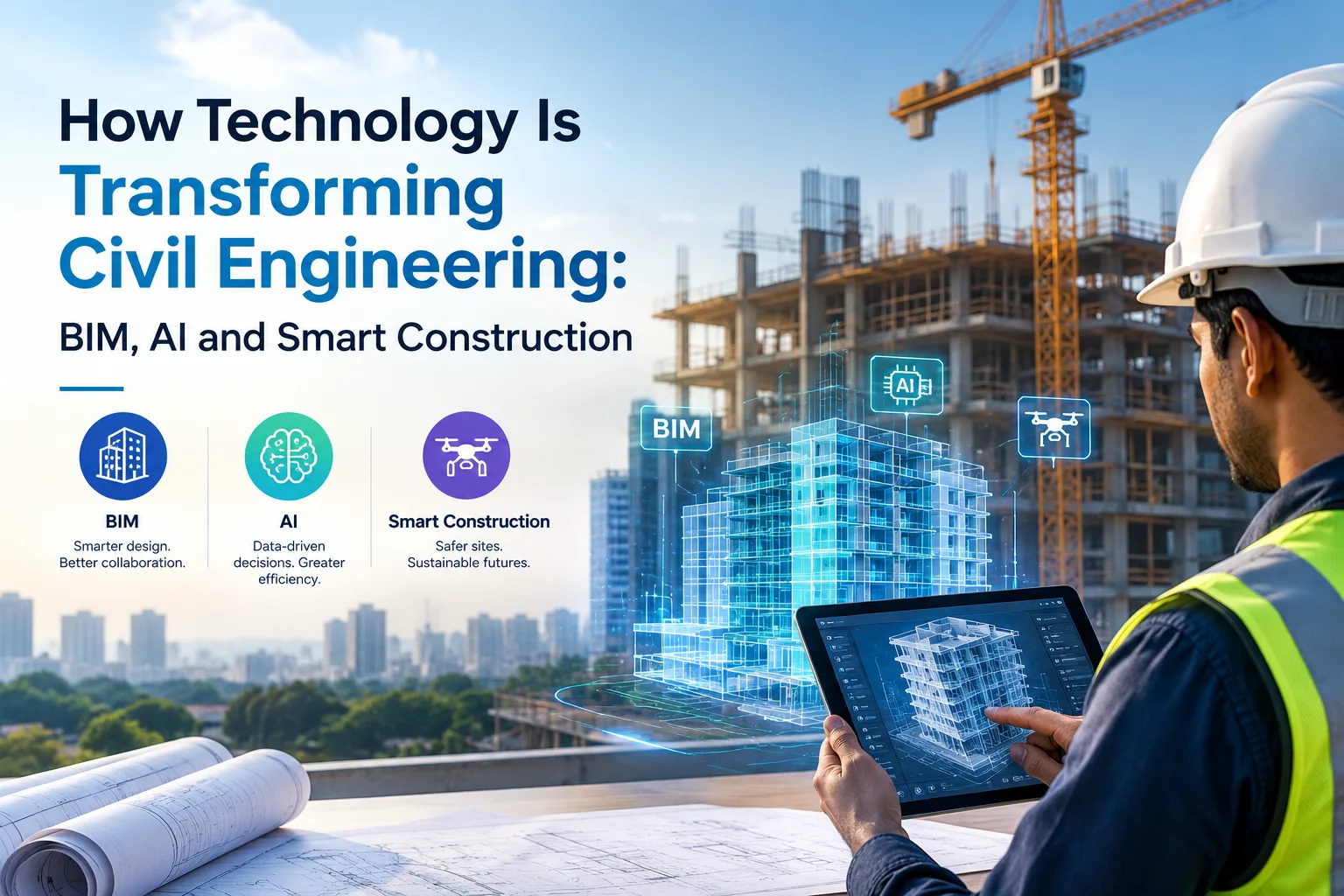
Civil engineering has always played a vital role in developing the infrastructure that supports modern society. From roads and bridges to residential buildings, airports, railways and water management systems, civil engineers help shape the places where people live and work. Today, however, the industry is undergoing a significant transformation as digital technologies change how construction projects are planned, designed, executed and maintained.
Building Information Modeling (BIM), artificial intelligence (AI), drones, digital surveying and smart construction technologies are helping engineering teams improve coordination, analyse complex information and monitor project progress. These developments are creating new possibilities for designing safer structures, managing resources efficiently and addressing the challenges of modern infrastructure development.
For students considering a career in civil engineering, understanding these technologies is becoming increasingly valuable. The future of the profession will depend not only on traditional engineering knowledge but also on the ability to apply digital tools to practical construction and infrastructure problems.
1. Building Information Modeling (BIM): Changing the Way Projects Are Designed
Building Information Modeling, commonly known as BIM, is one of the most influential digital developments in the construction industry. It involves creating and managing digital representations of buildings and infrastructure, combining geometry with information about materials, components and other project characteristics.
Traditional construction drawings often require different teams to interpret separate sets of plans. BIM helps bring architectural, structural and building services information into a coordinated digital environment.
How BIM Helps Civil Engineers
BIM supports several important activities throughout a construction project's lifecycle.
Improved design coordination: Engineers, architects and other professionals can coordinate their designs and identify potential conflicts before construction begins.
Clash detection: Digital models can help identify situations where structural elements, pipes, electrical systems or other components occupy conflicting spaces.
Quantity estimation: Information within models can support the estimation of construction materials and quantities, depending on model quality and the associated workflows.
Project visualisation: Three-dimensional models allow project teams and clients to understand a proposed structure more clearly than conventional two-dimensional drawings alone.
Lifecycle management: BIM information can support construction planning, facility operations and maintenance when it is developed and maintained for those purposes.
Software Used in BIM Workflows
Civil engineering professionals may encounter tools such as Autodesk Revit, Autodesk Civil 3D, Navisworks and other applications that support digital modelling, infrastructure design and project coordination.
Learning a particular software package is useful, but students should also understand the engineering principles behind the models they create. Digital tools are most effective when supported by accurate data, sound technical judgement and appropriate quality checks.
2. Artificial Intelligence in Civil Engineering
Artificial intelligence is creating new ways to analyse engineering information, support decision-making and automate selected tasks.
Civil engineering projects generate substantial amounts of data from surveys, design models, construction reports, sensors, inspection records and project schedules. AI techniques can help identify patterns within this information and provide insights that may be difficult to obtain through manual analysis alone.
Applications of AI in Civil Engineering
Structural health monitoring: AI models can analyse sensor readings and inspection data to help identify unusual structural behaviour or changes that may require further investigation.
Construction planning: Predictive models can support schedule analysis, resource allocation and the identification of potential project delays.
Safety monitoring: Computer vision systems can assist with identifying selected site hazards, such as missing personal protective equipment, when suitable cameras and monitoring systems are available.
Design optimisation: AI-assisted tools can help engineers explore design alternatives and compare potential solutions against selected constraints, including cost, material use and performance.
Predictive maintenance: Data from infrastructure assets can help maintenance teams prioritise inspections and identify components that may require attention.
Can AI Replace Civil Engineers?
AI is more likely to change many engineering tasks than eliminate the need for professional engineering judgement.
Although AI tools can assist with calculations, documentation, data analysis and design exploration, civil engineering decisions involve safety, regulations, material behaviour, environmental conditions and responsibilities that require qualified human oversight.
Engineers must verify outputs, evaluate assumptions and ensure that designs comply with applicable standards and project requirements.
For students, this means AI literacy can be a useful additional skill, but it should complement rather than replace core subjects such as structural analysis, geotechnical engineering, surveying and construction materials.
3. Smart Construction: Making Building Projects More Connected
Smart construction refers to the use of connected technologies and data-driven processes to improve the planning, execution and monitoring of construction activities.
Instead of depending entirely on manual reports and periodic inspections, project teams can use digital systems to collect information from construction sites and share it with relevant stakeholders.
Technologies Supporting Smart Construction
Internet of Things (IoT): Connected sensors can collect information about equipment, temperature, humidity, vibration and other site conditions.
Drones: Unmanned aerial vehicles can support surveying, site mapping, progress documentation and inspections in suitable operating conditions.
GPS and digital surveying: These technologies help surveyors establish positions, measure sites and support the layout of infrastructure projects.
Digital project management platforms: These systems help teams coordinate schedules, track issues, share drawings and manage project documentation.
Robotics and automation: Selected tasks, such as repetitive material handling or specialised construction operations, can be supported by robotic systems.
Together, these technologies can improve information sharing and help project teams make decisions based on more current site information.
4. Digital Twins: Connecting Physical Infrastructure With Digital Models
A digital twin is a digital representation of a physical asset or system that can be updated using relevant operational or sensor data.
In civil engineering, digital twins may be developed for buildings, bridges, transportation networks, water systems and other infrastructure.
For example, a digital representation of a bridge could combine design information, inspection records and sensor readings. Engineers could use this information to understand the asset's condition, investigate unusual measurements and plan maintenance activities.
Digital twins are not simply three-dimensional models. Their usefulness depends on the quality of the underlying data, the frequency of updates and the connection between the digital representation and the physical asset.
When implemented appropriately, digital twins can support asset management and help infrastructure owners make more informed maintenance decisions.
5. Sustainable Construction Through Technology
Sustainability is another important area where technology is influencing civil engineering.
Construction projects consume materials, energy and water, while generating waste and emissions. Digital tools can help engineers evaluate alternatives and make more informed decisions about resource use.
How Technology Supports Sustainable Construction
Material optimisation: Design and analysis tools can help engineers compare structural alternatives and assess material requirements while maintaining applicable safety and performance criteria.
Energy-efficient buildings: Building performance simulations can help evaluate energy consumption, daylight availability and thermal comfort during the design stage.
Water management: Digital modelling can support drainage planning, flood analysis, water distribution and wastewater system design.
Construction waste reduction: Better quantity estimation and project coordination can help reduce avoidable material waste.
Environmental monitoring: Sensors and digital reporting systems can assist with monitoring selected environmental conditions around construction sites.
Technology does not automatically make a project sustainable. Engineers must consider the entire lifecycle of materials and infrastructure, including durability, maintenance, environmental impacts and end-of-life management.
6. How Technology Is Improving Construction Safety
Construction sites involve risks associated with heavy equipment, working at heights, excavation, lifting operations and moving vehicles. Digital technology can help organisations monitor selected risks and improve safety planning.
For example, drones can inspect certain hard-to-access locations, reducing the need for some preliminary manual inspections. Sensors can monitor environmental conditions, while digital site records can help teams document hazards and track corrective actions.
Computer vision systems may also help identify selected unsafe conditions, although their performance depends on camera placement, lighting, system design and the circumstances being monitored.
These tools should supplement established safety procedures, competent supervision, worker training and statutory requirements. Technology is most effective when it is integrated into a broader safety management system.
7. Challenges of Adopting Technology in Civil Engineering
Despite its advantages, digital transformation presents several challenges for construction companies and engineering professionals.
Initial Investment and Training
Digital software, sensors, equipment and supporting systems can require significant investment. Organisations must also train employees to use these technologies effectively.
Data Quality and Interoperability
Information created by different software applications may not always transfer smoothly between systems. Inaccurate, incomplete or inconsistent data can affect design coordination and project decisions.
Cybersecurity and Data Privacy
Connected construction systems may contain sensitive project documents, operational information and commercial data. Appropriate access controls, security procedures and data management practices are essential.
Resistance to Change
Teams accustomed to traditional processes may require time and support to adopt new digital workflows. Successful implementation often depends on training, collaboration and clear organisational objectives.
Maintaining Human Oversight
Automated outputs should not be accepted without review. Engineers must check assumptions, validate results and ensure that digital recommendations meet technical, legal and safety requirements.
Addressing these challenges requires investment in people and processes as well as technology.
8. Skills Civil Engineering Students Should Develop for the Future
Students preparing for careers in civil engineering can improve their readiness for a technology-driven industry by combining fundamental engineering knowledge with practical digital skills.
Some useful areas to explore include:
CAD and digital modelling: Learn how engineering drawings and models are created, reviewed and coordinated.
BIM fundamentals: Understand how digital project information supports design coordination, quantity estimation and construction planning.
Data analysis: Develop the ability to interpret spreadsheets, measurements, survey information and basic statistical results.
Surveying technologies: Become familiar with total stations, GNSS/GPS equipment, digital surveying methods and relevant mapping applications.
Project management: Learn about scheduling, cost estimation, risk management, quality control and project documentation.
AI awareness: Understand the potential uses and limitations of AI tools, including the need to validate calculations, references and technical outputs.
Communication and teamwork: Practise explaining technical concepts, preparing reports and working with professionals from different disciplines.
Students do not need to master every technology at once. A practical approach is to establish strong engineering fundamentals and then develop digital competencies that match their chosen specialisation.
9. How Engineering Colleges Can Prepare Students for Digital Construction
Engineering education has an important role in preparing graduates for changing industry requirements.
In addition to classroom instruction, students benefit from laboratory work, practical design exercises, surveying activities, internships and exposure to real construction projects.
Colleges can strengthen learning by incorporating relevant digital tools into coursework, encouraging interdisciplinary projects and helping students understand how engineering principles are applied in professional environments.
Students exploring this field can review the Civil Engineering programme at Kumaraguru College of Technology (KCT) to learn more about the academic programme and assess how it aligns with their interests.
Prospective students should also examine the curriculum, laboratory facilities, faculty expertise, industry interaction and practical training opportunities when comparing institutions.
10. What Is the Future of Technology in Civil Engineering?
The future of civil engineering is likely to involve greater integration between physical construction activities and digital information systems.
BIM can support better coordination between project teams. AI can assist with analysing complex data. Sensors and digital twins can contribute to infrastructure monitoring, while drones and advanced surveying tools can improve the collection of site information.
At the same time, sustainable design, climate resilience, infrastructure maintenance and efficient resource use are likely to remain important considerations for engineers.
The pace of adoption will vary across organisations, project types and regions. Not every construction company will use the same tools, and technology alone cannot solve every engineering challenge.
Nevertheless, professionals who understand both engineering fundamentals and digital workflows will be better equipped to evaluate emerging tools and apply them appropriately.
Conclusion
Technology is transforming civil engineering by changing how infrastructure projects are designed, constructed, monitored and maintained. Building Information Modeling improves digital coordination, AI supports selected analytical tasks, and smart construction technologies help project teams collect and use information more effectively.
Digital twins, advanced surveying and sustainability-focused design tools are also expanding the possibilities for infrastructure planning and asset management.
For aspiring civil engineers, the most valuable approach is to combine strong technical knowledge with practical experience, digital awareness and a commitment to continuous learning. Understanding these technologies can help students prepare for a profession that continues to evolve alongside the needs of modern society.
Civil engineering remains fundamentally about creating safe, durable and useful infrastructure. Technology provides new tools to achieve that goal, but sound engineering judgement, responsible decision-making and human collaboration remain essential.