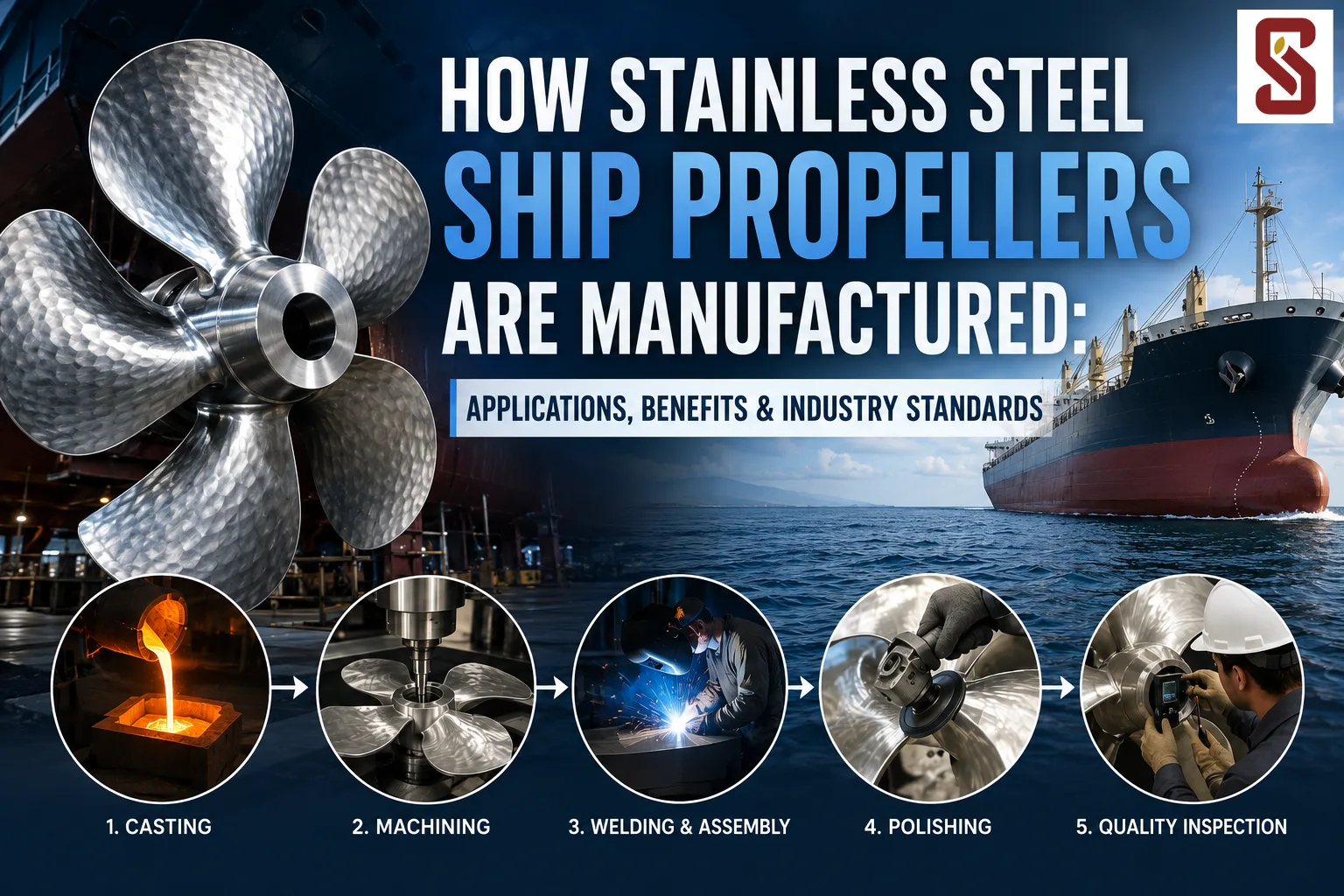
Stainless steel ship propellers play a vital role in the marine industry by converting engine power into the thrust required to move vessels efficiently through water. From commercial cargo ships and fishing boats to luxury yachts and naval vessels, ship propellers significantly influence speed, fuel efficiency, manoeuvrability, and overall operational performance.
Modern marine industries prefer stainless steel ship propellers because of their exceptional strength, corrosion resistance, and long service life. Manufactured through advanced steel casting techniques and precision machining, these propellers are designed to withstand harsh marine environments while delivering reliable performance.
What Are Stainless Steel Ship Propellers?
A stainless steel ship propeller is a precision-engineered marine component that converts rotational energy from a vessel's engine into forward thrust. Unlike aluminum or cast iron propellers, stainless steel propellers offer superior durability, resistance to seawater corrosion, and excellent structural integrity.
Manufactured using advanced casting and machining technologies, these propellers provide consistent performance even under demanding operating conditions, making them suitable for both commercial and recreational marine applications.
Manufacturing Process of Stainless Steel Ship Propellers
Producing a high-quality stainless steel ship propeller requires a combination of engineering expertise, precision casting, and rigorous quality control.
1. Design and Engineering
The manufacturing process begins with computer-aided design (CAD), where engineers determine the propeller's diameter, blade pitch, blade angle, number of blades, and hydrodynamic profile based on the vessel's specifications.
Proper design ensures:
- Maximum propulsion efficiency
- Reduced vibration
- Improved fuel economy
- Smooth vessel operation
2. Pattern and Mold Preparation
A pattern is developed based on the approved design. High-quality molds are then prepared to accurately replicate the propeller's complex geometry.
Precision mold preparation ensures:
- Accurate dimensions
- Uniform metal flow
- Minimal casting defects
- Excellent surface finish
3. Stainless Steel Casting
Molten stainless steel is poured into the prepared mold under controlled conditions. The quality of the casting process directly impacts the strength and reliability of the finished propeller.
Advanced casting techniques help achieve:
- Dense, defect-free castings
- Uniform grain structure
- High mechanical strength
- Excellent corrosion resistance
4. Heat Treatment
After casting, the propeller undergoes heat treatment to enhance its mechanical properties.
Heat treatment improves:
- Hardness
- Toughness
- Wear resistance
- Fatigue strength
This step is particularly important for propellers operating in demanding marine environments.
5. CNC Machining
Once heat treatment is complete, the propeller is machined using CNC equipment to achieve precise dimensions and blade geometry.
Machining ensures:
- Accurate blade pitch
- Proper balancing
- Smooth surface finish
- Enhanced hydrodynamic performance
6. Quality Inspection and Testing
Every stainless steel ship propeller undergoes strict quality checks before delivery.
Common inspections include:
- Dimensional verification
- Chemical composition testing
- Mechanical property testing
- Non-destructive testing (NDT)
- Dynamic balancing
- Visual inspection
Only propellers meeting international quality requirements are approved for marine use.
Applications of Stainless-Steel Ship Propellers
Due to their strength and durability, stainless steel ship propellers are widely used across various marine industries.
Commercial Cargo Ships
Large cargo vessels require durable propellers capable of continuous operation under heavy loads while maintaining fuel efficiency.
Fishing Vessels
Fishing boats operate in corrosive saltwater conditions. Stainless steel propellers provide excellent corrosion resistance and long service life.
Naval and Defence Ships
Military vessels demand high-performance propulsion systems that deliver reliability under extreme operating conditions.
Luxury Yachts
Premium yachts use stainless steel propellers for smooth cruising, reduced vibration, and improved speed.
Offshore Support Vessels
Tugboats, research ships, offshore supply vessels, and workboats rely on stainless steel propellers for dependable performance in challenging environments.
Benefits of Stainless Steel Ship Propellers
Superior Corrosion Resistance
Marine environments expose propellers to seawater, humidity, and chemicals. Stainless steel naturally resists corrosion, extending service life and reducing maintenance.
High Strength
Stainless steel provides excellent tensile strength, allowing propellers to withstand heavy loads and impacts without deformation.
Improved Fuel Efficiency
Accurate blade geometry and smooth surface finish improve propulsion efficiency, helping vessels reduce fuel consumption and operating costs.
Longer Service Life
Compared to many alternative materials, stainless steel propellers require fewer replacements, offering excellent long-term value.
Reduced Maintenance
The durability and corrosion resistance of stainless steel minimize repair needs and maintenance downtime.
Industry Standards for Stainless Steel Ship Propellers
Reliable manufacturers follow internationally recognized standards to ensure safety, durability, and consistent product quality.
Common quality practices include:
- Certified raw material sourcing
- Chemical composition verification
- Mechanical property testing
- Precision dimensional inspection
- Non-destructive testing (NDT)
- Dynamic balancing
- Compliance with marine industry specifications
Following these standards ensures that propellers perform efficiently under demanding marine operating conditions.
Why Choose a Reliable Stainless Steel Ship Propeller Manufacturer?
Selecting an experienced manufacturer is essential for achieving long-lasting marine performance.
A trusted manufacturer offers:
- Advanced steel casting technology
- Precision CNC machining
- Strict quality control
- Custom propeller manufacturing
- Experienced engineering support
- Timely delivery
- Compliance with international quality standards
Working with an established stainless steel casting manufacturer ensures dependable products tailored to your vessel's operational requirements.
Conclusion
Stainless steel ship propellers are indispensable components for modern marine vessels. Their exceptional corrosion resistance, strength, fuel efficiency, and long service life make them the preferred choice for commercial shipping, offshore operations, fishing fleets, naval vessels, and luxury yachts.
Manufactured through precision casting, heat treatment, CNC machining, and rigorous quality inspections, these propellers deliver outstanding performance in harsh marine environments. Choosing a trusted manufacturer ensures superior product quality, reliability, and long-term operational value.
Looking for a Trusted Stainless Steel Ship Propeller Manufacturer?
At Sumukh Steel Castings, we manufacture high-quality stainless steel ship propellers using advanced casting technology, precision CNC machining, and strict quality control processes. Our marine casting solutions are designed for exceptional durability, corrosion resistance, and superior propulsion performance across commercial, offshore, and industrial marine applications.
Contact our team today to discuss your custom marine propeller requirements and discover reliable, precision-engineered casting solutions tailored to your vessel's needs.
Frequently Asked Questions (FAQs)
1. Why are stainless steel ship propellers preferred over other materials?
Stainless steel ship propellers offer superior corrosion resistance, higher strength, longer service life, and improved fuel efficiency, making them ideal for demanding marine applications.
2. What is the manufacturing process of a stainless steel ship propeller?
The process includes CAD design, pattern and mold preparation, stainless steel casting, heat treatment, CNC machining, balancing, and comprehensive quality inspection.
3. Where are stainless steel ship propellers commonly used?
They are widely used in cargo ships, fishing vessels, naval ships, luxury yachts, offshore support vessels, and commercial marine applications.
4. What quality tests are performed on stainless steel ship propellers?
Manufacturers conduct dimensional inspections, chemical analysis, mechanical testing, non-destructive testing (NDT), dynamic balancing, and visual inspections to ensure product quality.
5. How do stainless steel ship propellers improve vessel performance?
Their precision-engineered design enhances propulsion efficiency, reduces vibration, improves fuel economy, increases durability, and minimizes maintenance requirements.