There is a number that industrial safety professionals rarely say out loud but think about constantly. It is the number of seconds — sometimes less than two — between a forklift entering a blind spot zone and a collision becoming unavoidable. Two seconds is not enough time for an operator to check a mirror, register a hazard, process the risk, and bring a loaded forklift to a stop. It is barely enough time to react at all.
This is the reality that sits behind every forklift collision statistic. Not negligence. Not recklessness. Just the brutal arithmetic of heavy machinery, restricted visibility, and human reaction time — colliding in a space where any one of them operating at the edges of their limits is enough to cause serious harm.
The industrial facilities that are genuinely reducing their forklift collision rates are not doing it by training harder or adding more warning signs. They are doing it by closing the gap between the moment a hazard appears and the moment the operator knows about it. And the technology making that possible, increasingly, is radar.
The Anatomy of a Forklift Collision
To understand why radar detection works, it helps to understand precisely how and where forklift collisions happen. The data from workplace incident investigations — across the UK's HSE reporting system, Gulf Cooperation Council industrial safety records, and global logistics sector analysis — consistently points to the same contributing factors.
Reversing manoeuvres account for a disproportionate share of pedestrian strike incidents. The rear blind spot of a counterbalance forklift is substantial, particularly when the vehicle is loaded. Intersections between pedestrian routes and forklift travel lanes — especially where racking or walls obstruct the view from either direction — are consistently high-risk locations. And shift transitions, when fatigue is highest and communications between operators are least reliable, see elevated incident rates.
What these situations share is not operator failure. They share a structural information gap: the operator does not know the hazard is there until it is too late to respond effectively. Closing that information gap is the entire point of active detection technology.
From Passive Awareness to Active Detection
Traditional forklift safety measures — mirrors, cameras, warning lights, pedestrian zones — are built on a passive awareness model. They make information available and trust that the right person will notice it at the right moment. In controlled conditions with low traffic and attentive operators, this model functions reasonably well.
In a real industrial facility running at operational tempo, it breaks down. Operators managing multiple tasks simultaneously cannot devote continuous attention to a camera screen. Mirrors only help if they are angled correctly and looked at in time. Painted pedestrian zones work until someone crosses in the wrong place — which, under production pressure, happens regularly.
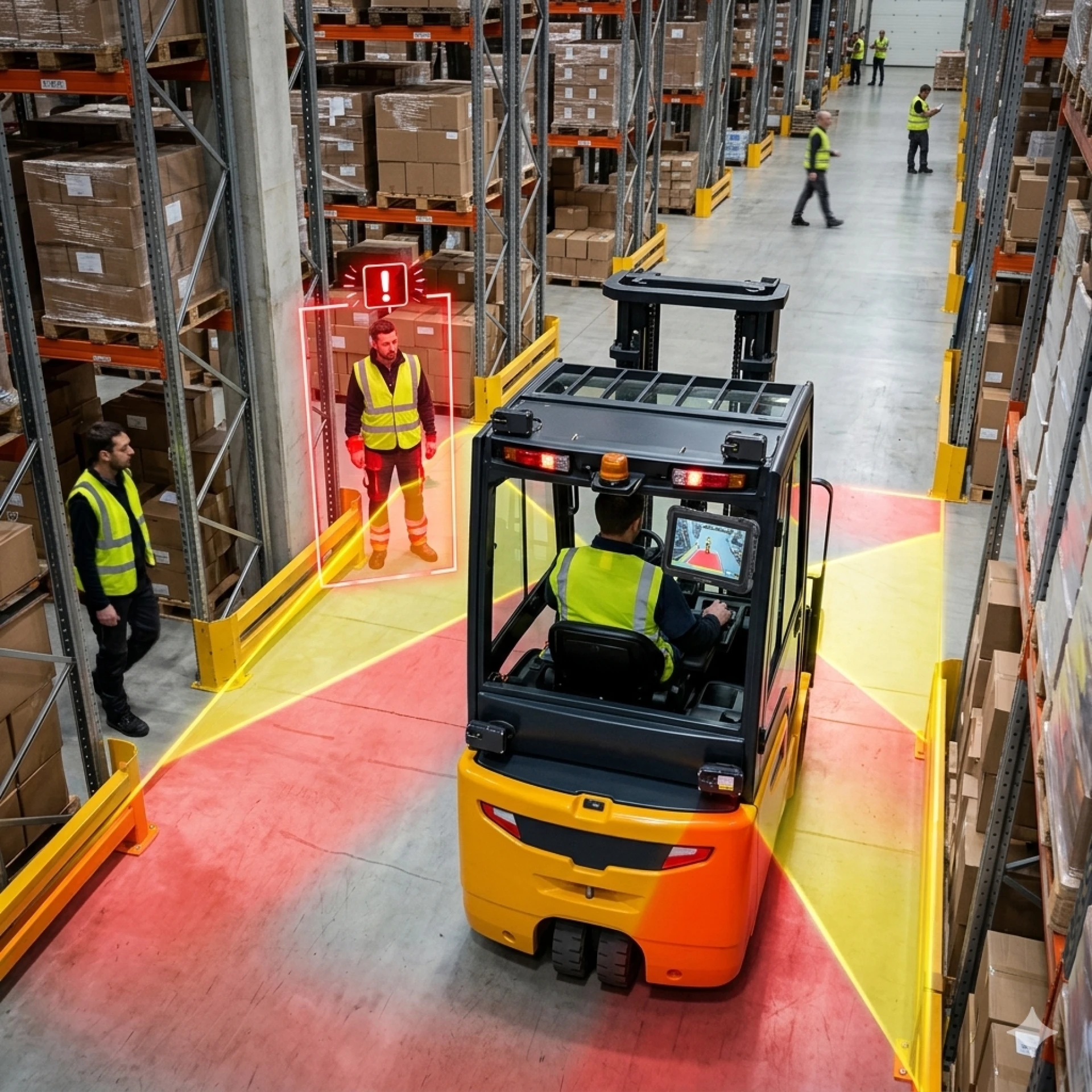
A Radar Object Detection System operates on an entirely different principle. It does not make information available and waits. It actively monitors the detection zone, identifies hazards the moment they appear, and delivers an immediate alert directly to the operator — without any human input required in between. The information gap does not just narrow. It closes.
How the RODS-L Delivers That Capability in Practice
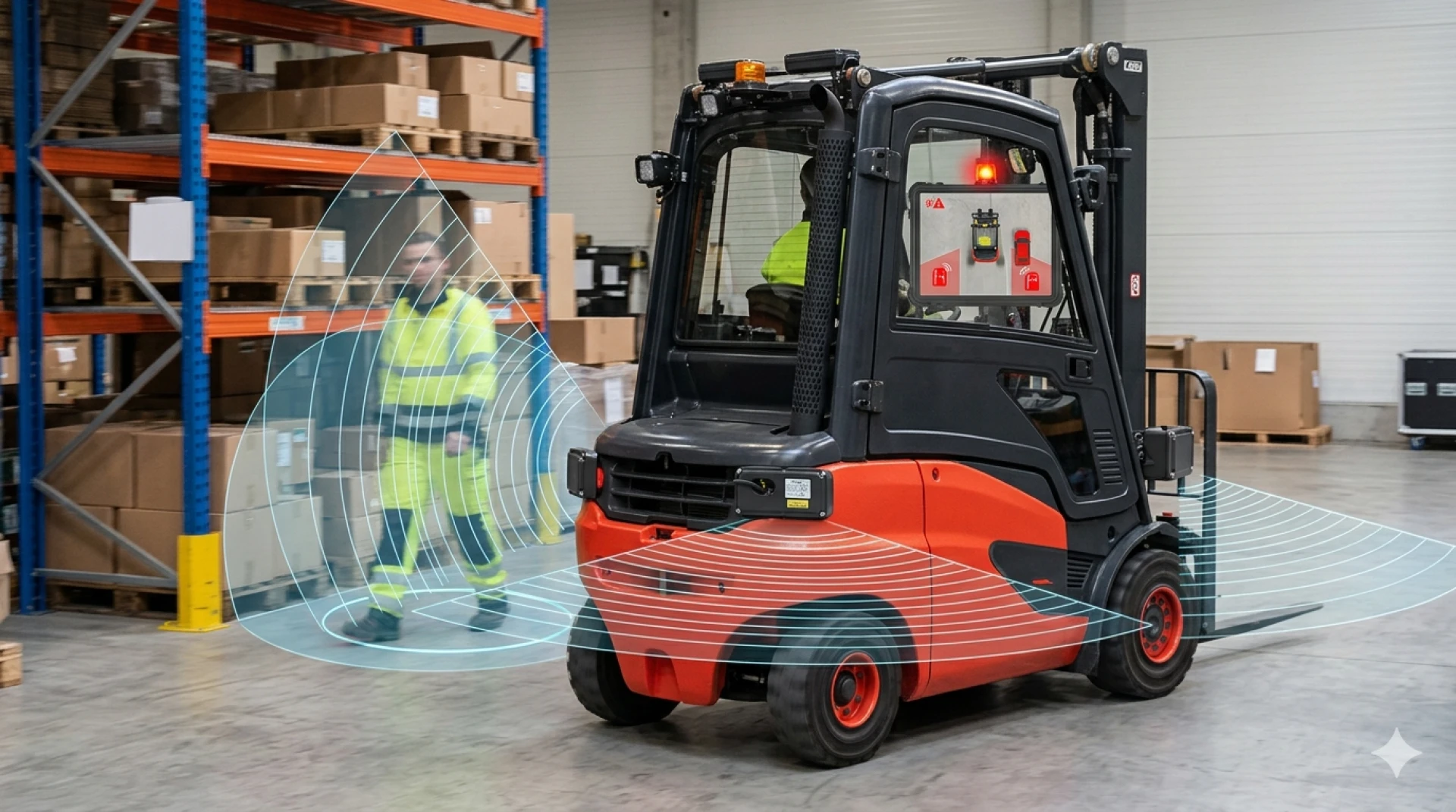
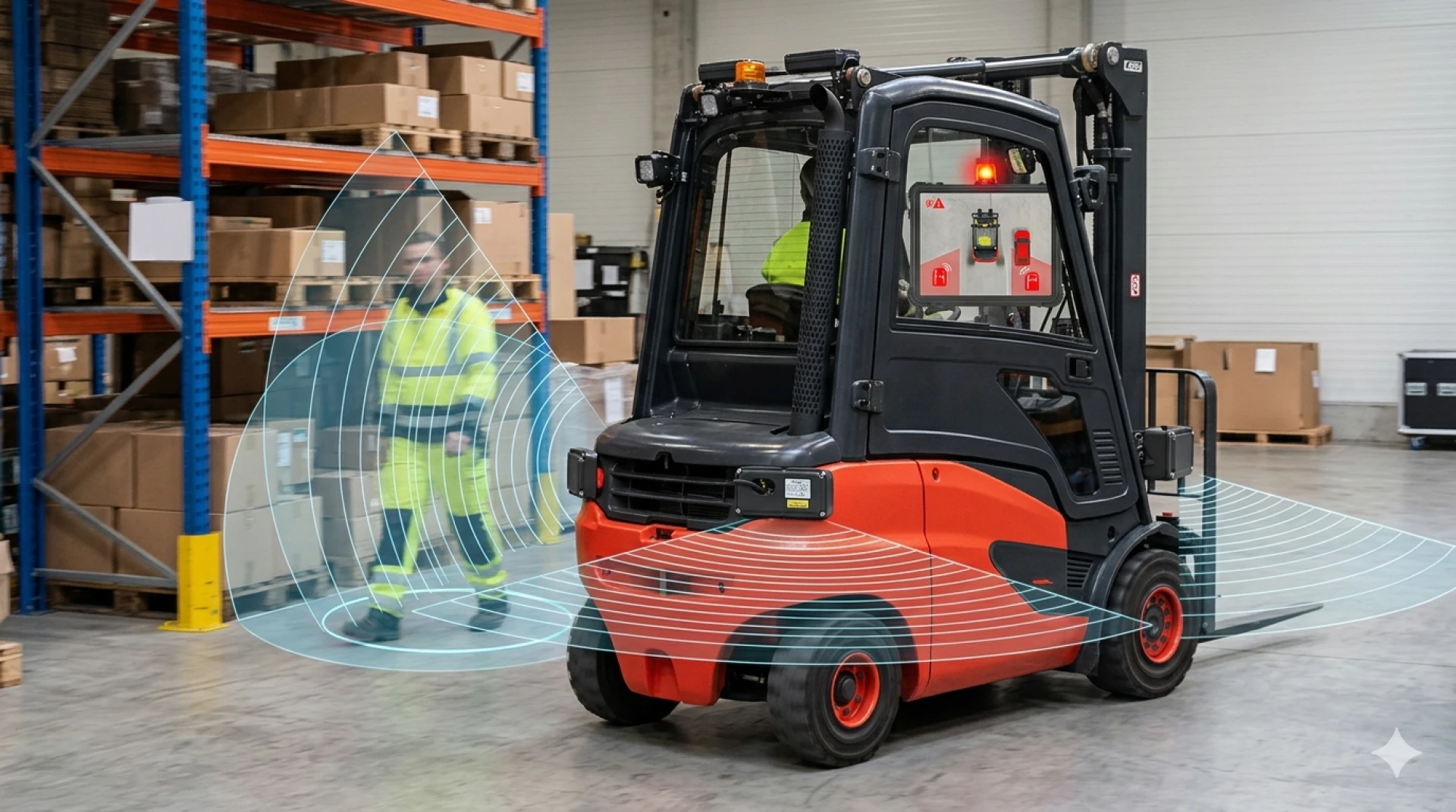
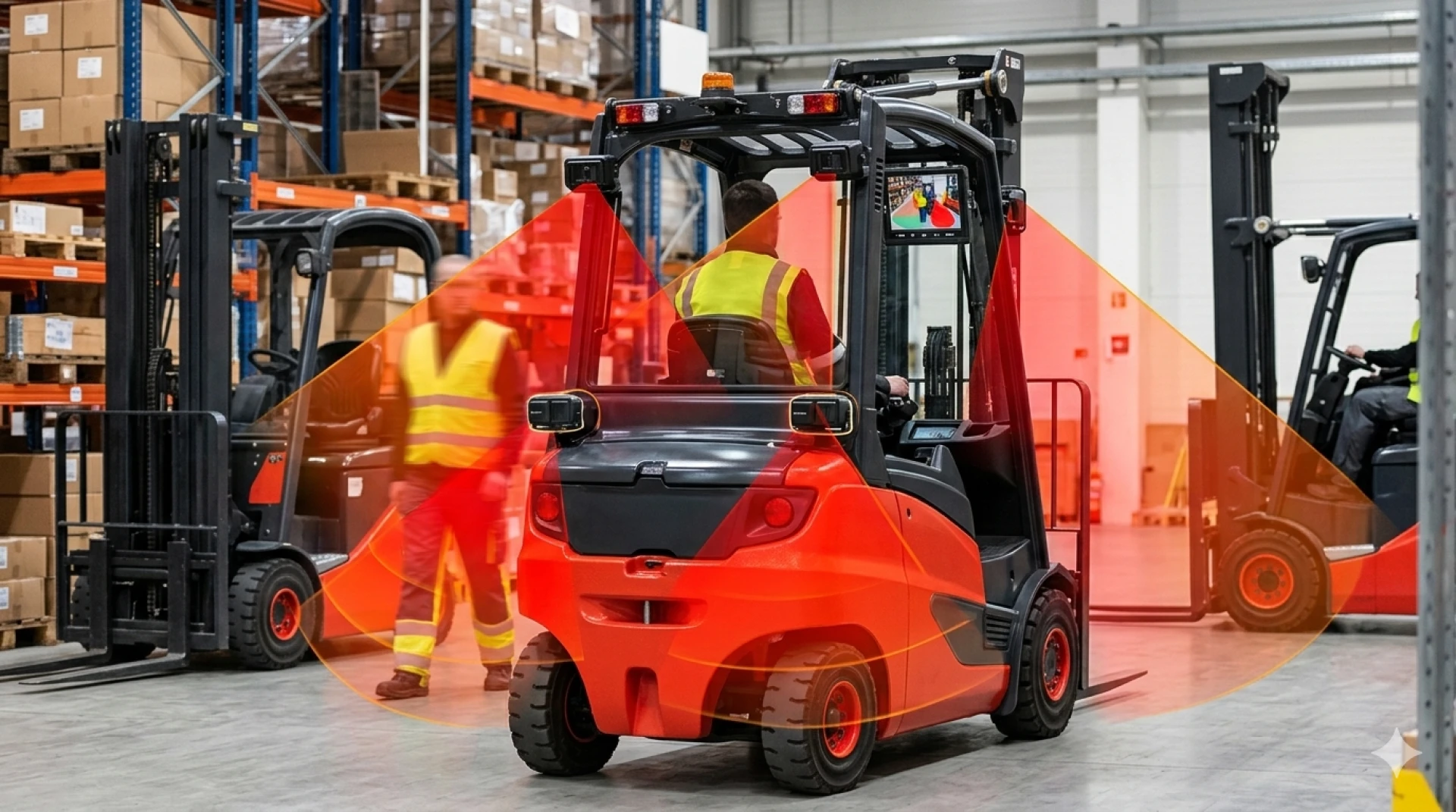
SharpEagle's Radar Object Detection System RODS-L was engineered to bring active radar detection into the forklift environment with the reliability and practicality that industrial operations demand. The RODS-L radar system mounts directly to the forklift — typically covering the rear detection zone where collision risk is highest — and provides continuous, uninterrupted monitoring throughout every shift.
When a person or object enters the defined detection zone, the RODS-L radar system triggers both audible and visual alerts inside the cab immediately. There is no processing delay that matters in human terms. The operator is informed before the situation becomes critical, not after.
The system's intelligent filtering is what makes this reliability operational rather than theoretical.
In a busy warehouse or industrial facility, background objects — racking, walls, other vehicles at distance — are present constantly. A detection system that alerts on everything would generate noise so continuous that operators would disable it or learn to ignore it entirely. The forklift radar blind spot detection system from SharpEagle is calibrated to distinguish between environmental background and genuine proximate hazards, ensuring that every alert the system generates represents a situation that warrants an immediate response.
This distinction matters more than almost any other specification. A detection system that operators trust is one they respond to. A detection system that cries wolf is one that eventually gets switched off — and at that point, it offers no protection at all.
The Operational and Financial Case for Radar Detection
Forklift collisions do not just injure people. They shut down operations, trigger regulatory investigations, generate insurance claims, damage racking and infrastructure, destroy product, and — in serious cases — result in criminal prosecution of responsible managers and directors. The financial exposure from a single serious incident routinely exceeds the cost of equipping an entire forklift fleet with active detection technology.
Framed that way, the investment case for a Radar Object Detection System is straightforward. But the more important frame is not financial. It is the straightforward moral obligation that comes with running an operation where workers are exposed to heavy vehicle risk every single shift. Active detection technology exists. It works. Deploying it is not an advanced safety initiative — it is a baseline responsibility.
For facilities across the UK, UAE, and Kuwait operating under increasingly stringent regulatory frameworks, that responsibility is also becoming a compliance requirement that cannot be deferred indefinitely. The Radar Object Detection System RODS-L positions operations ahead of that curve rather than scrambling to meet it after an incident forces the issue.
Scaling Detection Across Complex Industrial Environments
One of the practical advantages that makes the RODS-L particularly well-suited to large-scale industrial deployment is its scalability. Single-site operations running a handful of forklifts and multi-site logistics networks managing dozens of vehicles across multiple countries face the same fundamental blind spot problem — and the RODS-L addresses it with an installation process that does not require significant vehicle modification or extended downtime.
For safety managers overseeing fleet-wide safety upgrades, this matters enormously.
Technology that is difficult to deploy tends not to get deployed consistently. Technology that integrates cleanly into existing operations gets adopted, maintained, and trusted — and trusted safety technology is the only kind that actually reduces collision rates over time.
Forklift collisions are not random events. They are predictable consequences of a specific set of conditions — blind spots, restricted sightlines, production pressure, and the physical limits of human attention — that every industrial facility shares to some degree. What is not inevitable is that those conditions produce injuries and fatalities. The Radar Object Detection System breaks the chain between hazard and harm by closing the information gap before the operator runs out of time to respond. SharpEagle's Radar Object Detection System RODS-L delivers that capability with the environmental resilience, intelligent filtering, and operational practicality that industrial facilities across the UK, UAE, and Kuwait need from a safety system they are going to rely on every single day — making it one of the most consequential investments a safety-conscious operation can make in the protection of its people and its future. To build a complete forklift safety framework that covers every compliance requirement your facility faces, make sure to read blog post: Forklift Safety Lights: Ultimate Guide to OSHA Compliance & Accident Prevention.