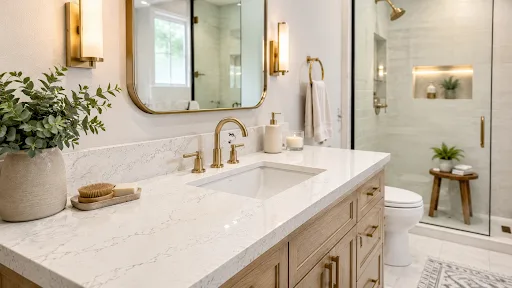
Kitchen countertops connect many parts of the room. Cabinets sit below them, backsplashes meet them, appliances interrupt them, and sinks become part of their surface. Therefore, countertop design strongly affects how organized and connected the kitchen feels. In homes throughout Dublin, Columbus, Ohio, quartz can provide many design options because it comes in a wide range of colors and patterns. However, a successful kitchen does not depend on choosing the most dramatic quartz. Instead, the countertop should support the cabinetry, lighting, flooring, backsplash, appliances, and overall layout. Therefore, we recommend starting with the entire kitchen design before selecting the final surface.
Decide What Role the Countertop Should Play
When homeowners compare quartz kitchen countertops, they should first decide whether the countertop will become a focal point or act as a calmer background. This decision can make later material choices much easier. For example, quartz with bold veining can become the main visual feature in a kitchen with simple cabinets. Meanwhile, a nearly solid quartz surface may work better when the backsplash or cabinetry already provides strong color or texture.
Key Takeaways
- Choose quartz according to the entire kitchen palette rather than selecting the countertop alone.
- Use pattern and contrast carefully so cabinets, backsplash, flooring, and countertops remain balanced.
- Think about daily cleaning, sink layout, edge details, and lighting before making the final decision.
Start With Cabinet Color
Cabinets create a large part of the kitchen’s visual background. Therefore, quartz should be compared directly with cabinet samples. White cabinets provide many options. A white-on-white combination can create a bright, seamless look. Meanwhile, gray-veined quartz can add definition. Warm wood cabinets may work well with cream, beige, soft white, or warmer gray quartz. Dark cabinets can create strong contrast with a light countertop. Therefore, the same quartz may produce very different results depending on the cabinetry.
Understand Undertones
Two countertops may both appear white but still look very different. One may lean cool and gray. Another may contain warmer cream tones. Therefore, undertones deserve attention. The same rule applies to cabinets and flooring. A very cool countertop can look disconnected beside warm beige flooring. As a result, samples should be compared under the lighting used in the home.
Use Quartz to Brighten a Small Kitchen
Light surfaces can reflect more light. Therefore, quartz can help a compact kitchen feel more open when the color remains light and balanced. However, pattern also affects visual space. A countertop with heavy contrast may create more visual activity. Therefore, a softer pattern can sometimes make a small room feel calmer. This does not mean small kitchens must remain plain. Instead, one carefully chosen feature can provide enough personality.
Use Strong Patterns in Larger Kitchens
Large kitchens often provide more space for dramatic materials. Therefore, broad veining may work especially well on an island. A large uninterrupted countertop can show more of the design. However, the backsplash and cabinet finish may need to stay quieter. As a result, the room gains a focal point without becoming overloaded.
Think About the Island as a Feature
The island often becomes the visual center of the kitchen. Therefore, the countertop deserves careful planning. Homeowners can continue the same quartz across the entire kitchen for a consistent appearance. Alternatively, the island can use a different but related surface. However, the two materials should still share some visual connection. For example, similar background colors may help the kitchen feel coordinated.
Coordinate With the Backsplash
The countertop and backsplash meet directly. Therefore, they should not be selected separately. A heavily veined quartz may pair best with a simple backsplash. Meanwhile, subtle quartz can support more decorative tile. Some homeowners may extend the quartz up the wall. This can create a smooth and continuous appearance. However, the final choice should suit the overall style.
Consider the Flooring
Flooring creates another major surface. Therefore, homeowners should compare the floor and countertop before making the final decision. Warm floors may pair naturally with quartz containing cream, beige, or warm gray tones. Cooler floors may work better with cleaner whites and cool gray movement. However, contrast can also work when it feels intentional. The goal is not exact matching. Instead, the surfaces should look comfortable together.
Plan Lighting Around the Surface
Lighting affects how quartz appears. Therefore, homeowners should view samples in natural daylight and artificial light. Warm bulbs may make cream tones stronger. Cool lighting may bring out gray details. In Dublin, Columbus, Ohio, seasonal changes can affect natural light as well. Therefore, the countertop should look balanced throughout the day and year.
Choose Sink Style Early
The sink creates a major opening in the countertop. Therefore, it should be chosen before fabrication. An undermount sink can create a clean countertop edge. Meanwhile, the sink color can either blend with or contrast against the quartz. The faucet and accessory holes also need planning. This is especially important when several fixtures sit behind a large sink.
Consider Edge Profiles
A quartz edge may look simple or decorative. Therefore, the profile should match the cabinet style. Clean edges often suit modern and transitional kitchens. Meanwhile, more decorative profiles can fit traditional spaces. However, a strong countertop pattern may need only a simple edge. This keeps attention on the surface rather than adding another visual detail.
Make Cleaning Easier
Countertops support many messy kitchen tasks. Therefore, easy cleaning matters. A smooth surface with an uncluttered sink area can make wiping simpler. Likewise, thoughtful storage can keep appliances and supplies off the countertop. Clear surfaces not only improve cleaning but also make the kitchen look larger and more organized.
Compare More Than One Sample
Choosing from a single sample can limit the design. Therefore, homeowners should compare several quartz options beside the cabinets and flooring. One surface may look ideal online but less suitable in the actual room. Another may appear simple at first but create better overall balance. Working with countertop companies can also help homeowners view materials at a useful scale and compare them with other finishes.
Use Quartz to Connect Open Spaces
Open-concept kitchens are visible from nearby dining and living areas. Therefore, countertop color can help connect these spaces. For example, the countertop may repeat a warm neutral found in the flooring or furniture. Likewise, dark veins may relate to black lighting or hardware. These small connections make the kitchen feel integrated with the larger home.
Avoid Too Many Competing Patterns
A kitchen may contain countertop movement, backsplash patterns, floor grain, cabinet detail, and decorative lighting. Therefore, restraint matters. If quartz contains strong veining, other materials can remain simpler. If the countertop is quiet, homeowners may add more detail elsewhere. The eye needs a place to rest. Therefore, balanced design often feels more polished than using several bold materials together.
Think About Appliance Finishes
Stainless steel works with many quartz colors. However, black, white, and panel-ready appliances may create different visual effects. Therefore, appliance finishes should be considered as part of the palette. For example, black veins in quartz may connect naturally with black appliance details or hardware. Likewise, warm metal accents can work with quartz that includes warmer tones.
Consider Cabinet Hardware
Hardware repeats across the kitchen. Therefore, it can help connect the countertop to the cabinets. Black pulls may highlight dark movement in quartz. Brass can bring out warm undertones. Meanwhile, brushed nickel may create a quieter transition. The hardware should also remain comfortable for everyday use.
Choose a Color That Supports Long-Term Updates
Countertops usually stay in place longer than paint or décor. Therefore, flexibility can be useful. A balanced quartz color may allow homeowners to update wall paint, stools, lighting, or cabinet hardware later. However, neutral does not have to mean boring. Subtle movement can add depth while still supporting future changes.
Use Full-Size Views When Possible
Small quartz samples do not always show the full pattern. Therefore, homeowners should view larger displays or slabs when considering surfaces with strong movement. Large-scale viewing can reveal vein spacing and overall balance. This becomes especially important for islands because they display a larger continuous area.
Consider the Countertop Layout
Seams may be required depending on kitchen size and shape. Therefore, the layout should be discussed before fabrication. A seam should support both structure and appearance. Pattern direction can also affect how visible a seam becomes. Careful planning helps make the entire surface feel intentional.
Plan the Backsplash After the Main Palette
Homeowners sometimes choose backsplash tile too early. However, the countertop and cabinet colors usually provide the stronger foundation. Therefore, backsplash selection may become easier once those major surfaces are confirmed. A simple backsplash can tie the kitchen together without adding another competing feature.
Final Thoughts
Quartz can support many kitchen styles because color, pattern, and contrast can be adjusted to suit the room. However, the best results come from looking at the kitchen as one connected design. For homeowners in Dublin, Columbus, Ohio, cabinet color, flooring, backsplash, lighting, sink design, appliances, and quartz should all work together. Ultimately, the strongest countertop is not always the boldest one. Instead, it is the surface that makes the entire kitchen feel more coordinated and practical.