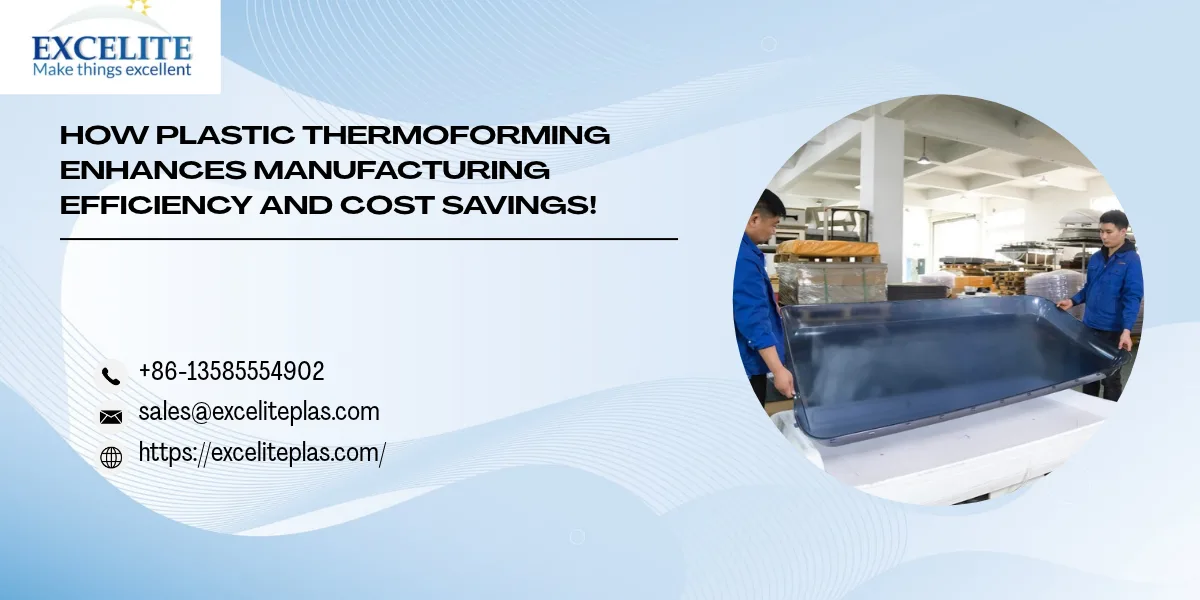
In today’s highly competitive manufacturing landscape, optimizing efficiency while controlling costs is crucial for business success. One manufacturing technology that excels in balancing these demands is plastic thermoforming. At Excelite International Limited, we specialize in leveraging this versatile process to help manufacturers improve production speed, reduce expenses, and maintain high-quality standards across a range of industries.
Plastic thermoforming involves heating a plastic sheet until it becomes pliable, then shaping it over a mold using vacuum, pressure, or mechanical forces. This relatively simple yet highly adaptable method stands out in terms of production speed, flexibility, and cost-effectiveness.
What Is Plastic Thermoforming?
Plastic thermoforming is a manufacturing process where thermoplastic sheets are heated to their forming temperature, then molded to create specific shapes by applying vacuum or pressure onto a specialized mold. Once cooled, the plastic retains the shape of the mold, becoming a finished part.
There are two main types:
- Vacuum Thermoforming: Uses vacuum pressure to pull the heated plastic sheet against the mold. Ideal for simpler shapes and thinner materials.
Pressure Thermoforming: Applies additional air pressure to press the sheet more firmly onto the mold, enabling more detailed, complex parts with finer detail.
Both methods support a wide range of plastics such as ABS, PVC, polycarbonate, polyethylene, and more.
Manufacturing Efficiency Gains Achieved Through Plastic Thermoforming
One of the prime advantages of plastic thermoforming is how it drives manufacturing efficiency. Several factors contribute to this:
1. Faster Production Cycles
Plastic thermoforming typically requires less cycle time than many other plastic shaping methods such as injection molding or blow molding. Since the process involves heating and molding thin plastic sheets instead of melting solid resin pellets, cycle times are often reduced to mere seconds or minutes depending on the part size and complexity. This rapid throughput enables manufacturers to meet high-volume demands without extensive delays.
2. Lower Tooling Costs and Quicker Tooling Development
Tooling costs are a major consideration in manufacturing. Thermoforming molds are generally less expensive and faster to produce than injection molds because they can be fabricated from simpler materials like aluminum or even wood for prototyping. Consequently, the shorter lead times and lower costs reduce the upfront capital expenditure required to commence production.
Moreover, the ability to quickly modify or rework thermoforming molds facilitates agile manufacturing setups where changes to product design do not result in significant downtime or costs.
3. Minimal Material Wastage
Many plastic thermoforming processes use rolls or sheets of plastic, and excess material can often be recycled or reused. This contrasts with injection molding, where sprues and runners are commonly discarded as waste (although many modern systems also recycle these). The efficient use of materials, combined with reuse possibilities, results in reduced raw material costs.
4. Flexibility for Diverse Product Designs
With plastic thermoforming, manufacturers can produce a wide variety of shapes, sizes, and thicknesses without extensive retooling. This flexibility expands product design possibilities, offering competitive advantages when introducing differentiated products to market. Since molds are less complicated and costly, small production runs and custom orders become economically viable.
5. Energy Efficiency
Since plastic sheets are heated directly and only to the required forming temperature, thermoforming tends to consume less energy compared to processes that melt plastic pellets completely (like injection molding). This contributes to lower energy bills and reduces the environmental footprint of manufacturing.
Also read - Plastic Thermoforming: Revolutionizing Custom Manufacturing Solutions!
How Plastic Thermoforming Saves Costs
Beyond efficiency in production, plastic thermoforming results in significant cost savings across different dimensions:
1. Reduced Capital Investment
The lower tooling costs dramatically reduce initial capital expenditures. This is especially beneficial for startups, small-to-medium enterprises, or companies that regularly introduce new product lines since it mitigates the financial risk associated with tooling investments.
2. Reduced Labor Costs
Automated thermoforming machines streamline the process and require fewer manual steps than some other forming methods. Additionally, the fast cycle times and minimal rework associated with precise mold shapes decrease labor hours per unit, contributing to overall labor savings.
3. Material Cost Optimization
Plastic thermoforming’s use of sheet stock enables manufacturers to source cost-effective thermoplastics and optimize sheet thickness based on specific product requirements. Because scrap can be recycled efficiently, overall material costs decrease.
4. Lower Shipping and Handling Costs
Plastic parts made through thermoforming tend to be lighter than metal or other heavier alternatives. Lightweight components significantly reduce transportation costs, whether materials are shipped as raw sheets or finished parts are distributed globally. In addition, lightweight parts simplify handling, lowering logistics and workplace safety expenses.
5. Improved Product Lifecycle Cost
Thermoformed plastic parts tend to be durable, corrosion-resistant, and maintenance-free compared to traditional materials like metal, wood, or glass. This reduced need for ongoing repairs or replacements saves money over the product’s lifecycle.
Applications of Plastic Thermoforming in Industry
To fully appreciate the benefits, it's helpful to see how plastic thermoforming is applied across different sectors:
- Automotive: Interior trims, instrument panels, and protective covers benefit from thermoforming’s ability to produce durable, aesthetically pleasing parts quickly.
- Medical: Custom trays, enclosures, and packaging that require sterility and precision use thermoformed plastics for reliability and cost control.
- Packaging: Food containers, clamshells, and blister packs rely on thermoforming for lightweight, protective packaging solutions.
- Electronics: Component housings and protective casings manufactured via thermoforming offer excellent insulation and aesthetic appeal.
- Consumer Products: Household items, toys, and sporting goods utilize thermoforming for efficient mass production of durable plastic components.
Why Choose Excelite International Limited for Your Plastic Thermoforming Needs?
At Excelite International Limited, we combine expertise with state-of-the-art thermoforming technology to deliver unmatched value to our clients. Here’s why partnering with us enhances your manufacturing efficiency and cost savings:
- Customized Solutions: We analyze your unique production requirements and recommend the most efficient thermoforming processes.
- Quality Assurance: Our stringent quality control ensures every thermoformed part meets exacting standards for consistency and durability.
- Innovative Technology: We invest in advanced thermoforming equipment to minimize cycle times and maximize throughput.
- End-to-End Support: From design consultation to mold fabrication and production, we provide seamless integration to simplify your manufacturing workflow.
Sustainability Focus: We prioritize eco-friendly raw materials and recycling practices to help clients meet their environmental goals.
Plastic thermoforming represents a powerful manufacturing technology that significantly enhances efficiency and reduces costs. By utilizing heated plastic sheets to rapidly create durable, lightweight parts, manufacturers can capitalize on faster production speeds, lower material waste, and reduced tooling expenses. Whether for automotive components, medical devices, packaging, or consumer goods, thermoforming offers the flexibility needed to keep pace with evolving market demands.
Frequently Asked Questions (FAQs)
Q1: What types of plastics are best suited for thermoforming?
A: Most thermoplastics with good formability are suitable, such as ABS, polystyrene (PS), polycarbonate (PC), polyethylene (PE), polypropylene (PP), and PVC. The choice depends on the mechanical properties, chemical resistance, and aesthetics needed for the final product.
Q2: Is plastic thermoforming suitable for high-volume production?
A: Yes, thermoforming is well-suited for both prototype and high-volume manufacturing, especially when cycle times are optimized with modern equipment. It offers a cost-effective alternative to injection molding in many cases.
Q3: How does thermoforming compare to injection molding in cost and efficiency?
A: Thermoforming generally has lower initial tooling costs and faster lead times, making it ideal for medium to large parts and lower production volumes. Injection molding is often preferred for small, intricate parts with extremely high volumes.
Q4: Can thermoforming produce complex shapes and fine details?
A: While thermoforming can handle moderately complex shapes, parts with extreme undercuts or fine, intricate details may require pressure forming or other specialized techniques. Advanced vacuum and pressure systems have expanded thermoforming capabilities considerably.
Q5: How does thermoforming help in sustainability efforts?
A: Thermoforming optimizes material usage with minimal waste, allows the use of recyclable plastics, and consumes less energy than many other processes. Lightweight thermoformed parts also reduce carbon footprints during transportation.