Talk to any trader in Lagos, Manila, or Karachi about liquidity and you'll probably hear a sigh before you hear an answer. Wide spreads. Orders sitting unfilled for hours. Prices jumping around for no clear reason. That's daily life on a lot of centralized platforms in emerging markets, and it's a big part of why p2p crypto exchange development has picked up so much interest lately.
A peer to peer platform, built properly, gets around this by letting buyers and sellers find each other directly instead of waiting on an order book that never quite gets deep enough. For teams entering this space, the p2p crypto exchange development company they choose usually decides whether the platform actually gets used or just sits there quietly, unused.
Why Liquidity Is a Challenge in Emerging Crypto Markets
A few things pile up against these markets at once. Banking systems aren't always dependable. Currency controls make moving money harder than it should be. And local exchanges often just don't have enough regular traders to keep order books meaningfully deep.
So you get stuck in a loop. Thin liquidity means bad pricing. Bad pricing pushes traders elsewhere. Fewer traders means liquidity gets thinner still, and the cycle just repeats. Exchange models designed around mature, high-volume markets weren't really built to handle any of this.
That gap is exactly what p2p exchange development is stepping into.
How P2P Crypto Exchanges Work
There's no central order book calling the shots here. A P2P exchange connects two people who want to trade and lets them work out the terms between themselves.
What the platform needs to get right is making that connection feel safe, and fast enough that people don't lose interest. That's really the whole idea behind any p2p cryptocurrency exchange development build worth taking on, real people trading with real people, using payment methods they already know.
How P2P Trading Unlocks Local Liquidity
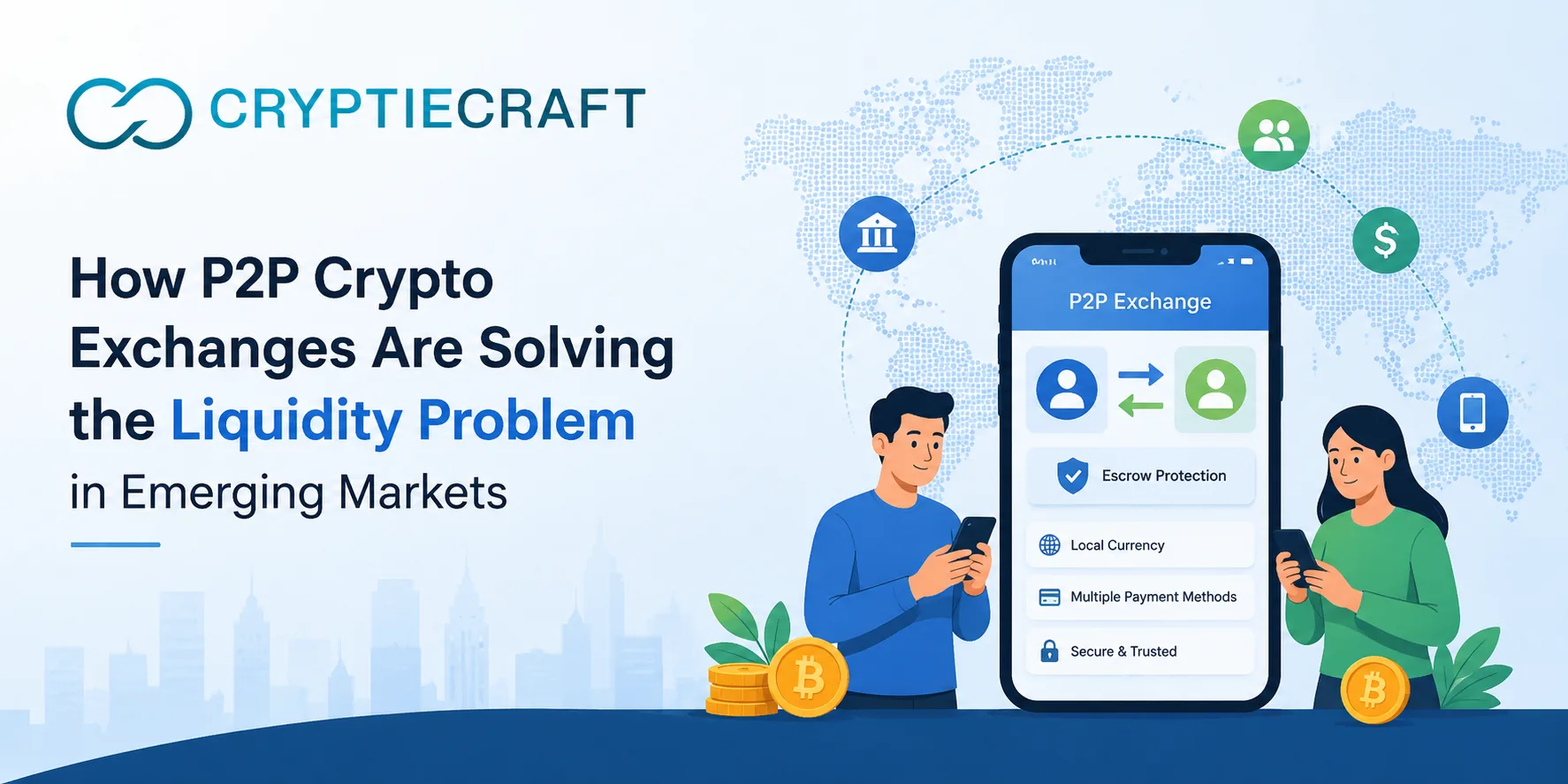
Local Currency and Payment Options
Most traders here aren't sending international wires. They're using mobile wallets, UPI, banking apps, sometimes even cash deposits. When a platform supports these local rails from day one, more people can actually get involved, and liquidity starts building itself.
Direct Buyer-Seller Matching
Instead of waiting around for some algorithm to decide what a "fair" price looks like, users just set their own rates. That flexibility draws more people in, which matters a lot in places where trading volume tends to be thin to start with.
Escrow for Safer Trades
Trust is probably the single biggest thing holding P2P trading back. Nobody wants to send payment first and just hope the other person actually follows through. Escrow fixes this problem directly, the crypto gets locked by a smart contract until both sides confirm the trade went through cleanly.
This part really isn't optional if you want people to trust the platform. We've broken down exactly how it works at the contract level in our piece on the bitcoin escrow script, which covers how funds stay locked until both parties hold up their end of the deal.
Key Ways P2P Exchanges Improve Liquidity
Multiple Payment Methods
It's a simple equation really. More ways to pay means more people who can trade. Bank transfers, e-wallets, regional apps, each one adds to the pool of active users on the platform.
Localized Trading Markets
Region-specific marketplaces let people trade in their own currency, at rates that reflect what's genuinely happening on the ground locally. Pricing stays realistic instead of swinging wildly, and activity stays fairly steady instead of coming in random bursts.
Competitive Pricing
Since buyers and sellers set their own rates, the market works out fair pricing through plain old competition. Nobody's stuck accepting whatever spread a centralized book happens to offer that particular day.
24/7 Global Access
Crypto doesn't really take breaks, so a good P2P marketplace shouldn't either. Round-the-clock access means someone halfway across the world can always find a counterparty, keeping liquidity moving even while one region sleeps.
Why P2P Crypto Is Growing in Emerging Markets
A lot of this growth comes down to necessity more than curiosity. Plenty of users simply don't have easy access to traditional banking. Others are dealing with currency instability and want something more stable, something borderless. P2P platforms give them a way in that skips the hoops of a conventional, bank-linked exchange.
The businesses moving early here, launching platforms actually built for these regions, are picking up users that the bigger global exchanges have been slow to serve well.
P2P vs Traditional Crypto Exchanges
Traditional exchanges lean heavily on deep order books and institutional market makers to stay liquid. Works fine in mature markets. Falls apart pretty quickly where the trading volume just isn't there yet.
P2P exchanges take a different route entirely. Liquidity comes straight from the community itself. Every person who joins to buy or sell adds to what's available, rather than the platform relying on outside players to keep things moving along. It's a big reason so many founders now choose to build a p2p crypto exchange instead of a traditional order book model when targeting these regions specifically.
Challenges P2P Exchanges Still Face
It isn't a flawless model, to be fair. Disputes need resolving quickly and fairly. Fraud prevention takes actual KYC checks and ongoing monitoring, not just a checkbox somewhere in the onboarding flow. And regulation is still catching up in a lot of countries, so platforms have to stay flexible as the rules shift underneath them.
None of that means the model is broken though. It just means you need a team that's already worked through these problems before. A serious p2p crypto exchange development service should come with dispute handling, identity verification, and compliance flexibility built in from the start, not bolted on as an afterthought.
The Future of P2P Crypto Trading in Emerging Markets
As mobile internet keeps spreading and financial inclusion becomes more of a priority for these economies, P2P trading looks set to become the default way millions of new users get into crypto in the first place. The platforms that get local payment support, solid escrow, and easy onboarding right will likely be the ones leading that shift forward.
Whether the goal is to develop a p2p crypto exchange from scratch or create a p2p crypto exchange tailored to one specific region, the opportunity here keeps growing.
Final Takeaway
Liquidity has always been the toughest problem for crypto to solve outside the major economies. If you're weighing your options here, a solid p2p crypto exchange development service is worth looking into before you commit to a build. P2P exchanges get around the liquidity problem by handing control back to local traders, backed by solid escrow and payment options that actually match how people transact where they live.
If you're planning to build in this space, working with an experienced p2p exchange development company means your platform is ready for real trading conditions from day one, not just something that looks good on paper. At CryptieCraft, our p2p cryptocurrency exchange development company builds exactly this kind of platform, made specifically for the liquidity challenges emerging markets face every single day.